
How to Choose a Car Hauler for Sale That Fits Your Vehicle
A trailer can be long enough for your car and still be wrong for its weight, clearance or towing setup. Use this practical fit checklist to compare car haulers and avoid expensive buying mistakes.
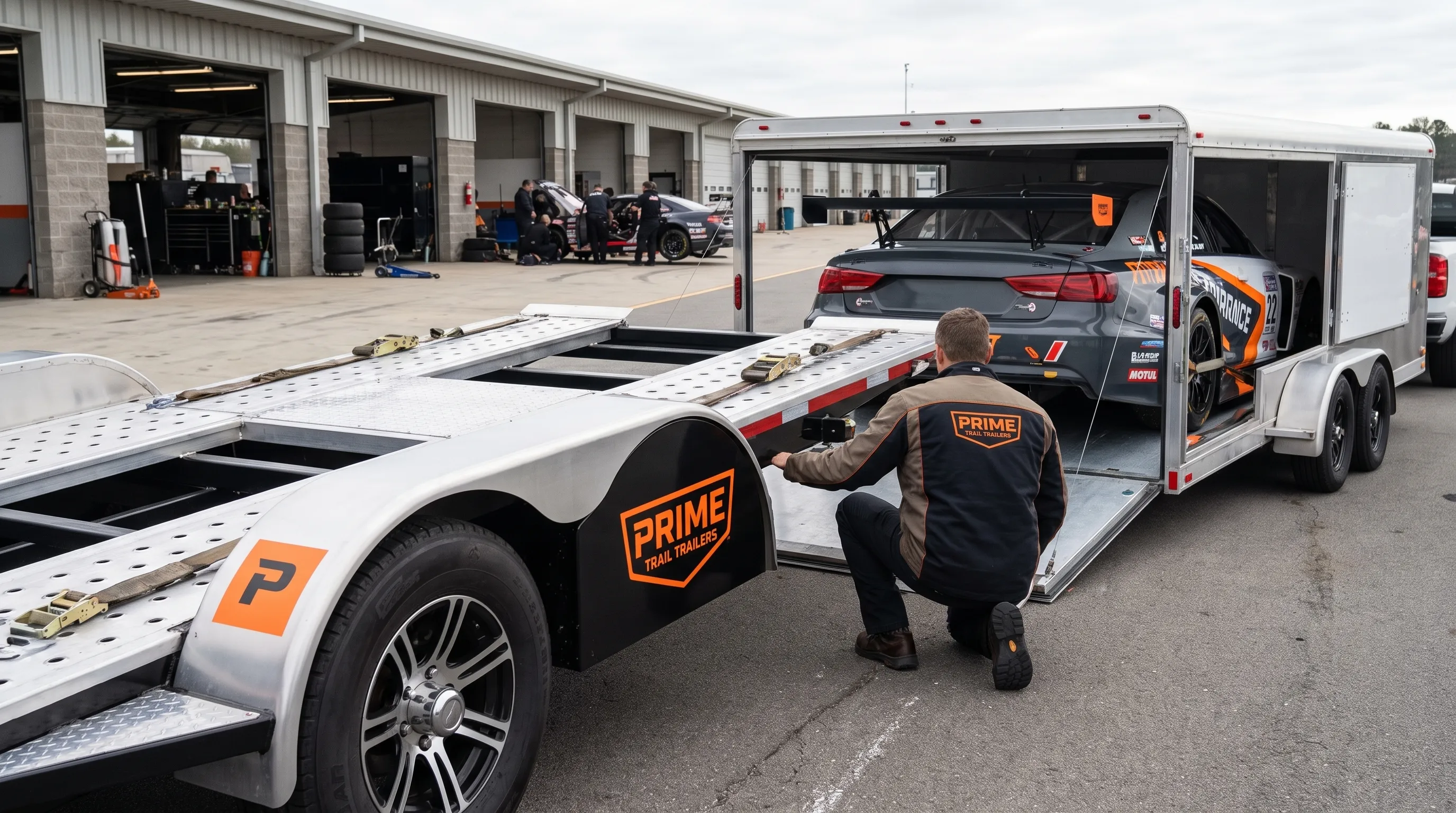
How to Choose a Car Hauler for Sale That Fits Your Vehicle
Choosing a car hauler for sale starts with the vehicle you need to move, not the trailer’s advertised length. A trailer can have enough deck space yet lack sufficient payload capacity, scrape a low front bumper during loading or leave too little room to open the driver’s door.
Before comparing listings, record your vehicle’s actual transport weight, overall dimensions and ground clearance. Then check those measurements against the trailer’s usable deck, loading system and ratings. Finally, confirm that your tow vehicle can handle the complete loaded combination. This guide walks through those checks so you can narrow your options before requesting pricing.
Start with vehicle weight, not trailer length
Use the vehicle’s actual transport weight
Manufacturer curb weight is a starting point, but it may not represent the vehicle you will haul. Aftermarket bumpers, larger tires, accessories and items carried inside can increase transport weight. This matters particularly with modified trucks, SUVs and off-road vehicles.
For the most reliable comparison, weigh the vehicle in its transport configuration. Separately account for equipment carried on the trailer, including a spare tire, tools, winch accessories and tie-down gear that are not already included in the trailer’s empty weight.
When evaluating a car hauler for sale, compare its available payload with everything you plan to carry, not just the vehicle’s published curb weight.
Calculate payload from verified ratings
Payload capacity equals the trailer’s gross vehicle weight rating (GVWR) minus its actual empty weight. The GVWR is the manufacturer’s maximum permitted total trailer weight, including the trailer itself and its cargo. A listing’s axle description or advertised length does not establish payload capacity.
Consider this illustrative example, which does not describe a particular Prime Trail Trailers product:
| Weight item | Example weight | |-------------|----------------| | Trailer GVWR | 7,000 lb | | Trailer empty weight | 2,200 lb | | Available payload | 4,800 lb | | Vehicle transport weight | 4,500 lb | | Additional equipment and gear | 300 lb | | Remaining payload capacity | 0 lb |
That combination reaches the trailer’s rating with no allowance for additional cargo. Choose a configuration with enough capacity for your actual load and foreseeable changes, while staying within every component rating.
Verify the manufacturer’s identification label and ask whether quoted empty weight includes installed options. Do not assume axle ratings alone determine the trailer’s GVWR.
Will the car hauler for sale fit your vehicle?
Compare usable dimensions, not nominal size
Measure the vehicle’s overall length and width, tire-to-tire width, wheelbase and ground clearance. Account for mirrors, wide tires, bodywork and accessories that extend beyond the original dimensions.
Then request the trailer’s usable deck length and width at the narrowest relevant point. On a between-fender trailer, the space between the fenders can limit fit even when the advertised overall width sounds adequate. Confirm that both the tires and body clear the fenders.
The vehicle also needs room for proper positioning and securement. A bumper that technically fits over the deck edge does not prove the trailer is suitable, particularly if it interferes with ramps, lights or tie-down access.
Check door access and weight distribution
A car can fit on the deck while its doors cannot open over the trailer fenders. Ask for fender height and location, then compare those measurements with your vehicle’s door swing. If removable fenders are offered on a particular unit, confirm how they work rather than assuming they are standard.
Deck length must also allow the vehicle to move forward or backward enough to achieve the manufacturer’s recommended tongue weight. A trailer that only fits the vehicle in one position may leave limited control over balance.
Choose the loading system around ground clearance
Low vehicles need more than adequate deck space. The approach onto the ramps, the transition onto the deck and the vehicle’s front and rear overhangs all affect clearance.
A car hauler for sale with sufficient capacity can still be unsuitable if the bumper, exhaust or underbody contacts the loading surface. Ask for ramp length, deck height and loading geometry, then arrange a fit check with the actual vehicle when practical.
| Trailer configuration | Potential advantage | Fit issue to verify | |-----------------------|---------------------|---------------------| | Between-fender open trailer | Lower deck height may suit vehicle loading | Fender clearance and door access | | Dovetail with ramps | Rear deck transition can help loading | Ramp rating, spacing and transition clearance | | Hydraulic tilt trailer | Tilting deck provides a loading path without separate ramps | Actual tilt angle and vehicle clearance | | Deckover trailer | Deck above the wheels avoids between-fender width restrictions | Higher deck and loading geometry | | Enclosed car hauler | Shelter from weather and road debris | Ramp opening, interior clearance and exit space |
These are design considerations, not guarantees. Compare the measurements of the specific trailer you are considering.
When a dovetail and ramps make sense
A dovetail slopes the rear portion of the deck toward the ground. Combined with suitable ramps, it can provide a practical loading arrangement for vehicles and equipment. However, a low car may still contact the transition where the sloped section meets the main deck.
The 20' Double-A Equipment Trailer w/ Dovetail & SU Ramps is a relevant option to evaluate for mixed vehicle and machinery hauling. Its listing specifies a 20-foot equipment lowdeck design, dovetail, ramps and 14,000-pound GVW with two 7,000-pound axles. Confirm its usable width, ramp ratings, empty weight and loading clearance before matching it to your vehicle.
When hydraulic tilt and deckover designs make sense
If your vehicle is too wide for a between-fender deck, a deckover configuration may be worth comparing. Its deck sits above the wheels, but the increased height makes loading geometry especially important.
When comparing a car hauler for sale with hydraulic tilt, check the actual loading angle rather than assuming the tilt mechanism makes it suitable for every low-clearance vehicle.
The 22' Double-A Deck Over Hydraulic Tilt Deck combines a 22-foot deckover layout with hydraulic tilt. The listing identifies 15,400-pound GVW and two 7,000-pound axles. It is an option to assess for wider vehicles or mixed heavy-load applications, subject to verified payload, dimensions and towing compatibility.
For both Double-A listings, the published GVW figure is not the available payload. Request the manufacturer’s GVWR and actual trailer weight before making a capacity decision.
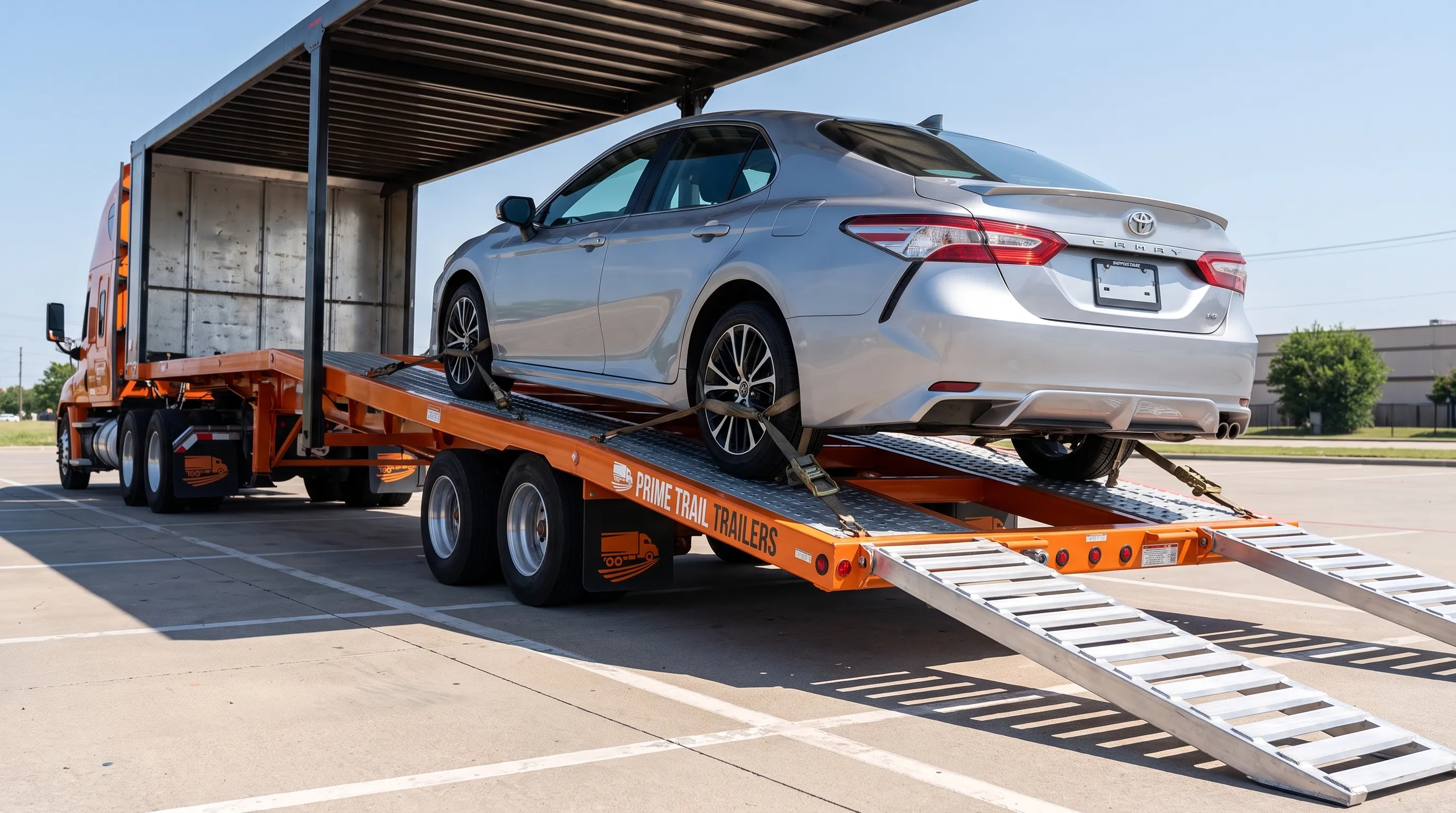
When enclosed protection is worth considering
An enclosed trailer provides shelter from weather and road debris, which may matter for collector vehicles, finished builds or frequent highway transport. Its walls also introduce fit restrictions that an open deck does not have.
Measure the rear door opening, interior width, interior height and space needed to exit the vehicle. The advertised exterior dimensions are not the usable loading dimensions. Confirm ramp-door capacity as well, including how concentrated wheel loads are handled.
The 8'6" x 18' Continental Cargo Auto-Plus car hauler is an enclosed option to compare. Before selecting it, request the opening measurements, interior clearances, empty weight and payload for the specific unit.
An enclosed car hauler for sale should pass the same weight and loading checks as an open trailer, with additional attention to driver access and interior working room.
Confirm that your tow vehicle can handle the combination
A higher-capacity trailer does not increase your truck’s or SUV’s towing capability. Check the towing information for the exact tow vehicle configuration, including its engine, drivetrain, axle ratio and required towing equipment.
Compare loaded trailer weight with the vehicle’s tow rating, then check gross combined weight rating (GCWR), tow vehicle GVWR, axle ratings, receiver rating and hitch component ratings. Passengers, tools and other cargo use tow vehicle capacity too.
For conventional bumper-pull trailers, tongue weight commonly falls around 10% to 15% of loaded trailer weight, but follow the trailer and tow vehicle manufacturers’ instructions. That tongue weight counts against the tow vehicle’s available payload and must stay within the applicable hitch ratings.
Check brakes, connections and hitch equipment
Confirm the trailer’s braking system and whether your tow vehicle needs a compatible brake controller. Inspect or verify the electrical connector, lights, breakaway system, coupler, hitch ball and safety chains. Requirements vary by jurisdiction and trailer weight, so check the rules that apply to your route.
Before reserving a car hauler for sale, establish that the entire combination works within its ratings. A weight-distributing hitch, when permitted and properly configured, does not increase the underlying vehicle or trailer ratings.
For a broader explanation of these limits, the Prime Trail Trailers buyer’s guide covers trailer selection, payload and towing compatibility.
Make sure you can load and secure the vehicle
A suitable trailer needs accessible, appropriately rated anchor points and a securement system compatible with the vehicle. Check that straps can be routed without rubbing against sharp edges, hot exhaust components or vulnerable suspension parts.
Wheel straps and axle straps require different attachment methods. Follow the instructions for the vehicle, trailer and securement equipment. Do not assume every hole, rail or suspension component is an approved attachment point.
For commercial operations covered by federal cargo-securement rules, 49 CFR § 393.128 addresses automobiles, light trucks and vans weighing 10,000 pounds or less individually. It includes front and rear restraint requirements. Other vehicle weights or operating circumstances may involve different rules.
Plan for non-running vehicles
If you transport project cars or disabled vehicles, ask about a suitable rated winch mounting arrangement and power supply. A loading winch is not a substitute for transport tie-downs.
The right car hauler for sale should let you reach the anchor points and inspect securement after loading. Follow the manufacturer’s loading procedure, use stable ground and never drive onto an unsupported or improperly stabilized trailer.
Before departure, verify load balance, strap tension, tire condition, lights and brake operation. Recheck securement during the trip according to equipment instructions and applicable requirements.
Compare the complete purchase, not just the asking price
A lower advertised price may not represent the lowest cost of a trailer ready for your vehicle. Request a quote identifying the specific unit, included equipment, applicable taxes and fees, delivery charges and any equipment you still need to purchase.
For used trailers, inspect frame condition, welds, decking, ramps, coupler wear, tires, brakes, bearings and wiring. Check the VIN, title documentation and manufacturer’s ratings. Modifications deserve particular attention because they may change weight or affect loading and securement.
Use these questions to keep comparisons consistent:
- What are the verified GVWR, empty weight and available payload?
- What are the usable deck dimensions or enclosed door and interior measurements?
- Will my vehicle clear the ramps, transitions and fenders?
- Are the tie-down points suitable for my securement equipment?
- What is included in the quoted price and delivered cost?
A car hauler for sale is worth pursuing when the seller can provide the information needed to verify fit. Resolve missing measurements or ratings before committing to the purchase.
Frequently Asked Questions
What size trailer do I need to haul one car? Choose by the vehicle’s measured length, width and weight rather than a universal trailer length. Allow space for safe positioning, tie-down access and the manufacturer’s recommended load balance. Confirm usable deck dimensions, not just the advertised size.
Can an equipment trailer haul a car? Yes, if its payload, deck dimensions, loading geometry and securement provisions suit the vehicle. Equipment capacity alone does not establish suitability for a low-clearance car.
Is a tilt trailer better for a lowered car? Not automatically. Deck height, tilt angle, vehicle wheelbase and overhangs determine clearance. A fit check or verified loading measurements are more useful than the tilt label alone.
Does a 7,000-pound trailer carry a 7,000-pound vehicle? No. A 7,000-pound GVWR includes the trailer’s own weight. Subtract actual empty weight, then account for the vehicle and all additional cargo.
Should I buy an open or enclosed car hauler? Open trailers provide accessible loading and securement areas. Enclosed trailers add shelter but require checks for door-opening dimensions, interior clearance, driver exit space and towing weight. Choose around your vehicle and transport conditions.
Find a trailer that matches your vehicle
Before choosing a car hauler for sale, have your vehicle measurements, transport weight and tow vehicle specifications ready. Those details make it easier to compare appropriate units and request useful answers instead of relying on nominal sizes.
Browse trailer options at Prime Trail Trailers and ask the sales team for help confirming dimensions, ratings and loading suitability. Request current pricing, availability and nationwide delivery options for the specific trailer you are considering.
Have Questions? We're Here to Help
Still unsure which trailer fits your needs, or need specs, pricing or delivery advice? The Prime Trail Trailers team is ready to answer your questions and help you find the right rig.