
What to Check on Cargo Trailers for Sale Before You Buy
A clean exterior can hide water damage, weak flooring or too little payload. Use this cargo trailer inspection guide to compare listings, verify towing compatibility and get a complete quote before you buy.
Quick Summary
A clean exterior can hide water damage, weak flooring or too little payload. Use this cargo trailer inspection guide to compare listings, verify towing compatibility and get a complete quote before you buy.
When you search for cargo trailers for sale near me, the lowest advertised price rarely tells you which trailer is the best buy. A clean exterior can hide a leaking roof, damaged flooring or too little payload for your equipment. Before paying a deposit, verify the trailer’s identity, inspect its enclosed body and confirm that your tow vehicle can handle it fully loaded.
Use the checks below when reviewing listings, visiting a dealership or arranging an inspection before delivery. They apply to both new and used enclosed cargo trailers, though used units deserve closer attention to wear, repairs and ownership records.
Match the listing to the actual trailer
Start by confirming that the trailer you inspect is the unit being quoted. Photos may show a representative model rather than the specific trailer available for purchase.
Compare the VIN on the trailer with its manufacturer’s certification label and sales documents. Ask for the model year, model designation and required ownership documents for your state. For a new trailer, confirm which manufacturer’s origin or title documents will accompany the sale.
Record the gross vehicle weight rating (GVWR), gross axle weight ratings (GAWR), specified tire sizes and recommended cold tire pressures. If labels are missing, unreadable or inconsistent with the listing, resolve the discrepancy before buying.
For used units, ask about roof repairs, collision damage, axle replacement and modifications. Fresh paint or new flooring is not automatically a problem, but you should understand what was repaired and why.
What should I inspect on cargo trailers for sale near me?
For enclosed trailers, start with the roof, seams and interior corners. Water intrusion can damage flooring and framing without leaving an obvious mark on the outside.
Inspect roof penetrations, vents, front corners, exterior seams and door seals. Look for cracked sealant, loose trim, separated joints and patches. Sealant smeared over a large area warrants questions about the underlying repair.
Inside, use a flashlight to examine ceiling edges, wall-to-floor joints and the space around rear doors. Brown staining, swollen panels, delamination, mildew odor or corroded fasteners can indicate moisture exposure. Ask to see behind removable mats and accessible shelving, with the seller’s permission.
Open and close each door, then inspect the weather stripping for gaps and compression damage. Daylight around a closed door can reveal an opening, although the absence of daylight does not prove the trailer is leak-free.
If water damage is suspected, request a professional inspection or a seller-approved water test. Do not climb onto a roof unless the manufacturer permits it and suitable access equipment is available.
Check the floor, frame and attachment points
When comparing cargo trailers for sale near me, pay as much attention to what supports the load as to the exterior panels. The floor must handle concentrated loads from equipment wheels, tool chests and shelving, not just evenly distributed cargo.
Walk the accessible floor and watch for excessive flex, soft areas, lifted edges or loose fasteners. With permission, move loose mats to inspect covered areas. A replacement plywood layer may conceal deterioration underneath.
Ask about floor material, thickness and support spacing. These details alone do not establish capacity, but they help a qualified inspector assess whether the construction suits your equipment.
From a safe position, examine visible frame members, crossmembers, the tongue and accessible welds. Distinguish light surface rust from deep scaling, cracks, bending or metal loss. Never crawl beneath an unsupported trailer or rely on a jack alone.
Check tie-down rings and track systems for loose fasteners, deformation and signs of pulling through the floor. An attachment point is only as useful as its rating and the structure supporting it. Wall panels and shelving should not be assumed to be load-rated securement points.
Measure the opening and test the loading system
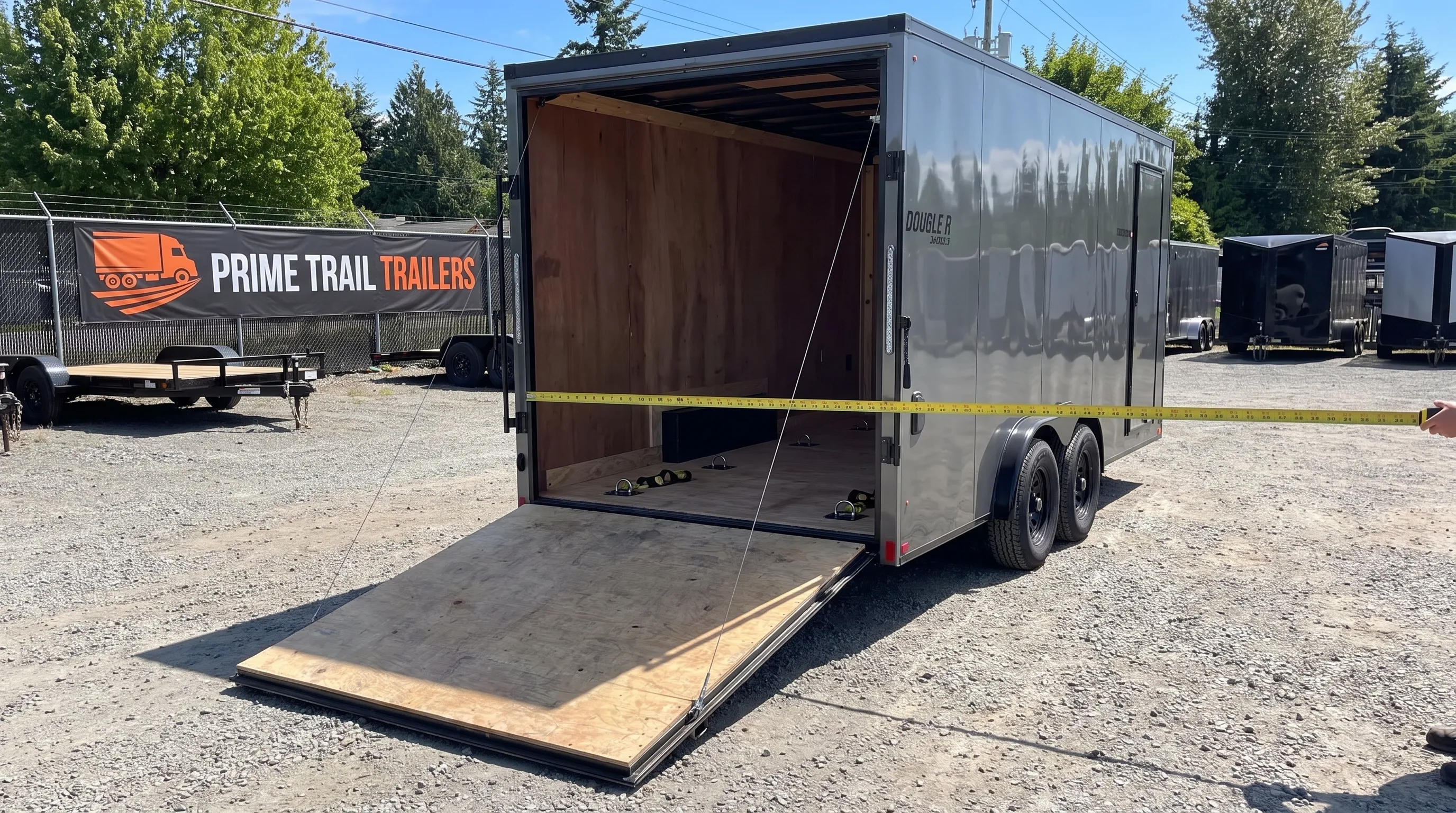
Nominal trailer dimensions are not the same as usable interior dimensions. Measure the interior length, width and height, plus the clear rear-door opening. Account for wheel boxes, shelving and any narrowing near the roof or door frame.
If your shortlist of cargo trailers for sale near me includes ramp-door models, verify the ramp’s rated capacity separately from the trailer’s payload. Ask whether that rating covers your equipment’s concentrated wheel loads and loading method.
Check hinges, cables, spring assistance, latches and the ramp surface. Operate the door through its full travel with the seller’s assistance. Damaged cables or springs need professional attention because these components can store substantial energy.
Barn doors offer rear access without a ramp, but wheeled equipment may need a separate loading solution. Confirm that doors open far enough for your intended loading area and can be secured against wind.
For low-clearance equipment or vehicles, evaluate the loading angle and transition at the threshold. A beavertail can change that transition, but it does not guarantee clearance for every load.
Finally, inspect lock hardware, hinges and exposed fasteners. An enclosed body provides coverage and some security, but it does not make unattended tools theft-proof.
Calculate usable payload before comparing prices
GVWR is the maximum rated weight of the loaded trailer, not the amount of cargo you can carry. To estimate available payload, subtract the trailer’s actual as-equipped empty weight from its GVWR.
For example, a hypothetical trailer with a 7,000-pound GVWR and an as-equipped empty weight of 2,200 pounds has 4,800 pounds of calculated payload. That is an illustration, not a specification for either product discussed below. Axle, tire, floor and hitch limits must also be respected.
When evaluating cargo trailers for sale near me, ask whether the listed empty weight includes installed options. Shelving, spare tires, batteries, cabinets and permanent equipment all consume capacity. A scale weight is more useful than an estimate when those additions are substantial.
Build your cargo estimate around a normal workday: machines, hand tools, materials, spare parts and supplies. Leave room within the ratings for realistic variations rather than buying a trailer that only works when lightly loaded.
Also distinguish volume from weight. A spacious trailer can run out of payload before it runs out of floor space, while lightweight bulky cargo may require more interior room without requiring a higher GVWR.
Compare listed models by the job they need to do
Two Prime Trail Trailers listings illustrate why loading access and weight ratings deserve separate checks. Confirm current specifications and availability for the exact unit before committing.
| Listed trailer | Details supplied in the listing | What to verify before buying | |---|---|---| | Universal Trailers 6' X 12' Continental Cargo - V-Series w/ Barn Doors, Electric Brakes | Nominal 6-by-12-foot configuration, barn doors and electric brakes | Clear door opening, usable interior dimensions, GVWR, as-equipped empty weight and brake-controller compatibility | | Double-A 8'6" X 20' Double-A Ruger Series w/ Ramp Door, Beavertail, 10K GVWR | Nominal 8-foot-6-inch-by-20-foot configuration, ramp door, beavertail and 10,000-pound GVWR | Actual payload, ramp rating, loading clearance, securement points and tow-vehicle suitability |
The smaller barn-door configuration is worth evaluating for tools and cargo that do not require a built-in ramp. The larger ramp-door configuration deserves consideration when your loading plan involves wheeled equipment or a vehicle, provided all dimensions and ratings work.
Comparing cargo trailers for sale near me becomes more useful when each listing is tested against the same load list. A larger body, electric brakes or a ramp door can be valuable, but none substitutes for verified compatibility.
Inspect tires, brakes and the towing connection
Check every tire for cracking, bulges, cuts and uneven wear. Verify the specified size, load capacity and cold inflation pressure rather than relying on appearance. If a spare is included, inspect it too and confirm that it fits the hubs.
The National Highway Traffic Safety Administration’s tire guidance explains tire identification numbers, age and maintenance. Deep tread alone does not establish that an older trailer tire is suitable for service.
Ask a qualified technician to assess wheel bearings, brakes, suspension components and any signs of overheating or leakage. Electric brakes should be checked with a compatible brake controller. Confirm that required breakaway equipment is complete and tested according to its manufacturer’s instructions.
A seller offering cargo trailers for sale near me should be able to help identify the trailer’s coupler size, electrical connector and brake setup. Independently confirm that your truck’s equipment matches.
Check tow-vehicle towing capacity, payload, rear axle rating, gross combined weight rating and receiver limits. Tongue weight uses part of the truck’s available payload, along with passengers, tools and other cargo. The hitch ball, ball mount, receiver and coupler must each suit the application.
Prime Trail Trailers’ trailer buyer’s guide provides broader guidance on matching trailer types, hauling needs and tow-vehicle limits. Before departure, verify lights, safety chains and the connection procedure, and confirm applicable brake and registration requirements where you will operate.
Compare complete quotes, not just advertised prices
A nearby trailer is not necessarily the least expensive purchase once repairs, pickup costs and missing equipment are included. Likewise, a delivered trailer should be evaluated on its complete cost and documented condition, not mileage alone.
When requesting quotes for cargo trailers for sale near me, give each seller the same requirements and ask for an itemized total. Useful questions include:
- Does the quote identify the exact trailer and VIN, and what equipment is included?
- Which taxes, title charges and dealer fees apply?
- What would delivery cost to my ZIP code, and what does that service include?
- Which repairs or adjustments will be completed before pickup or delivery?
- What written warranty terms, if any, apply to this unit?
For a remote purchase, request current photos and a live walk-through showing the roof edges, floor, underside, tires, doors, labels and electrical operation. A third-party inspection can be worthwhile when condition is uncertain or the purchase would be difficult to reverse.
Prime Trail Trailers offers nationwide delivery options. Request a destination-specific quote and confirm the inspection, payment and handoff arrangements before making plans. Do not assume that delivery, accessories or registration services are included unless they appear in writing.
Frequently asked questions
What is the best cargo trailer for the money? The best value is a trailer that safely carries your normal load, works with your tow vehicle and does not require unexpected repairs or modifications. When comparing cargo trailers for sale near me, prioritize verified condition, usable payload and a complete quote over the lowest sticker price.
What is the average cost of a cargo trailer? A single average is not very useful without specifying size, GVWR, construction, condition and equipment. Compare current written quotes for similarly configured units, including taxes, fees and transportation, rather than using a price for a smaller or lighter-duty trailer as your benchmark.
What is the 60/40 rule for trailers? It is a general starting point for placing roughly 60% of cargo weight in the front half of a conventional trailer and 40% in the rear half. It does not replace the manufacturer’s loading instructions or measured tongue weight. Conventional bumper-pull trailers commonly call for approximately 10% to 15% of loaded trailer weight on the tongue, subject to the specific manufacturer’s guidance and equipment ratings.
Should I inspect a new cargo trailer? Yes. Confirm the ordered configuration, VIN, paperwork, tire pressures, door operation, lights and brakes. Look for transport damage and installation issues, and document anything that needs correction before accepting the trailer.
Find a trailer that passes the checks
Before choosing among cargo trailers for sale near me, narrow your shortlist to units with documented ratings, sound construction and a loading system that fits your work. Then compare complete purchase costs and resolve inspection concerns before paying a deposit.
Browse available trailers at Prime Trail Trailers and request current pricing or availability. Share your cargo dimensions, estimated loaded weight, tow-vehicle details and delivery ZIP code so the sales team can help you evaluate suitable options.
Have Questions? We're Here to Help
Still unsure which trailer fits your needs, or need specs, pricing or delivery advice? The Prime Trail Trailers team is ready to answer your questions and help you find the right rig.
Prime Trail Trailers
Prime Trail Trailers is a family-owned trailer dealer in Markle, Indiana, stocking utility, dump, enclosed, equipment, car hauler and gooseneck trailers with nationwide delivery. This guide is based on what our customers ask us most and the trailers we sell every day.
More about Prime Trail Trailers