
How to Choose a Heavy Duty Trailer for Demanding Loads
A high gross weight rating does not tell you what a trailer can safely carry. Learn how to compare usable payload, loading design and tow-vehicle limits, with two Double-A deck-over options to evaluate.
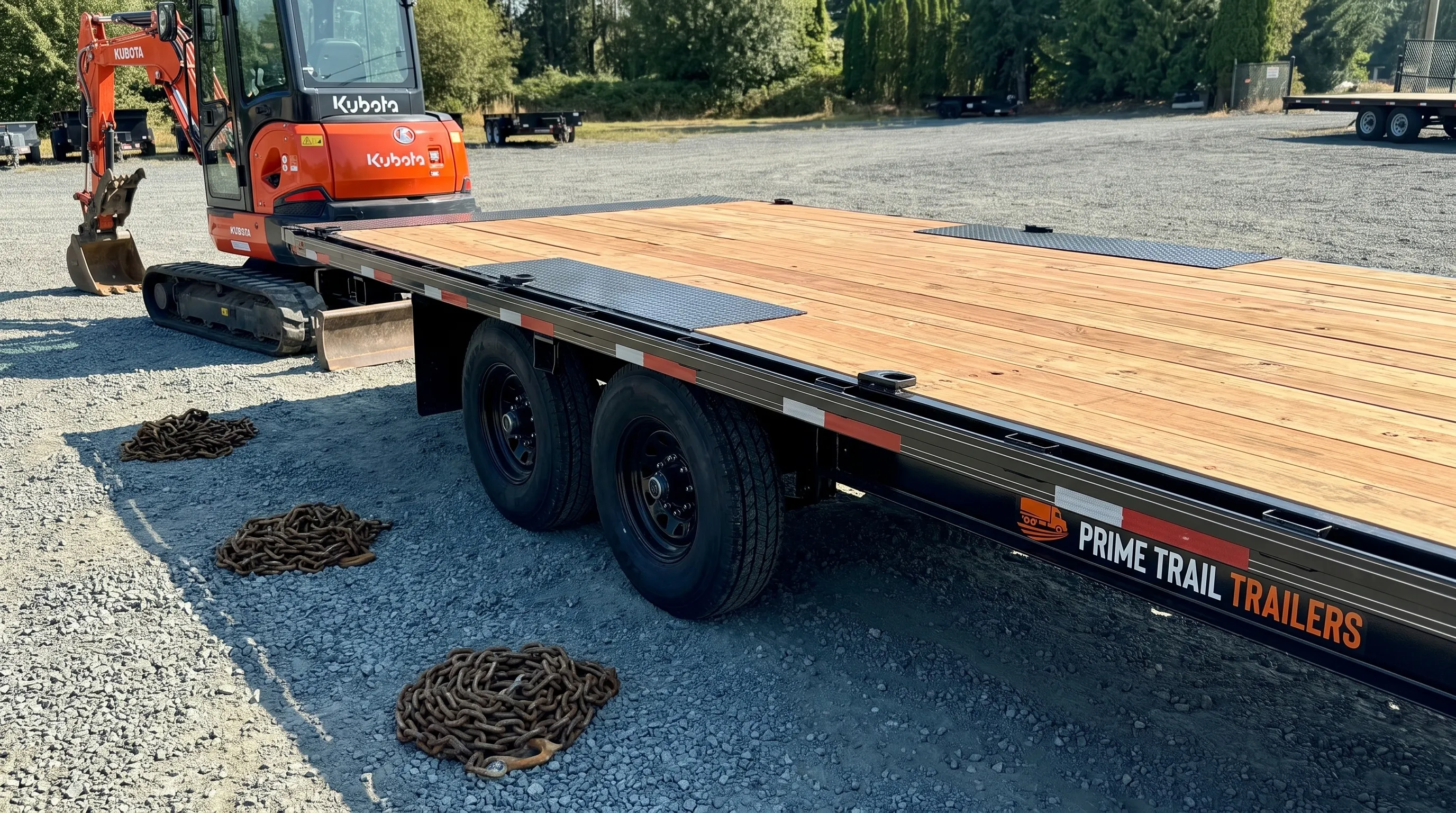
What makes a trailer heavy duty is its ability to handle your actual load within every applicable rating, not simply a thick frame or an extra axle. For contractors, farmers and equipment operators, choosing well means checking usable payload, loading geometry, concentrated-load support and compatibility with the tow vehicle.
Start with your hardest routine job. A trailer that accommodates the machine but cannot handle its attachments, load it properly or reach the worksite is the wrong purchase, regardless of its advertised capacity.
Calculate the load your trailer must actually carry
Write down the weight of everything that will travel on the trailer. For equipment, use the machine’s operating weight in its transported configuration, including fuel, installed attachments and accessories. Add any separately carried buckets, implements, tools and securement equipment.
Usable payload = manufacturer’s GVWR minus the trailer’s actual empty weight as configured.
GVWR means gross vehicle weight rating: the manufacturer’s maximum permitted loaded trailer weight. It is not the amount of cargo you can carry. Selecting a heavy duty trailer starts with understanding that distinction.
Consider this hypothetical comparison, unrelated to the products below:
| Item | Weight | |---|---:| | Machine in transport configuration | 12,000 lb | | Additional attachment | 900 lb | | Chains, binders and other carried gear | 300 lb | | Total required payload | 13,200 lb |
A trailer with an 18,000 lb GVWR and a 5,000 lb ready-to-work empty weight provides 13,000 lb of payload. It would fall short, even though the machine alone appears to fit comfortably.
Use documented weights rather than estimates whenever possible. An advertised base weight may not include optional equipment. A toolbox, spare tire or added winch also consumes capacity. Leave practical room for foreseeable changes instead of buying a trailer that only accommodates today’s lightest configuration.
What makes a trailer heavy duty for your application?
Capacity alone does not determine suitability. The trailer must also support the load’s footprint, permit controlled loading and provide accessible securement points.
| Primary hauling job | Trailer configuration to evaluate | Important buying check | |---|---|---| | Construction equipment and attachments | Equipment trailer or deck-over | Concentrated-load support, deck space and loading capacity | | Wide machinery or bulky agricultural implements | Deck-over or suitable flatbed | Usable width, transport height and securement access | | Equipment loaded frequently | Hydraulic tilt-deck trailer | Approach angle, tilt operation and loading limits | | Soil, aggregate and demolition debris | Dump trailer | Material weight, payload and unloading requirements | | Tools and weather-sensitive materials | Enclosed cargo trailer | Remaining payload after interior equipment is installed | | Vehicles with low ground clearance | Car hauler or suitable tilt trailer | Approach clearance, wheelbase and tie-down access |
A deck-over generally places its platform above the wheels, avoiding fenders that interrupt the loading surface. That can help with wide loads, but the deck height may increase the loading angle and overall transport height.
For enclosed work applications, our guide to heavy-duty enclosed trailer features covers floor, ramp and cargo-protection considerations in more detail.
Compare hydraulic tilt and tri-axle deck-over options
Two Double-A listings illustrate different buying priorities: loading convenience and a higher listed gross rating. Neither specification by itself proves that a heavy duty trailer fits your equipment.
22-foot Double-A hydraulic tilt deck
The 22' Double-A Deck Over Hydraulic Tilt Deck is listed with a 17,500 lb gross rating, two 8,000 lb axles and a hydraulic tilt system.
This configuration is worth evaluating when equipment loading is a frequent part of the workday. A tilt deck changes how equipment transitions onto the trailer, but you still need to confirm approach clearance and the manufacturer’s loading procedure.
Before choosing it, request the usable deck dimensions, actual empty weight, permitted loading capacity and any restrictions on equipment position during tilt operation. Check whether your machine can reach its transport position without an attachment or undercarriage contacting the deck.
24-foot Double-A tri-axle equipment deck-over
The 24' Double-A Tri-Axle Deck-Over Equipment Trailer is listed with a 24,000 lb gross rating and three 7,000 lb axles.
Its longer listed deck and higher gross rating make it a relevant comparison for larger equipment or combinations of machinery and attachments. However, extra length does not establish usable payload, and an additional axle does not remove tow-vehicle limitations.
Both listings use the term “GVW.” Request the manufacturer’s certification-label GVWR and gross axle weight ratings before making a purchase decision. Axle-rating totals and gross trailer ratings are different limits because some loaded weight is supported through the hitch. Neither allows you to exceed an individual axle, tire, wheel or coupling rating.
Verify the truck, hitch and loaded combination
A heavy duty trailer can exceed a truck’s capabilities even when the truck’s advertised maximum tow rating looks sufficient. That headline number may apply to a different engine, axle ratio, cab configuration or equipment package.
Check the specific truck’s documentation and loading labels. Its payload must accommodate occupants, tools, hitch equipment and the trailer’s tongue or pin load. Truck axle ratings, gross combined weight rating and towing limits must also remain within their respective limits.
The receiver, hitch, ball or gooseneck assembly and trailer coupler each have their own ratings. Use the manufacturer’s required tongue or pin weight and loading guidance rather than applying one universal percentage to every trailer design.
If you are considering a different hitch arrangement, our guide to choosing a gooseneck equipment trailer for heavy loads explains the additional truck and loading considerations.
Confirm the finished setup on a suitable certified scale. Check truck axle loads, trailer axle loads and total combination weight. Remember that trailer-axle weight alone excludes the portion supported by the hitch, so it is not the trailer’s total loaded weight.
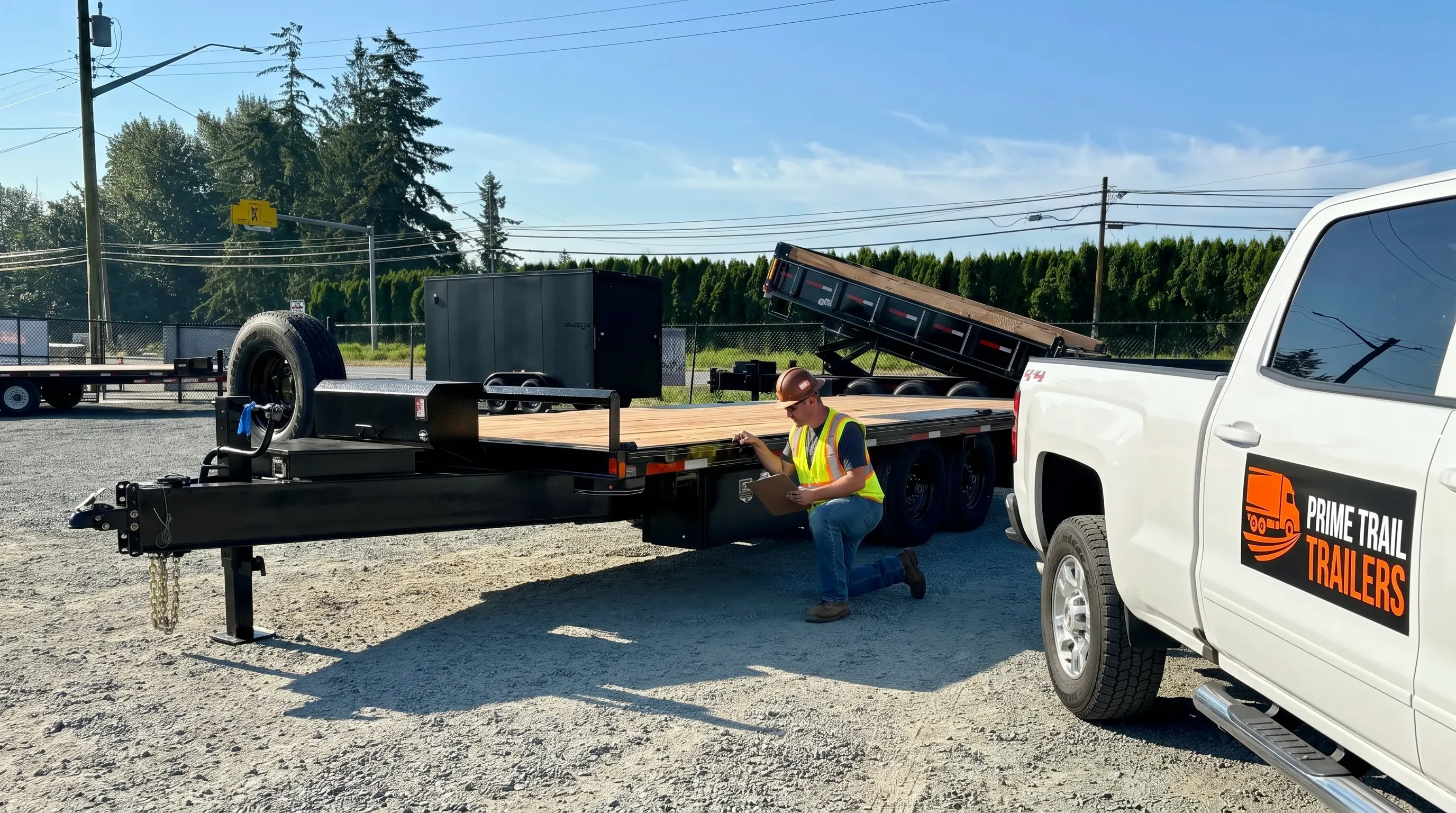
Inspect construction where the load actually bears
Frame, deck and concentrated loads
An excavator, skid steer or tractor does not distribute weight evenly across the entire deck. Tires, tracks and attachment contact points can create concentrated loads that a general payload figure does not fully describe.
Ask the manufacturer or dealer whether the trailer supports your specific machine’s operating weight and footprint. Confirm any restrictions on equipment position, crossmember loading or deck support.
The construction features that make a trailer heavy duty should be evaluated together: main frame, crossmembers, deck, suspension and attachment points. A thick-looking outer rail cannot establish the capacity of the whole structure.
For a used trailer, inspect for frame distortion, cracked welds, corrosion and undocumented repairs. Have questionable structural work assessed before relying on the original rating.
Loading equipment and securement
Ramps and tilt systems need their own capacity checks. Ask how a ramp rating is expressed, whether load must be shared across a pair and whether the equipment’s track or tire spacing is supported.
Check tie-down locations with the machine in its intended transport position. Chains or straps need suitable attachment points and adequate working load limits, without routing across sharp edges or vulnerable equipment components.
Commercial operators should review the FMCSA cargo securement rules, including the provisions applicable to their equipment. A trailer’s payload rating does not establish whether a particular securement arrangement complies.
Evaluate the workday, not just the purchase price
When comparing heavy duty trailer costs, include loading time, maintenance demands and access to the places you actually work.
A longer deck can accommodate more equipment but may be harder to maneuver through farm entrances or confined jobsites. Additional axles bring more tires, brakes and wheel-end components to maintain. Tight turns can also increase tire scrub on multi-axle trailers.
For hydraulic tilt equipment, inspect the battery, wiring, hoses and controls, and ask about the maintenance schedule. For ramp-equipped trailers, evaluate ramp handling, storage and support requirements. Neither loading method is automatically better for every operator.
Route conditions matter as well. Check loaded height, width, ground clearance and turning space. A load that fits on the deck may still create an overwidth or overheight combination that requires additional planning or permits.
Before committing, commercial buyers should also verify FMCSA commercial driver’s license requirements and applicable state rules. Do not assume a trailer is “non-CDL” based on its rating alone; the towing combination and operation matter.
Get a quote based on your complete hauling setup
A useful quote request gives the sales team enough information to compare actual fit rather than broad trailer categories. Provide your heaviest routine load and explain how often you move it.
Include these details in your request:
- Equipment make, model, transported weight and overall dimensions, including attachments.
- Additional cargo and the combined payload you need.
- Truck year, model, configuration, hitch type and documented ratings.
- Loading conditions, trip frequency, typical routes and jobsite access restrictions.
- Required documentation, including certification-label ratings, configured empty weight and loading-system limits.
Ask for an itemized quote identifying included equipment, optional accessories and any delivery charges. For used units, request condition information and available maintenance history. Compare the complete hauling setup, not two prices attached to different specifications.
Frequently asked questions
Does another axle make a trailer heavy duty? Not by itself. Additional axles can support a different rated configuration, but capacity still depends on the manufacturer’s ratings and the limits of the frame, suspension, tires, wheels and other components. More axles also mean additional maintenance items.
Is GVWR the same as payload capacity? No. GVWR is the maximum permitted weight of the loaded trailer. Payload is what remains after subtracting the trailer’s actual empty weight as configured. Options and permanently installed equipment reduce the capacity available for cargo.
Is a tilt trailer better than a ramp trailer? It depends on your equipment and loading routine. Compare approach clearance, loading capacity, operating procedure and maintenance needs. Confirm that the machine can be loaded in accordance with both the equipment and trailer manufacturers’ instructions.
Can a trailer be overloaded even if its total weight is below GVWR? Yes. Poor load placement can overload an axle, tire, hitch or the tow vehicle while total trailer weight remains below GVWR. Concentrated deck loading and inadequate securement create separate problems that a gross weight check will not resolve.
Choose the trailer around the load
The right heavy duty trailer is one you can load, tow and maintain within documented limits throughout your normal workday. Establish the full cargo weight first, then compare deck layout, loading method, construction and truck compatibility.
Browse available trailers at Prime Trail Trailers to compare equipment, deck-over, tilt and other hauling options. Share your equipment dimensions, loaded weights and tow-vehicle details with the sales team to request current pricing and availability for a suitable configuration.
Have Questions? We're Here to Help
Still unsure which trailer fits your needs, or need specs, pricing or delivery advice? The Prime Trail Trailers team is ready to answer your questions and help you find the right rig.