
Are Hydraulic Car Trailers Better for Low-Clearance Vehicles?
Hydraulic loading can help protect a low car, but deck geometry matters more than the pump. Learn how to compare approach angles, breakover clearance and payload before choosing a trailer.
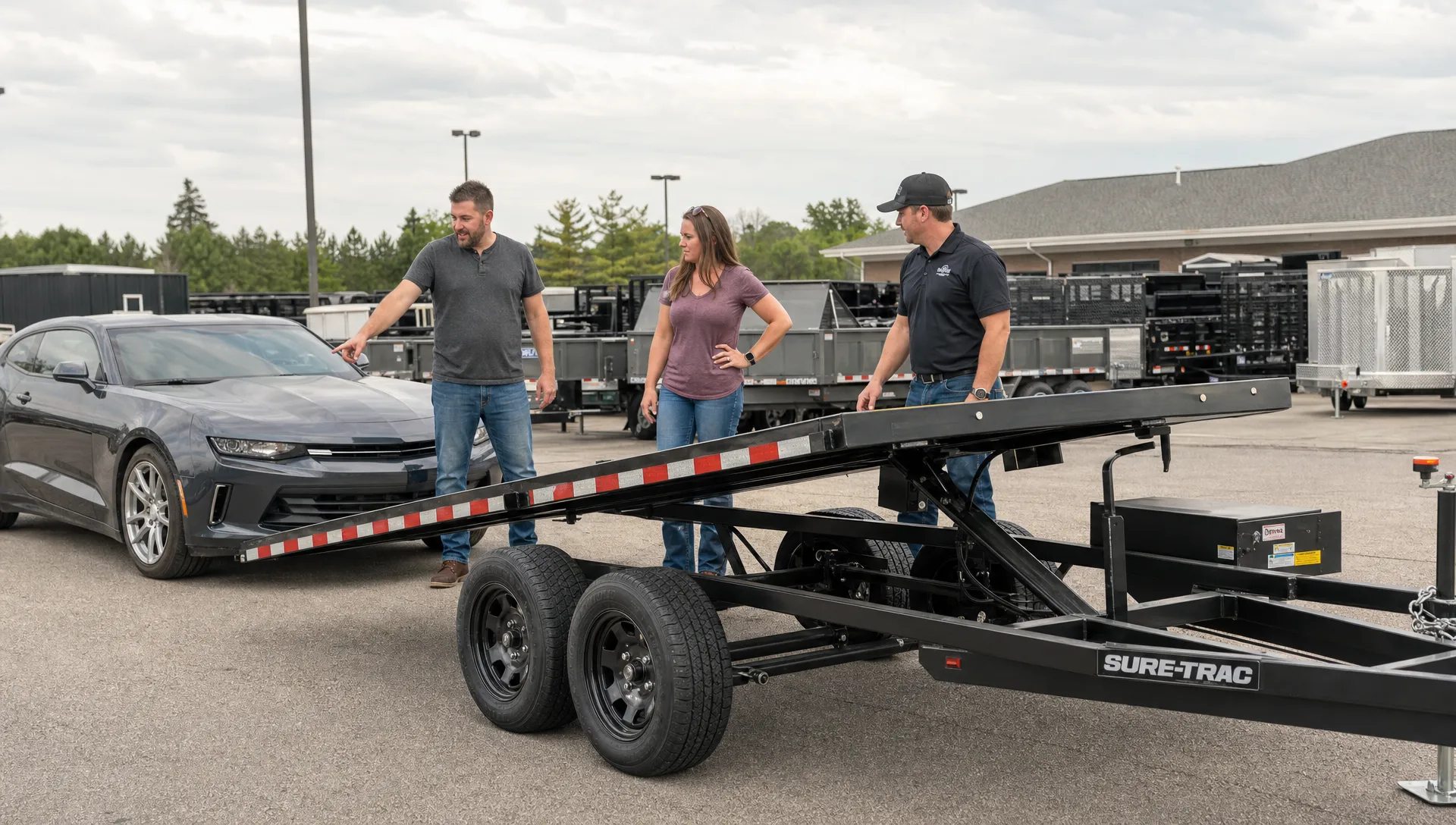
A hydraulic car trailer can be better for a low-clearance vehicle, but only if its loading geometry suits the car. Powered tilt makes positioning the deck easier and can reduce the need to handle separate ramps. It does not automatically provide a shallow approach angle or prevent a front splitter from scraping. For lowered cars, sports cars and vehicles with long overhangs, the deciding factors are the loading angle, transition points and usable deck dimensions.
Why powered loading helps, but does not guarantee clearance
Hydraulic tilt trailers use hydraulic cylinders to change the deck’s position. Depending on the design, the rear of the deck moves toward the ground as the front rises. Other hydraulic designs lower the platform closer to the ground instead of simply tilting it. These systems can produce very different loading paths.
The practical advantages include less manual ramp handling and powered control over deck positioning. Those benefits matter when loading frequently or transporting a vehicle that requires careful alignment.
However, a tall tilt deck can still create an approach that is too steep for a low bumper. A fixed-deck car hauler with properly rated extended ramps may provide better clearance than a higher hydraulic model.
Choose by the vehicle’s path onto the trailer, not by the presence of a hydraulic pump. A hydraulic car trailer is the better choice when its actual loading configuration clears your vehicle with a reasonable margin and fits your hauling requirements.
Check three clearance points before comparing trailers
Ground clearance alone does not tell you whether a car will load safely. Evaluate the front approach, the transition beneath the wheelbase and the rear overhang.
Front approach: will the bumper reach the deck before the tires?
A low splitter combined with a long front overhang can contact the loading surface before the front tires begin climbing it. Measure the lowest front component and its horizontal distance from the front tire’s ground-contact area.
For a simplified illustration, a component 4 inches above level ground and 32 inches ahead of the tire contact point produces a geometric angle of about 7.1 degrees. That is not a recommended loading limit. Tire deflection, uneven pavement, suspension movement and the shape of the ramp entrance can reduce the available clearance.
Ask for the trailer’s measured loading angle in its specified loading configuration. A description such as “low profile” is not a substitute for that measurement.
Breakover: will the underside clear the transition?
A car can clear the entrance and still scrape when its front wheels reach the deck while its rear wheels remain on the ramp or tilted section. Long-wheelbase vehicles with low exhaust components, side skirts or underbody panels need particular attention here.
A hydraulic car trailer may reduce this problem when its design creates a gentler transition, but hydraulic operation alone does not eliminate the crest.
Inspect every change in slope, including the junction between separate ramps and the deck. A single published loading angle may describe the main incline without explaining what happens at that junction.
Rear departure: will the tail scrape during loading or unloading?
The rear bumper, diffuser or exhaust can contact the ground as the front of the car rises. Rear clearance also matters when backing off the trailer.
Check the entire movement in both directions. A car that loads without contact may follow a slightly different path during unloading because of the parking surface, suspension position or deck setup. Vehicles with adjustable suspension should use only manufacturer-approved loading and transport settings.
Hydraulic tilt versus ramps and lowering platforms
The most useful comparison is between specific loading configurations, rather than hydraulic and nonhydraulic trailers as broad categories.
When comparing a hydraulic car trailer with another car hauler, use the following distinctions to narrow your options:
| Trailer configuration | Potential advantage for a low vehicle | Main point to verify | |---|---|---| | Powered full-tilt deck | Powered deck positioning and potentially fewer separate ramp components | Actual incline, rear deck lip and transition during loading | | Fixed deck with extended ramps | Longer ramps can create a shallower approach for a given deck height | Ramp rating, attachment, storage and deck transition | | Hydraulic lowering or drop-deck design | Lower platform position can reduce the rise the car must climb | How far the platform lowers and whether an entry lip remains | | Gravity-tilt deck | Tilting operation without a powered lift system on some designs | Balance behavior, operating procedure and suitability for the vehicle | | Deck-over hydraulic tilt | Deck width may suit wider loads | Higher deck position can require a longer loading path for low cars |
For a given vertical rise, a longer horizontal loading run produces a shallower angle. However, overall trailer length does not reveal that run. Axle placement, pivot location, deck height and any fixed front section affect the actual loading geometry.
How to compare a hydraulic car trailer before purchase
Request measurements that describe the loading path
Ask the seller for the deck height, loading angle and details of any ramp extensions or approach plates. Confirm whether the quoted angle includes optional equipment and what surface conditions were used to measure it.
Also ask for side-view photos showing the trailer in its loading position. These can help identify an abrupt entrance lip or crest, although photos cannot replace measurements or a controlled test load.
Keep comparisons consistent. One trailer measured with extensions should not be treated as directly equivalent to another measured without them.
Check usable space, not just advertised deck size
A hydraulic car trailer must fit the vehicle after it is loaded, not merely allow it to climb aboard. Check usable deck length, width between the fenders and space for securement equipment.
Low doors can strike trailer fenders even when the tires fit between them. Wide tires may leave little positioning tolerance, while a long front overhang can interfere with a winch mount or front rail.
Measure the vehicle’s overall length and width, tire track, wheelbase and door-opening clearance. Then compare those dimensions with the trailer’s actual layout. Our guide to choosing a car hauler that fits your vehicle covers the broader sizing and tow-vehicle checks that remain necessary regardless of loading system.
Separate payload from GVWR
GVWR is the trailer’s maximum permitted loaded weight, not the amount of vehicle weight it can carry. Available payload must account for the trailer’s own weight, and added equipment can reduce the remaining capacity.
For example, Prime Trail Trailers’ 2024 Down To Earth 7 x 20 full hydraulic tilt trailer listing specifies a 10,000-pound GVWR and a 7,200-pound payload. Those figures help evaluate carrying capacity, but they do not establish whether a particular lowered car will clear the deck.
Include the car’s actual transport weight plus tools, spare wheels and other carried equipment. Confirm the specific unit’s ratings and account for dealer-installed or aftermarket accessories. Also verify the truck’s tow rating, available payload, hitch rating and loaded axle weights.

Use a controlled test load to confirm fit
A measurement-based shortlist is useful, but a controlled test with the actual vehicle provides stronger evidence of fit. Arrange it with the seller and follow the trailer manufacturer’s loading procedure.
- Prepare the site: Use firm, level ground with sufficient space around the trailer. Keep it coupled to a suitable tow vehicle and apply brakes, chocks and any specified supports as directed by the manufacturer.
- Set the loading configuration: Position the deck and install any approved ramps or extensions according to the operating instructions. Never improvise supports or enter a pinch area beneath a moving deck.
- Use a spotter safely: Keep the spotter visible to the driver and outside the vehicle’s path, deck movement area and potential crush points.
- Check each transition slowly: Watch the front splitter, lowest underbody components and rear overhang. Stop before contact rather than trying to push through a tight spot.
- Verify the transport position: Confirm that the car can sit where the manufacturer’s load-distribution requirements can be met, with room to reach the securement points.
For a hydraulic car trailer, the test should include returning the deck to its transport position and engaging all specified latches or locks. A car that clears during loading can still interfere with hardware once the deck is level.
If a winch is required, verify its rating, mounting and approved vehicle attachment points. A winch line is not a substitute for transport tie-downs. Use appropriately rated securement equipment at locations approved for the vehicle and trailer.
Factor in hydraulic maintenance and operating costs
Powered loading adds components that need inspection and maintenance. Depending on the system, these may include a battery, charging connections, pump, reservoir, hoses and cylinders.
Before purchase, ask how the system is powered, how its battery is maintained and what the manufacturer specifies if powered operation becomes unavailable. Follow the manual for fluid selection, inspection intervals and safe servicing. Do not loosen hydraulic fittings to improvise a lowering procedure.
When inspecting a used hydraulic car trailer, look for damaged hoses, visible leaks, corroded electrical connections and worn deck pivots or latches. Have questionable components assessed before relying on the trailer for vehicle transport.
Compare the complete setup cost, including any approved approach extensions, winch equipment or securement hardware you need. A lower purchase price is not necessarily a better value if the trailer still requires substantial changes to load your car safely.
Which setup makes the most sense for your vehicle?
For frequent loading, a well-matched powered tilt trailer can reduce setup work and make deck positioning more convenient. It is especially worth considering when repeated handling of heavy ramps is a practical problem.
For occasional transport, a fixed-deck car hauler with appropriately rated long ramps may be sufficient. The tradeoff is more ramp handling and storage, but it may offer the clearance your vehicle needs without adding a hydraulic system.
For a very low car with an extended splitter or long wheelbase, prioritize verified low-angle geometry and smooth transitions. That may point toward a lowering platform, a purpose-built low-angle tilt design or an approved extended-ramp configuration.
The right hydraulic car trailer should solve a demonstrated clearance problem while also meeting capacity, securement and towing requirements. Buying more GVWR or a larger deck does not compensate for the wrong approach angle.
Frequently asked questions
Are all hydraulic tilt trailers suitable for lowered cars? No. Some are designed primarily around equipment loading and may have deck heights or transitions that do not suit a lowered vehicle. Confirm the loading geometry and vehicle fit for the specific model.
What loading angle does a low-clearance car need? There is no universal safe angle. Front overhang, splitter height, wheelbase and underbody clearance all matter. Use measurements to identify likely conflicts, then confirm adequate clearance through a controlled test where possible.
Can longer ramps work as well as hydraulic loading? Yes, properly rated longer ramps can provide a shallow approach. Their attachment, support requirements and transition to the deck must also suit the vehicle. Use only configurations approved for the trailer.
Does a hydraulic system replace vehicle tie-downs? No. The deck must be secured for travel as instructed, and the car requires its own rated transport securement. Hydraulic pressure and a winch cable do not replace those measures.
What should I send a dealer when asking for help? Provide the vehicle’s transport weight, overall dimensions, wheelbase, lowest clearance points and front and rear overhang measurements. Include tow-vehicle details and photos of any splitter, diffuser or other vulnerable components.
Compare trailers around your car’s actual requirements
A hydraulic car trailer can be an excellent choice for a low-clearance vehicle when its loading angle, transitions and usable dimensions are verified. Start with those measurements, then confirm payload, towing compatibility and securement access.
Browse available trailers at Prime Trail Trailers and request help comparing suitable car-hauler and hydraulic tilt options. Share your vehicle measurements and hauling requirements so the sales team can help you evaluate specific units and confirm pricing and availability.
Have Questions? We're Here to Help
Still unsure which trailer fits your needs, or need specs, pricing or delivery advice? The Prime Trail Trailers team is ready to answer your questions and help you find the right rig.