How to Calculate Trailer Center of Gravity and Axle Loads Using the Lever Formula
Learn how to calculate your trailer's center of gravity and exact axle loads using the lever formula to ensure safe weight distribution and legal compliance.
Prime Trail Trailers Published 2026-11-05Updated 2026-11-05T07:03:46.506000
Properly calculating your trailer's center of gravity ensures safe axle loads and prevents dangerous sway.
Quick Summary
Learn how to calculate your trailer's center of gravity and exact axle loads using the lever formula to ensure safe weight distribution and legal compliance.
<p>Proper trailer weight distribution is the foundation of safe towing, yet many haulers rely on guesswork rather than mathematics when loading their cargo. Understanding how to calculate your trailer's center of gravity and exact axle loads using the lever formula ensures you maximize payload without exceeding legal limits or compromising stability. Whether you are hauling heavy equipment across state lines or managing multi-drop delivery routes, mastering these calculations is essential for professional and recreational towers alike.</p><h2>Why Center of Gravity Matters for Trailer Axle Loads</h2><p>The center of gravity is the exact point where your cargo's weight is perfectly balanced. When you place a load on a trailer, its center of gravity dictates how that weight is distributed between the tow vehicle's hitch and the trailer's axles. If the center of gravity is too far forward, you risk overloading your truck's rear axle and exceeding your payload capacity. If it sits too far back, you create a dangerous negative tongue weight scenario that inevitably leads to severe trailer sway.</p>
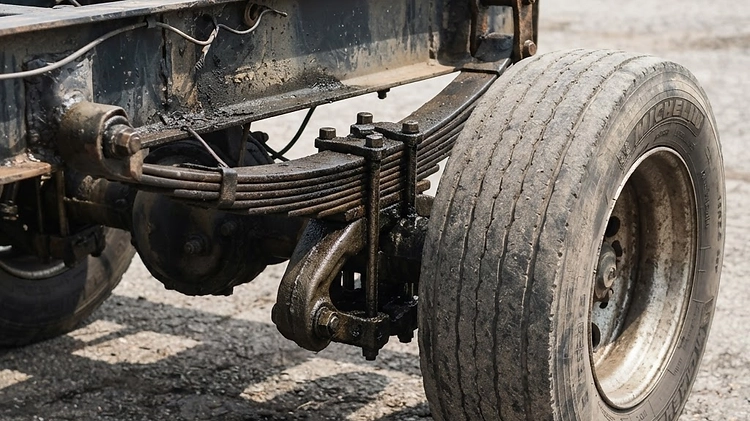
The trailer axles act as a fulcrum, transferring weight between the hitch and the tires based on cargo placement.
<p>For commercial haulers operating <a href="https://primetrailtrailers.com/trailers/flatbed-trailers/">flatbed trailers</a> or <a href="https://primetrailtrailers.com/trailers/utility-trailers/">utility trailers</a>, knowing the center of gravity is not just about safety; it is about legal compliance. Weigh stations measure per-axle weights, and a load that is perfectly legal in total gross weight can still result in a hefty fine if the center of gravity shifts too much weight onto a single axle group. This is why understanding the physics of weight transfer is a critical skill for anyone serious about towing.</p><h2>Understanding the Lever Formula for Trailer Weight Distribution</h2><p>To accurately determine how much weight is resting on your trailer axles versus your tow vehicle, you can use the lever formula. Think of your trailer as a lever, with the axles acting as the fulcrum. The distance from the load's center of gravity to the fulcrum determines the mechanical advantage and the resulting weight distribution.</p>
Gooseneck trailers use a longer effective wheelbase, allowing for higher pin weights and better stability.
<h3>The Math Behind Axle Loading</h3><p>The basic lever calculation for a trailer involves multiplying the total cargo weight by the distance from the front support (the hitch or kingpin) to the load's center of gravity, and then dividing that number by the total wheelbase (the distance from the hitch to the center of the trailer axles). For example, if you have a 10,000-pound load placed 12 feet behind the hitch on a trailer with a 20-foot wheelbase, the calculation is (10,000 x 12) / 20. This means 6,000 pounds of the cargo weight will rest on the trailer axles, while the remaining 4,000 pounds transfers to the tow vehicle as tongue or pin weight.</p><h3>Bumper Pull vs. Gooseneck Calculations</h3><p>The lever formula applies to both bumper pull and gooseneck setups, but the wheelbase measurements differ significantly. Gooseneck trailers typically have a longer effective wheelbase because the pivot point is located over the truck's rear axle rather than behind the bumper. This allows goosenecks to safely transfer a higher percentage of pin weight (often 15% to 25%) to the tow vehicle without unloading the truck's front steering axle. For more details on pin weights, check out our guide on <a href="https://primetrailtrailers.com/guides/calculate-gooseneck-pin-weight-tandem-axle-loads/">how to calculate gooseneck pin weight and tandem axle loads</a>.</p><h2>How Multi-Drop Routes Shift Your Trailer's Center of Gravity</h2><p>One of the most overlooked aspects of trailer weight distribution is how multi-drop routes affect axle loads. When you start your day with a fully loaded trailer, your center of gravity might be perfectly positioned. However, as you remove cargo at each stop, the center of gravity shifts. If you unload heavy items from the rear of the trailer first, the remaining weight is concentrated at the front, drastically increasing your tongue weight and potentially overloading your truck's rear axle.</p>
Unloading cargo during a multi-drop route shifts the trailer's center of gravity, requiring careful load planning.
<p>Commercial drivers operating in busy hubs like <a href="https://primetrailtrailers.com/locations/houston-tx/">Houston, TX</a> or delivering <a href="https://primetrailtrailers.com/locations/trailers-for-sale-in-texas/">trailers for sale in Texas</a> must plan their loading sequence carefully. The goal is to maintain a stable center of gravity throughout the entire route. This often requires loading the heaviest, last-to-be-delivered items directly over the trailer axles, while distributing lighter, early-drop items evenly toward the front and rear. Always recalculate your estimated axle loads for the final leg of your trip to ensure you remain within safe operating limits.</p><h2>The 60/40 Rule vs. Exact Center of Gravity Calculations</h2><p>For everyday hauling, the 60/40 rule is a reliable rule of thumb: place 60% of your cargo weight ahead of the trailer axles and 40% behind them. This generally ensures a safe 10% to 15% tongue weight for bumper pull trailers. However, the 60/40 rule is a simplification that assumes uniform cargo density. When hauling dense, concentrated loads like machinery or pallets of concrete, exact center of gravity calculations become necessary.</p><p>If you are loading a heavy skid steer onto a <a href="https://primetrailtrailers.com/shop/2026-pj-trailers-l6-85x24-10k-deckover-straight-deck-pull-out-ramps-f10k824p/">2026 PJ Trailers 10k Deckover</a>, simply eyeballing the 60/40 split is not enough. You must know the machine's exact center of gravity and position it precisely relative to the trailer's axle centerline. For a deeper dive into payload math, review our <a href="https://primetrailtrailers.com/guides/trailer-payload-math-gvwr-curb-weight-guide/">trailer payload math guide</a> and our comprehensive resource on <a href="https://primetrailtrailers.com/guides/commercial-trailer-load-placement-axle-limits/">commercial trailer load placement</a>.</p><h2>Key Specifications: Axle Spacing and Legal Weight Limits</h2><p>When calculating axle loads, you must also account for the spacing between your trailer's axles. Federal and state regulations dictate maximum allowable weights based on axle configurations. A standard tandem axle group (axles spaced between 40 and 96 inches apart) is typically limited to 34,000 pounds on the interstate system, while a single axle is limited to 20,000 pounds. Spread axle configurations can legally carry more weight per axle group because they distribute the load over a larger area of the bridge or roadway.</p><ul><li><strong>Single Axle:</strong> Up to 20,000 lbs legal limit (depending on tire and component ratings).</li><li><strong>Tandem Axle (Closed):</strong> Up to 34,000 lbs legal limit.</li><li><strong>Spread Axle:</strong> Can often qualify for 20,000 lbs per axle (40,000 lbs total) under the Federal Bridge Formula.</li></ul><p>Always verify your specific trailer's Gross Axle Weight Rating (GAWR) by checking the VIN plate. Your calculated axle load must never exceed the GAWR, regardless of legal highway limits. For more information on reading these plates, see our guide on <a href="https://primetrailtrailers.com/guides/how-to-read-trailer-vin-plate-gvwr-gawr-payload/">decoding GVWR, GAWR, and payload limits</a>.</p><h2>Bottom Line</h2><p>Calculating your trailer's center of gravity and axle loads using the lever formula takes the guesswork out of weight distribution. By understanding the math behind weight transfer, you can prevent dangerous trailer sway, avoid costly overweight fines, and extend the lifespan of your towing equipment. Whether you are outfitting a <a href="https://primetrailtrailers.com/shop/2026-bedboss-dually-armorbed-flatbed-truck-bed-86-l-x-97-30k-gooseneck-midnight-black-dflatbb/">2026 BEDBOSS Dually ArmorBed</a> or a standard utility trailer, precision loading is the mark of a professional hauler. Ready to upgrade your towing setup? Explore our full inventory at the <a href="https://primetrailtrailers.com/shop/">Prime Trail Trailers shop</a> or visit our <a href="https://primetrailtrailers.com/guides/">guides hub</a> for more expert towing advice.</p>
FAQ
Have Questions? We're Here to Help
Still unsure which trailer fits your needs, or need specs, pricing or delivery advice? The Prime Trail Trailers team is ready to answer your questions and help you find the right rig.
Prime Trail Trailers is a family-owned trailer dealer in Markle, Indiana, stocking utility, dump, enclosed, equipment, car hauler and gooseneck trailers with nationwide delivery. This guide is based on what our customers ask us most and the trailers we sell every day.