
Used Utility Trailers for Sale: A Buyer’s Inspection Checklist
A low price can hide worn tires, damaged frames or paperwork problems. Use this practical inspection checklist to compare used trailers, estimate repairs and decide which unit is ready for your next hauling job.
Used Utility Trailers for Sale: A Buyer’s Inspection Checklist
When comparing used utility trailers for sale, inspect more than the deck size and asking price. A trailer that looks clean may still have worn bearings, an overloaded axle history or paperwork that complicates registration. For contractors, landscapers and property owners, those problems can turn a bargain into repair bills and downtime.
Use this checklist before committing to a purchase. It covers load capacity, ownership documents, structural condition, running gear and towing equipment, with clear guidance on what to negotiate and when to walk away.
1. Confirm the fit before inspecting used utility trailers for sale
Start with your heaviest realistic load, not your average trip. Include equipment, attachments, fuel, tools and materials that will travel together. Measure the load’s width and length, then check usable deck space rather than relying solely on advertised trailer dimensions.
Three weight figures matter:
- GVWR: The manufacturer’s maximum permitted weight for the loaded trailer.
- Empty weight: What the trailer itself weighs, including installed equipment and accessories.
- Payload capacity: The weight available for cargo after subtracting actual empty weight from GVWR, subject to component ratings and load distribution.
For illustration, a trailer with a 7,000-pound GVWR and an actual empty weight of 2,000 pounds has a calculated payload allowance of 5,000 pounds. That does not automatically mean its ramp can support a 5,000-pound machine.
Confirm the tow vehicle’s limits, hitch rating and available payload for tongue weight. The lowest applicable rating controls your setup. Adding stronger tires or another axle does not, by itself, change the trailer’s manufacturer-assigned GVWR.
Prime Trail Trailers’ trailer buyer’s guide provides broader guidance on matching trailer capacity and configuration to your hauling needs.
2. Verify ownership, VIN and maintenance records
Paperwork should be an early screening step when shopping used utility trailers for sale. Ask what ownership documents the seller can provide before arranging pickup or spending money on an inspection.
Compare the VIN on the trailer with the title or other ownership documents required by your state. Check the manufacturer’s certification label for GVWR and axle ratings, where present and readable. Missing, altered or inconsistent identification needs an explanation that can be verified.
Title and registration requirements vary by state, trailer weight and trailer classification. An older trailer without a title is not automatically unlawful, but a bill of sale may not be sufficient for your state. Confirm transfer requirements with your motor vehicle agency before paying.
Ask for maintenance records covering bearings, brakes, tires and structural repairs. Receipts help establish what was done, but they do not replace a physical inspection. Ask whether the trailer has carried unusually heavy loads, sustained collision damage or received frame modifications.
If a lender has a lien, verify the release process. Do not rely on a promise that ownership issues will be resolved after the sale.
3. Inspect the frame, tongue and crossmembers
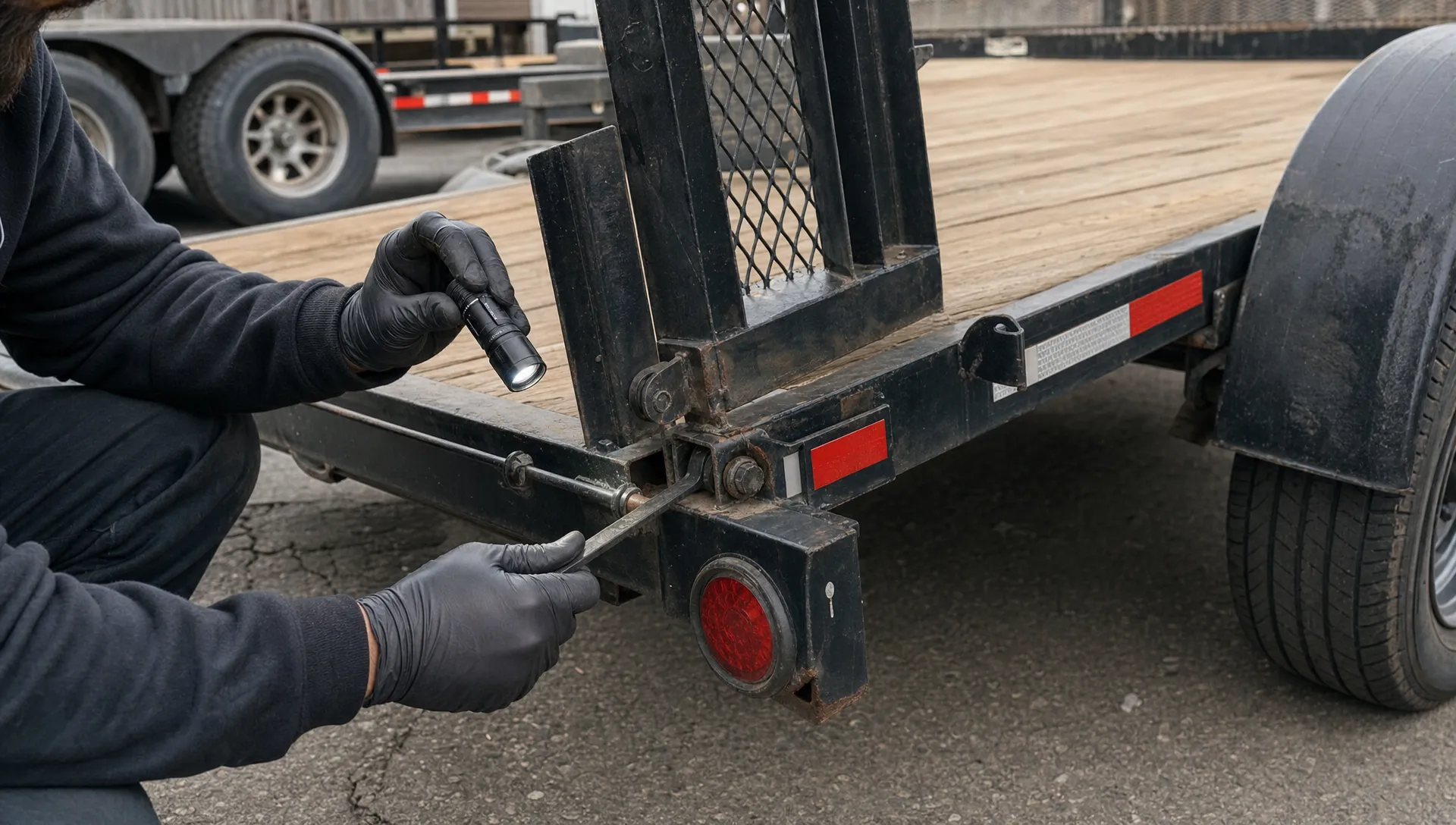
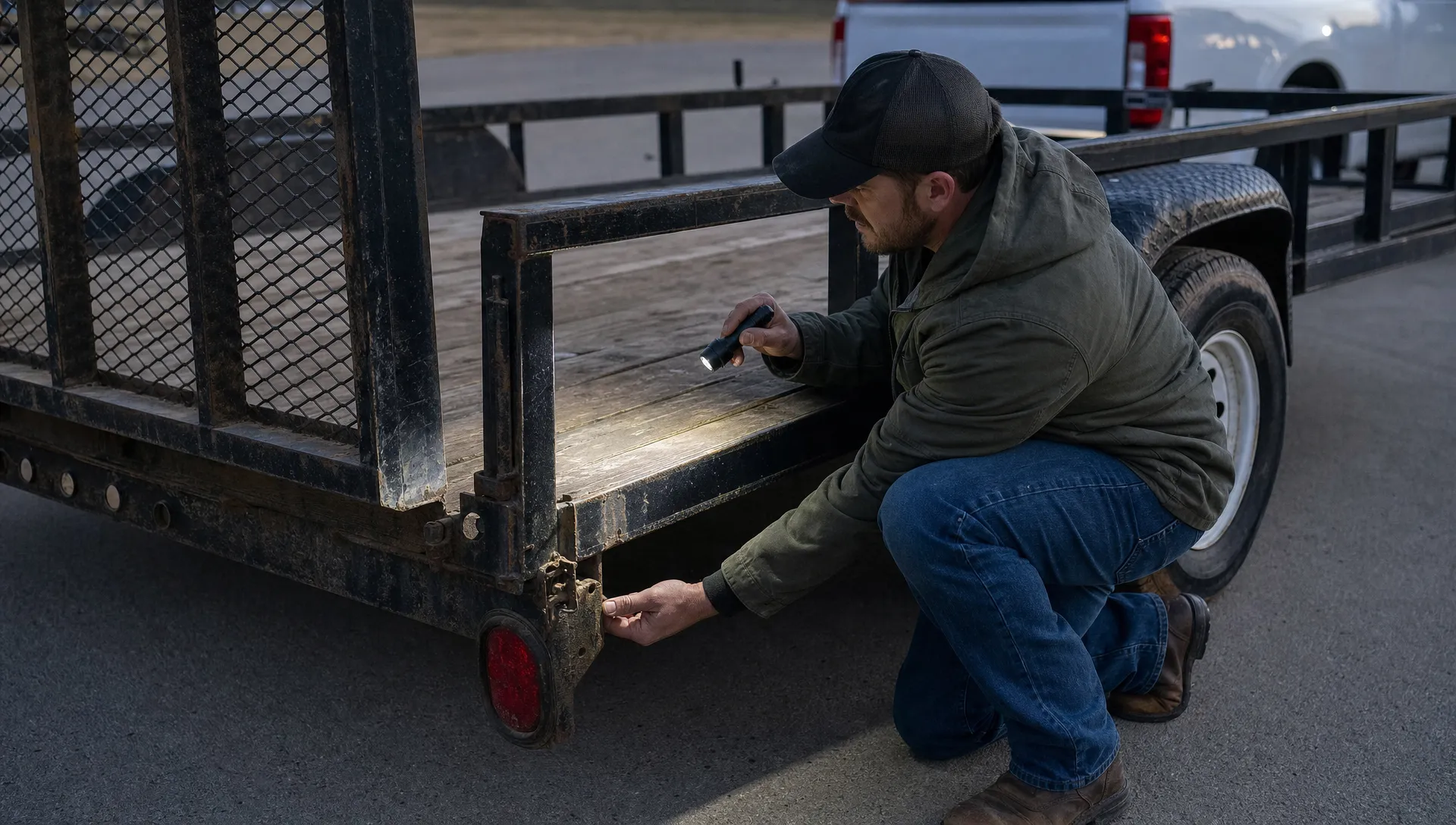
Park the trailer on firm, level ground and inspect it in daylight. Bring a flashlight and gloves. Do not crawl underneath a trailer supported only by its jack or place yourself beneath an unsupported ramp.
Look along both frame rails for bends, twists or uneven alignment. Inspect the tongue where it joins the main frame, the coupler mounting area and the crossmembers beneath the deck. Pay particular attention to welds and suspension attachment points.
Light surface rust differs from corrosion that has thinned the metal or created holes. Flaking scale, cracks beside welds and distorted brackets deserve closer evaluation. Fresh paint is not proof of a defect, but it can hide damage, so ask about recently refinished areas.
When evaluating used utility trailers for sale, unexplained reinforcement plates or nonfactory welds should prompt questions about past damage. A repair may be acceptable if its purpose and workmanship can be verified by a qualified professional.
Check that the coupler latches correctly on the specified ball size and that its locking mechanism is intact. Examine the jack, safety chains and chain attachment points for damage or excessive wear.
Pause the purchase for structural cracks, substantial metal loss or a visibly bent tongue. These are not routine cosmetic bargaining points.
4. Check the deck, ramp gate and tie-down points
Walk the deck and inspect it from accessible angles underneath. On a wood deck, look for rot, splitting, loose fasteners and deterioration where boards rest on crossmembers. On a metal deck, check for perforation, cracked welds and distortion.
A replacement deck may be a manageable expense. Rotten boards combined with heavily corroded supports indicate a larger repair.
Lower and raise the ramp gate safely, keeping clear of pinch points. Inspect hinges, latches, support cables or springs, where fitted. The gate should close securely without forcing it into alignment. Look for bent mesh, cracked ramp framing and damaged transition points.
For used utility trailers for sale that will carry mowers or compact equipment, verify the ramp’s rated capacity separately from the trailer’s payload. Consider concentrated wheel loads and the machine’s clearance as it passes over the ramp-to-deck transition. A wide gate is not necessarily an equipment-rated ramp.
Examine tie-down anchors and their attachment to the trailer. Thin side rails, mesh and convenience hooks should not be assumed suitable for securing heavy machinery. Confirm rated securement points and use equipment appropriate to the cargo.
5. Examine tires, axles, hubs and suspension
Check every tire, including the spare if one is supplied. Verify size, load rating and suitability against the trailer manufacturer’s requirements. Look for sidewall cracks, bulges, exposed cords and uneven wear.
The last four digits of a tire’s DOT identification number indicate its manufacturing week and year. Age matters even when tread remains, and replacement guidance should follow the tire manufacturer’s recommendations. The NHTSA tire safety guide explains tire identification, pressure and aging considerations.
Uneven wear can reflect inflation problems, alignment issues or damaged running gear. Do not assume that new tires alone will fix it.
When inspecting used utility trailers for sale, check spring hangers, shackles, bushings and U-bolts for damage, movement or missing hardware. Inspect leaf springs for broken leaves and unusual alignment. Trailer axles can have an intentional upward camber, so a visible curve alone does not establish that an axle is bent.
Look around hubs for lubricant leakage and damaged seals or caps. Ask when the bearings were last serviced. A qualified technician can safely lift the trailer to check wheel play, rotation and bearing condition.
Visible inspection cannot confirm that the bearings are healthy internally. If service history is unknown, include professional inspection and any needed service in your purchase budget.
6. Test lights, brakes and the breakaway system
Connect the trailer to a compatible tow vehicle and check running lights, brake lights and turn signals. Inspect the connector for corrosion, damaged pins or improvised repairs. Follow accessible wiring for crushed sections, exposed conductors and poorly secured splices.
A working light circuit does not prove that trailer brakes work. If brakes are fitted, identify the system and confirm that the tow vehicle has compatible controls. Ask for a functional demonstration and, when condition is uncertain, a professional brake inspection.
For used utility trailers for sale equipped with electric brakes and a breakaway system, check the battery, switch and cable condition. Testing should follow the component manufacturer’s procedure. Do not tow with the breakaway switch activated or assume that a connected battery holds an adequate charge.
Brake and breakaway requirements depend on applicable law and the trailer’s use. Check your state’s requirements and any rules relevant to interstate commercial operation rather than relying on the seller’s statement that “it has always been fine.”
Repair lighting and braking defects before highway use. Missing brakes, damaged wiring or a failed breakaway system should not become problems you plan to solve after towing the trailer home.
7. Confirm hookup and arrange a safe towing check
Verify the coupler size, hitch-ball rating and required hitch height. A conventional bumper-pull utility trailer should be set up according to its manufacturer’s instructions, with appropriate tongue weight and a compatible tow vehicle.
Check that safety chains and the breakaway cable, where fitted, can be attached correctly. Confirm that the jack retracts fully and that nothing drags or interferes with turning. Secure the ramp gate and any loose equipment before moving.
A towing check can help compare used utility trailers for sale, but only after paperwork, attachment and basic safety checks are satisfactory. Obtain the seller’s permission and use a suitable vehicle. Do not road-test a trailer with questionable tires, structural damage or unresolved brake defects.
During a controlled check, watch for abnormal pulling, vibration, brake behavior and loose components. An empty test cannot establish how the trailer will handle a full working load, and a short drive does not replace a bearing or brake inspection.
If safe towing cannot be established, arrange appropriate transport or delay pickup until the defects are resolved. A low purchase price does not justify an unsafe trip home.
8. Calculate the purchase price plus immediate repairs
Compare the trailer’s total ready-to-work cost, not just its asking price:
Purchase price + immediate repairs + applicable taxes and registration fees + pickup or delivery costs = initial ownership cost.
When comparing used utility trailers for sale, get estimates for unresolved issues before negotiating. Account for labor and downtime as well as replacement parts. Tires, bearing service, deck replacement and brake work can change which listing offers better value.
Use this summary to separate routine repairs from problems requiring further evaluation:
| Inspection area | What to verify | Buying response | |---|---|---| | Ownership and VIN | Matching identification and transferable documents | Resolve discrepancies before payment | | Frame and tongue | No cracks, significant distortion or substantial corrosion | Obtain qualified evaluation or reject the unit | | Deck and supports | Sound boards or metal with secure attachment | Price repairs only after checking underlying structure | | Ramp gate | Sound hinges, secure latches and suitable rating | Confirm capacity and estimate necessary repairs | | Tires and hubs | Correct ratings, acceptable condition and service history | Budget verified replacement or service needs | | Brakes and wiring | Functional equipment and compatible controls | Correct safety defects before towing | | Tie-down points | Suitable anchors with sound attachments | Confirm the trailer can secure your actual load |
Separate firm repair estimates from unknown costs. An inexpensive trailer with several unresolved systems may be less economical than a higher-priced unit with documented condition. Compare it with an equivalent new trailer before deciding that buying used delivers meaningful savings.
When an enclosed trailer is worth comparing
An open utility trailer suits many landscaping, farm and general hauling jobs. It may not be the right fit when tools must travel out of the weather or equipment needs an enclosed storage space between stops.
If weather exposure is driving your search for used utility trailers for sale, compare enclosed options before committing to an open trailer. An enclosure adds weight and changes access, clearance and towing requirements, so evaluate it against the same working load.
For example, the Double-A 8'6" X 16' Double-A Ruger Series w/ Ramp Door, HD 14K GVWR offers an enclosed alternative for equipment, tools or vehicles. Its supplied listing information identifies a 14,000-pound GVWR and a 4,000-pound empty weight. Confirm the specific unit’s configuration, usable interior dimensions and ramp rating before determining suitability.
The Double-A 7.5' X 16' Double-A Ruger Series w/ Ramp Door, 10K GVWR, Extra Tall is another option when interior height matters. Verify both the interior clearance and door opening against your tallest equipment.
These are configuration alternatives, not claims that either listing is used or currently available. Ask Prime Trail Trailers to confirm condition, pricing and availability for the unit you are considering.
Make the final decision: buy, negotiate or walk away
A sound frame, clear ownership and suitable capacity should come before cosmetic condition. Faded paint or worn deck boards may be manageable; an unidentified trailer with structural cracks is a different proposition.
Use these final checkpoints before paying:
- Buy: The trailer fits the load, ownership is clear and condition supports safe use.
- Negotiate: Repairs are understood, estimates are available and the adjusted total remains competitive.
- Request further inspection: Brake, bearing, axle or structural condition remains uncertain.
- Walk away: Ownership cannot be verified, ratings are unsuitable or serious defects remain unresolved.
- Confirm the transaction: Record the VIN, price, included equipment and disclosed condition in the appropriate sale documents.
Before choosing among used utility trailers for sale, photograph the identification label and relevant condition details. Get agreed repairs or included accessories documented rather than relying on a verbal understanding.
For a commercial buyer, reliability has financial value. A trailer that costs less initially but cannot serve your daily workload is not the better purchase.
Frequently Asked Questions
What should I check first on a used utility trailer? Confirm load capacity and ownership documents, then inspect the frame and tongue. These checks can reveal a fundamental mismatch or serious problem before you spend time evaluating smaller components.
How do I calculate a used trailer’s payload capacity? Subtract its actual empty weight from its manufacturer-assigned GVWR. Added accessories reduce available payload. Axles, tires, ramps, hitch equipment and the tow vehicle must also support the intended use within their applicable ratings.
Is rust a reason not to buy a trailer? Light surface rust alone may not rule out a purchase. Corrosion that has thinned structural metal, created holes or weakened attachment points requires qualified evaluation. Fresh paint does not establish structural condition.
Should I have a used trailer professionally inspected? Professional inspection is especially useful when service records are missing, heavy commercial use is planned or brakes, bearings and structural repairs are uncertain. Ask what the inspection covers rather than assuming every system is included.
Can I tow a newly purchased trailer home immediately? Only if ownership and operating requirements are satisfied and the trailer, tires, brakes, lights and hitch setup are safe. Otherwise, arrange repairs or suitable transport before pickup.
Find a trailer that fits your workload
The best used utility trailers for sale are the ones that match your load, pass inspection and make financial sense after necessary repairs.
Explore trailer categories and buying options at Prime Trail Trailers, then contact the sales team with your cargo weight, required deck size and tow vehicle details. Prime Trail Trailers offers new and used trailers, sales assistance and nationwide delivery options. Request pricing, availability and delivery details for the specific unit before making your decision.
Have Questions? We're Here to Help
Still unsure which trailer fits your needs, or need specs, pricing or delivery advice? The Prime Trail Trailers team is ready to answer your questions and help you find the right rig.