
Food Trailer Waste Water Tank Sizing & Health Department Compliance Guide
Learn how to properly size your food trailer's fresh and gray water tanks, choose the right water heater, and pass local health department plumbing inspections.

Navigating health department regulations for a mobile kitchen can be daunting, especially when it comes to plumbing and water storage. A single miscalculation in your food trailer waste water tank sizing can result in failed inspections and costly rebuilds. This comprehensive guide breaks down the exact specifications, tank ratios, and plumbing components you need to ensure your concession trailer is fully compliant and ready for service.
The Golden Rule of Food Trailer Water Tanks
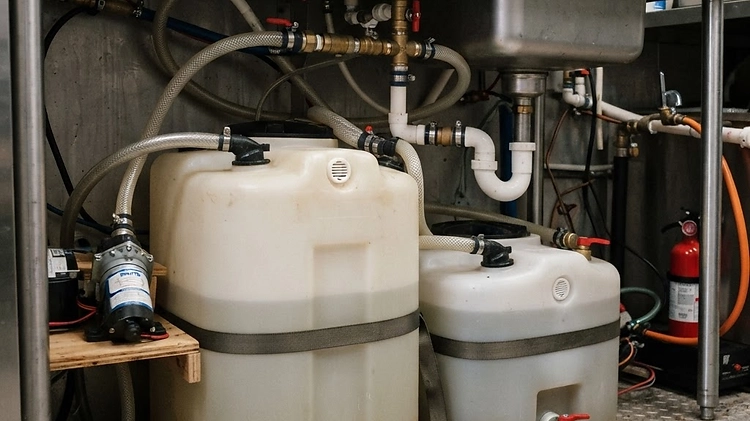
When outfitting a mobile kitchen, the most critical plumbing regulation across almost all jurisdictions is the ratio between your fresh water supply and your waste water (gray water) capacity. Most local health departments require your waste water tank to be at least 15% larger than your fresh water tank. However, some strict jurisdictions, such as Louisville, KY, mandate that the wastewater tank must be 50% larger than the potable water tank (e.g., a 20-gallon fresh tank requires a 30-gallon waste tank). This ensures that all water brought on board, plus any liquid waste generated during cooking and cleaning, can be safely contained without overflowing. Always consult your local health department before purchasing tanks, as requirements vary significantly between states like Texas and Florida.
Fresh Water vs. Gray Water Tank Sizing Guidelines
Determining the absolute size of your tanks depends on your menu, operating hours, and local codes. A standard baseline for a fully equipped food trailer is a 30 to 40-gallon fresh water tank paired with a 45 to 50-gallon gray water tank. If you are boiling pasta, washing extensive cookware, or operating for 10-hour shifts at festivals in Atlanta, you may need to upgrade to a 50-gallon fresh and 65-gallon gray system. Remember that water weighs roughly 8.3 pounds per gallon; a full 50-gallon fresh tank adds over 400 pounds to your trailer's payload. Proper weight distribution over the axles is essential, which is why many builders install tanks directly over the axles or under the sinks to maintain balance. For more on layout planning, review our Concession Trailer Layout and Equipment Planning Guide.
Essential Plumbing Components for Health Code Approval


Beyond the tanks, your food trailer must feature specific plumbing fixtures to pass inspection. Almost every county requires a commercial 3-compartment sink (for washing, rinsing, and sanitizing) with drain boards on either side. The sink compartments must be large enough to submerge your largest piece of cookware. Additionally, a separate, dedicated handwashing sink must be installed, complete with splash guards, a soap dispenser, and single-use paper towels. All sinks must have hot and cold running water under pressure. To achieve this, avoid 12-volt RV pumps; instead, opt for a robust 110-volt on-demand water pump that provides consistent pressure for commercial use. Ensure all plumbing connections are secure and that your fresh water fill port is lockable to prevent tampering. For a deep dive into overall compliance, see our 2026 Food Trailer Licensing & Regulations Guide.
Propane vs. Electric Water Heaters for Mobile Kitchens
Hot water is a non-negotiable requirement for mobile food units. Health inspectors will test your water temperature, which typically must reach at least 120 degrees Fahrenheit at the hand sink and up to 180 degrees for sanitizing, depending on local codes. Propane tankless water heaters are highly recommended for food trailers. They provide hot water on demand without drawing massive amounts of electricity from your generator. An electric water heater can consume 12 to 15 amps, which can easily overload a standard generator when combined with refrigerators, fryers, and AC units. Propane heaters are efficient, save electrical capacity, and ensure you never run out of hot water during a busy lunch rush. For more details on balancing your power and water systems, check out our Mobile Kitchen Trailer Utilities Guide.
Best Practices for Tank Placement and Installation


Where you place your water tanks impacts both the longevity of the equipment and the towing dynamics of the trailer. It is generally best practice to install fresh water tanks inside the trailer, often under the 3-compartment sink or built into custom cabinetry. This protects the potable water from extreme weather, freezing temperatures, and road debris. Gray water tanks are typically under-mounted beneath the trailer chassis. If you are operating in colder climates like Chicago, you must install tank heaters or heavily insulate the under-mounted gray tank to prevent freezing and cracking. Always ensure your waste tank has an easily accessible dump valve (usually a standard RV-style 3-inch gate valve) to make emptying at approved commissary or RV dump stations quick and sanitary. If you are looking for a pre-built solution, explore our kitchen trailers category or view specific models like the 8.5 x 20 White BBQ Smoker Porch Catering Trailer and the 7x16TA Coast to Coast Concession Trailer Pink Blackout Package.
Bottom Line
Properly sizing your food trailer's water tanks and installing the correct plumbing fixtures is the foundation of a compliant, efficient mobile kitchen. By adhering to the 15% to 50% gray water rule, investing in a propane water heater, and ensuring your 3-compartment sink meets local dimensions, you will breeze through health inspections and keep your business running smoothly. Ready to start your mobile food journey? Browse our complete inventory of compliant enclosed trailers and custom builds at the Prime Trail Trailers shop, or visit our guides hub for more expert advice.
FAQ
Have Questions? We're Here to Help
Still unsure which trailer fits your needs, or need specs, pricing or delivery advice? The Prime Trail Trailers team is ready to answer your questions and help you find the right rig.