
Trailer Approach Angles and Deck Height Dimensions for Low-Clearance Vehicles
Learn how to calculate trailer approach angles, deck heights, and ramp lengths to safely load low-clearance vehicles without damaging bumpers or undercarriages.

Quick Summary
Learn how to calculate trailer approach angles, deck heights, and ramp lengths to safely load low-clearance vehicles without damaging bumpers or undercarriages.
Loading a low-clearance vehicle onto a trailer can quickly turn into a costly disaster if the approach angle is too steep. Whether you are hauling a modified sports car, a track vehicle, or specialized low-profile equipment, understanding the relationship between deck height, ramp length, and ground clearance is critical. This guide breaks down the exact dimensions and calculations you need to ensure a safe, scrape-free loading process every time.\n\n## Understanding Trailer Approach Angles and Ground Clearance\n\nThe approach angle is the maximum angle of an incline that a vehicle can climb without its front bumper or undercarriage scraping the surface. When loading a car onto a trailer, a conventional car hauler with separate ramps creates at least two important transitions: the pavement-to-ramp transition and the ramp-to-deck transition. If the angle of the ramps exceeds the vehicle's approach angle, the front splitter or bumper will hit the ramps before the tires even make contact. \n\n

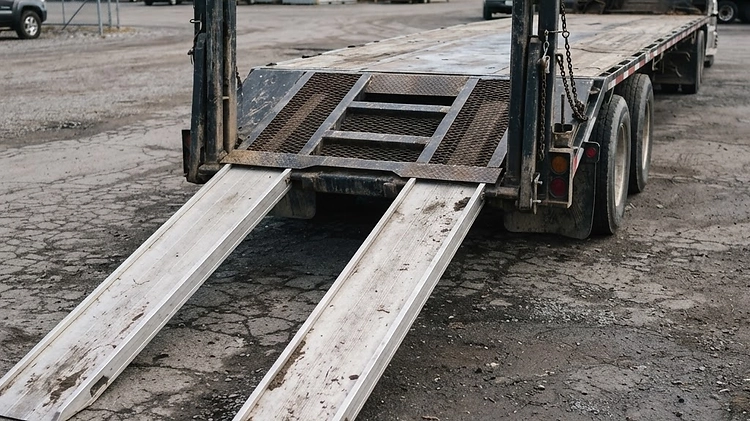
\n\nTo calculate the required approach angle, you need to know the vehicle's ground clearance at its lowest point (usually the front bumper or side skirts) and the distance from that lowest point to the center of the front tire. However, loading clearance cannot be calculated reliably from deck height and ground clearance alone. The actual angles vary considerably with deck height, ramp length, dovetail design, suspension loading, and the slope of the parking surface. For a simple straight incline, the approximate ramp angle is based on the height of the trailer deck divided by the length of the ramps. If you are looking for trailers for sale in Texas, ensuring you have the right ramp setup is essential for low-profile hauling.\n\n## How Deck Height and Ramp Length Affect Loading\n\nDeck height is the primary factor dictating how long your ramps need to be. Standard car haulers typically have a deck height between 18 and 22 inches. If you have a 20-inch deck height and use standard 5-foot ramps, the resulting angle is often too steep for sports cars. To reduce the angle, you must either lower the deck height (using drop axles) or increase the ramp length. \n\n

\n\nMany modern car haulers incorporate a dovetail (or beavertail) at the rear of the deck. A dovetail slopes downward over the last 2 to 4 feet of the trailer, effectively lowering the ramp attachment point and reducing the ramp-to-deck transition angle. When shopping at our shop inventory, look for models with a 2-foot or 4-foot dovetail if you frequently haul low vehicles. For comprehensive sizing, check out our guide on What Size Car Hauler Do I Need? 2026 Length & Width Guide.\n\n## Tilt Trailers vs. Ramps for Low-Clearance Cars\n\nTilt trailers eliminate the need for heavy, cumbersome ramps by allowing the entire deck (or a portion of it) to pivot downward. This creates a single, continuous loading plane. Gravity tilt trailers use a hydraulic dampening cylinder to smoothly lower the deck as the vehicle drives on, while power tilt models use an electric-over-hydraulic pump. \n\n

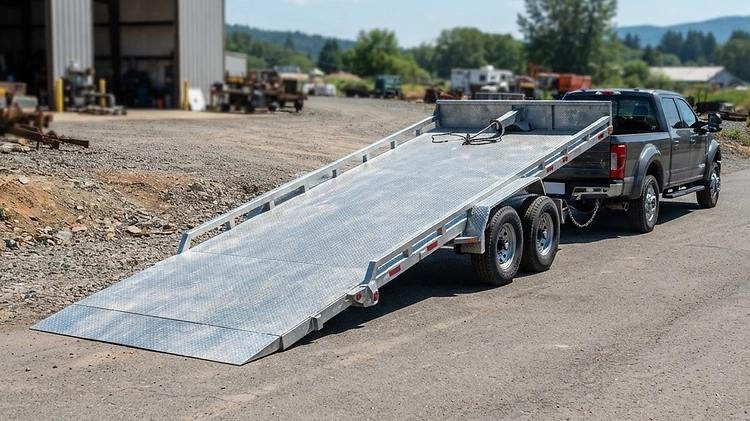
\n\nFor low-clearance vehicles, tilt trailers often provide a superior loading experience because they eliminate the sharp ramp-to-deck transition peak where many cars high-center. For example, the 2027 PJ T6 7x20 Gooseneck Gravity Tilt Equipment Trailer offers a smooth, dampened tilt that is ideal for careful loading. Similarly, the 2027 Horizon HET 8.5x20 Gravity Tilt Equipment Trailer provides a wide deck and drive-over fenders for wider track cars. You can explore more options in our tilt trailers category.\n\n## Key Dimensions to Measure Before Loading\n\nBefore attempting to load a low-clearance vehicle, measure the following dimensions to ensure compatibility:\n* Vehicle Approach Angle: Measure from the front tire contact patch to the lowest protruding point of the front bumper.\n* Vehicle Breakover Angle: The clearance between the front and rear axles. This dictates whether the car will high-center at the ramp-to-deck transition.\n* Trailer Deck Height: Measure from the ground to the top of the trailer deck while hitched to the tow vehicle.\n* Ramp Length: The total length of the loading ramps.\n* Trailer Width: Ensure the vehicle fits between the fenders. See our guide on Trailer Width Codes Explained: 80, 96, and 102-Inch Dimensions for more details.\n\nIf you are operating in urban areas like Los Angeles, CA, where tight loading conditions are common, having a trailer with optimized dimensions saves time and prevents property damage. Always park on firm, level ground, follow the trailer manufacturer's tilt procedure, and verify that the deck is fully secured before towing.\n\n## Bottom Line\n\nLoading low-clearance vehicles requires precise attention to approach angles, deck heights, and ramp lengths. By choosing a trailer with a low deck height, a dovetail, or a tilt mechanism, you can protect valuable vehicles from undercarriage damage. For more expert advice, visit our guides hub or browse our extensive selection of car haulers to find the perfect fit for your hauling needs.
Shop Related Trailers
FAQ
Have Questions? We're Here to Help
Still unsure which trailer fits your needs, or need specs, pricing or delivery advice? The Prime Trail Trailers team is ready to answer your questions and help you find the right rig.
Prime Trail Trailers
Prime Trail Trailers is a family-owned trailer dealer in Markle, Indiana, stocking utility, dump, enclosed, equipment, car hauler and gooseneck trailers with nationwide delivery. This guide is based on what our customers ask us most and the trailers we sell every day.
More about Prime Trail Trailers