
Bumper Pull Flatbed Trailers: Capacity and Towing Guide
A trailer’s GVWR does not tell you how much cargo you can safely haul. Learn how payload, tongue weight and truck ratings work together, plus the checks to make before choosing a flatbed for equipment or materials.
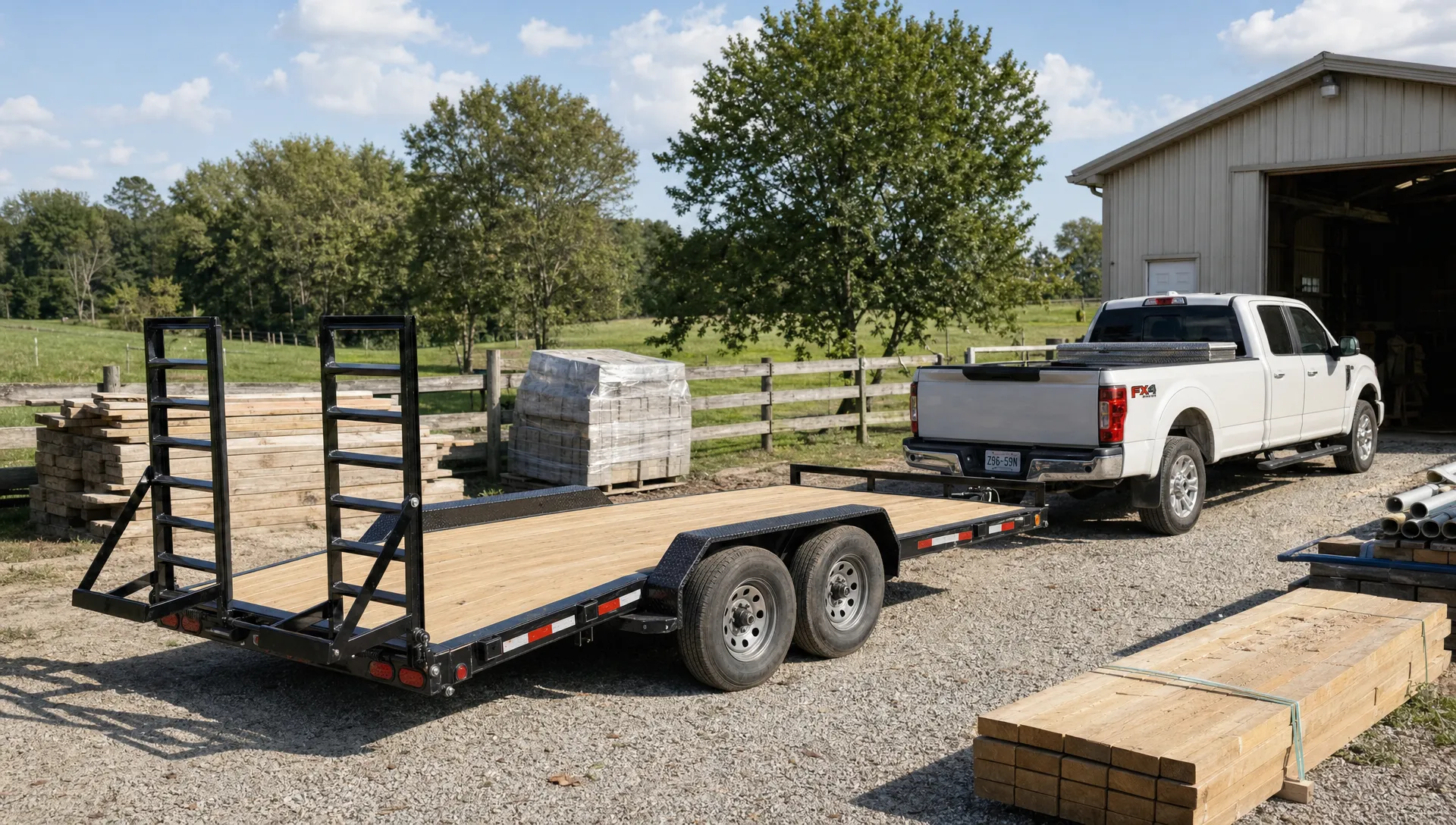
A trailer can have enough deck space for your equipment and still exceed your truck’s limits once loaded. Choosing bumper pull flatbed trailers starts with three numbers: the trailer’s usable payload, its loaded tongue weight and the tow vehicle’s remaining capacity. For contractors, landscapers and farm operators, checking those numbers before buying helps prevent an expensive mismatch between the trailer, the load and the truck.
This guide explains how to calculate capacity, evaluate your towing setup and compare specifications before requesting pricing or availability.
How bumper pull flatbed trailers carry weight
A bumper pull trailer connects to a hitch behind the tow vehicle, usually a frame-mounted receiver and ball mount. The name does not mean a heavy-duty flatbed should attach directly to the truck’s bumper.
The trailer’s axles support most of its loaded weight. The coupler transfers the remainder to the truck as tongue weight. Both sides of that arrangement have limits, so a trailer that stays within its own rating can still overload the tow vehicle.
Calculate payload from GVWR, not axle ratings
Gross vehicle weight rating (GVWR) is the maximum permitted weight of the loaded trailer. It includes the trailer itself, equipment, materials and anything else carried on it.
The basic calculation is:
Available trailer payload = trailer GVWR minus ready-to-haul empty trailer weight.
| Specification | What it tells you | What to verify | |-------------|-------------------|----------------| | GVWR | Maximum loaded trailer weight | Manufacturer’s certification label | | Empty trailer weight | Weight before cargo is loaded | Whether installed options are included | | Payload capacity | Remaining allowance for cargo | GVWR minus actual empty weight | | Gross axle weight rating (GAWR) | Maximum load permitted on an axle | Actual axle loads when loaded | | Tire and wheel ratings | Limits of those components | Correct size, inflation and load capacity |
When comparing bumper pull flatbed trailers, use an empty weight that includes installed ramps, a spare tire, toolboxes and other accessories. Anything added after the stated empty weight reduces the remaining cargo allowance.
Adding the axle ratings together does not establish cargo capacity. The manufacturer’s GVWR and every applicable component rating still govern the trailer.
A worked example: 14,000 lb GVWR
Consider a hypothetical flatbed with a 14,000 lb GVWR and a ready-to-haul empty weight of 3,500 lb:
14,000 lb minus 3,500 lb = 10,500 lb of available payload.
If you load an 8,500 lb machine and 1,000 lb of attachments, tools and materials, the cargo totals 9,500 lb. The loaded trailer weighs 13,000 lb, leaving 1,000 lb below its GVWR.
That calculation confirms only the trailer’s gross-weight allowance. It does not confirm acceptable tongue weight, axle loading or truck capacity.
For bumper pull flatbed trailers, the purchase decision should follow the complete loaded setup, not the largest capacity number printed in a listing. Equipment attachments and jobsite supplies need to be included even when they are carried only occasionally.
Match the trailer to the truck’s actual limits
A truck’s advertised maximum towing capacity may apply to a specific engine, axle ratio, cab configuration and equipment package. Your truck’s owner’s manual, towing documentation and door-jamb labels are the starting points for determining what your vehicle can handle.
Estimate loaded tongue weight
For many conventional ball-hitch trailers, loaded tongue weight is commonly about 10% to 15% of loaded trailer weight. Follow the tow vehicle and trailer manufacturers’ guidance for your particular combination rather than treating that range as a universal specification.
At 13,000 lb loaded, that range represents approximately 1,300 to 1,950 lb on the hitch. A 12% example produces 1,560 lb of tongue weight.
Too little tongue weight can contribute to sway. Too much can overload the receiver, truck or rear axle. Cargo position changes tongue weight, so a correct-looking load still needs verification.
Check remaining truck payload
Truck payload must accommodate people, cargo, added equipment, hitch hardware and the trailer’s tongue load.
Bumper pull flatbed trailers can reach a pickup’s payload limit before reaching its advertised towing limit, especially when the truck also carries a crew and tools.
Suppose the truck’s payload label allows 2,000 lb. Subtract 400 lb for occupants, 250 lb for tools and 100 lb for hitch equipment:
2,000 lb minus 400 lb minus 250 lb minus 100 lb = 1,250 lb remaining.
The example trailer’s 1,560 lb tongue weight exceeds that remaining allowance by 310 lb. The trailer is below its own GVWR, but this truck-and-load combination does not fit the truck’s payload allowance.
Use actual weights when practical, particularly if the truck has aftermarket accessories that were not included in its original payload calculation.
Verify the receiver, axles and combined weight
Check the receiver, ball mount, hitch ball and coupler individually. The lowest applicable rating limits the connection. Some receivers list different capacities for weight-carrying and weight-distributing operation, and the permitted setup depends on the vehicle and hitch manufacturers.
A weight-distribution hitch redistributes load among the axles. It does not increase the truck’s GVWR, GAWR, GCWR or manufacturer-rated towing capacity. Use one only where the complete setup permits it.
Also confirm the truck’s gross combined weight rating (GCWR), which limits the loaded truck and trailer together. On a connected scale ticket, add the truck’s axle weights and the trailer’s axle weights to determine combined weight. Do not add tongue weight again because it is already carried on the truck.
Before purchasing bumper pull flatbed trailers, confirm that the intended load can satisfy all these limits simultaneously. Passing one calculation does not cancel a failure elsewhere.
Choose deck dimensions that fit the load
Capacity and deck size solve different problems. A long deck may accommodate a machine and attachments without having enough payload for both. Conversely, a high-capacity trailer may be too short or too narrow for the equipment you intend to carry.
For equipment hauling, measure the machine’s full transport footprint, including the bucket or attachment in its secured transport position. Check usable width between fenders, ramp width, ground clearance and room to reach securement points.
For building materials, consider bundle length, support requirements, unloading access and whether the load can be positioned without creating excessive rear overhang.
Our guide to flatbed utility trailer features for daily work covers deck and loading features in more detail. Here, the key is choosing dimensions that allow correct weight distribution, not merely getting everything onto the deck.
Compare an actual flatdeck listing carefully
When evaluating bumper pull flatbed trailers, use individual product specifications rather than assuming all trailers of a given length have the same capacity.
Prime Trail Trailers lists an 18′ Double-A Lowdeck Flatdeck with Dovetail with a stated 9,900 lb gross weight rating and two 5,000 lb axles. Those figures illustrate why axle ratings should not replace the stated gross rating.
Before deciding whether that configuration fits your work, confirm its empty weight, hitch configuration, usable deck dimensions and loading-equipment ratings. A dovetail affects the loading approach, but it does not establish ramp capacity or guarantee clearance for every machine.
Load and verify the trailer before regular hauling
Position equipment to achieve the specified tongue weight
Start with the trailer manufacturer’s loading instructions. Position heavy cargo so it produces the recommended tongue weight while keeping individual axle and tire loads within their ratings.
A fixed rule such as “put the machine directly over the axles” is not reliable for every trailer. Equipment weight distribution varies, especially with attachments installed. Moving a machine forward or backward can materially change hitch load.
For bumper pull flatbed trailers carrying different equipment from day to day, record successful loading positions only after verifying weights. A reference mark for one machine may not work for another.
Avoid concentrating heavy material in a small area unless the deck and structure are designed for that loading. Overall payload capacity is not a guarantee that any point on the deck can support the same load.
Use a scale to check the complete combination
A public truck scale can help establish loaded truck axle weights, trailer axle weights and total combined weight. A separate weighing procedure or suitably rated tongue-weight scale is needed to determine tongue weight accurately.
Compare the results with the truck and trailer GVWRs, each GAWR, GCWR and applicable hitch limits. Follow the scale operator’s procedure and the hitch manufacturer’s instructions, particularly with weight-distribution equipment.
If a limit is exceeded, remove cargo, reposition the load where appropriate or change the towing setup. Repositioning alone cannot solve every overload, and reducing tongue weight below the recommended range is not a safe workaround for insufficient truck payload.
Check brakes, tires and securement
Confirm that the truck has the correct controller for the trailer’s braking system. Test brake operation and inspect the breakaway system, including its battery where fitted. Attach the breakaway cable as instructed so it can activate if the trailer separates.
Inspect tire condition, cold inflation pressure, wheel hardware, lights, coupler engagement and safety-chain routing before departure. Use the pressure specified for the trailer’s tire and load application, not a passenger-car setting.
Secure equipment with appropriately rated attachment points and tiedowns. A machine’s parking brake is not a substitute for cargo securement. Commercial operators should check the FMCSA cargo securement rules, including provisions applicable to heavy equipment, along with relevant state requirements.
Recheck securement after the initial portion of the trip and at appropriate intervals.
When a gooseneck or a different trailer type makes sense
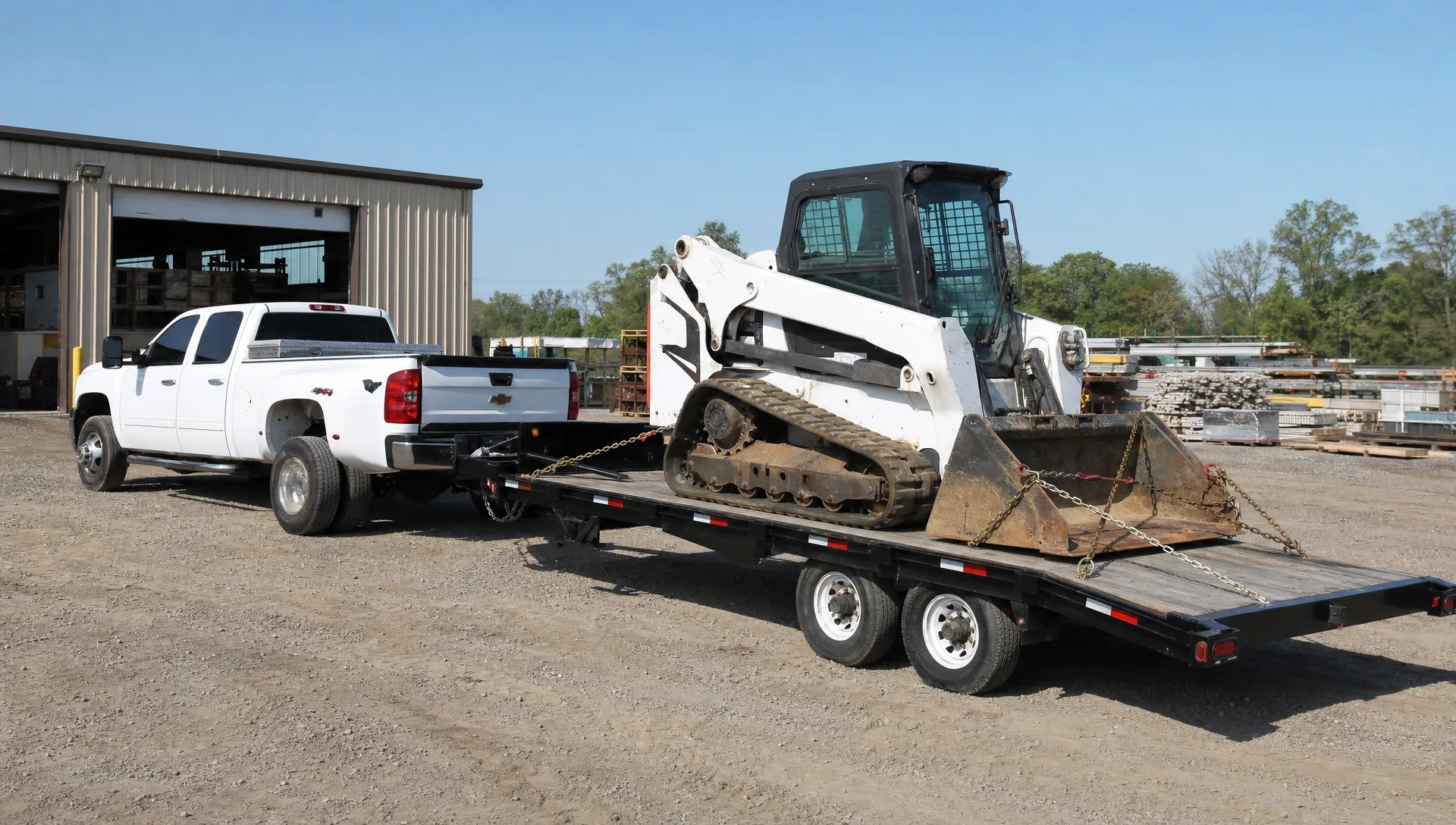
Bumper pull flatbed trailers suit many equipment and material-hauling jobs, but their tongue weight can demand substantial truck payload. If your intended load cannot fit the receiver-hitch setup’s limits, compare a suitable gooseneck flatbed and a properly equipped tow vehicle.
A gooseneck uses a bed-mounted connection rather than a rear receiver. It still imposes hitch load on the truck and must satisfy payload, axle and combined-weight limits. Changing hitch style does not automatically make an overloaded combination acceptable.
For agricultural buyers, first distinguish equipment hauling from livestock transport. These require different trailer designs. Prime Trail Trailers’ Big Bend 6'8"X24' Full Top Stock / Stock Combo Trailer is a gooseneck livestock trailer, not a bumper pull flatbed. Its supplied specifications include two Dexter 8,000 lb rubber torsion axles, a 16,000 lb GVWR and a 7,800 lb payload capacity.
The Big Bend 6'8"X28' 3/4 TOP Stock / Stock Combo Trailer is also a gooseneck livestock model, with a partial-top design and three Dexter 7,000 lb rubber torsion axles with brakes. These stock trailers belong in a livestock comparison, not an open-flatbed capacity comparison.
What to request before buying
Ask for information about the specific unit you are considering, especially when comparing new and used trailers. Similar-looking models can differ in weight, ratings and installed equipment.
When shopping for bumper pull flatbed trailers, request these details before committing:
- Verified ratings: Trailer GVWR, axle ratings and hitch-component capacities.
- Empty weight: Whether the figure includes the actual installed options and accessories.
- Usable dimensions: Deck length, width between fenders and loading clearances.
- Loading limits: Ramp ratings, support requirements and suitable equipment loading positions.
- Condition: Brake operation, tires, bearings, deck condition and signs of structural damage or modification.
- Purchase details: Current pricing, availability and applicable delivery options.
For a broader comparison of trailer types and buying considerations, the Prime Trail Trailers buyer’s guide can help organize your shortlist. Bring your truck’s ratings and a realistic cargo list to the sales conversation.
Frequently asked questions
Does a 14,000 lb GVWR trailer carry 14,000 lb of cargo? No. GVWR includes the trailer’s own weight. A trailer rated at 14,000 lb that weighs 3,500 lb ready to haul has 10,500 lb of available payload, subject to axle, tire, hitch and other limits.
Can a half-ton pickup tow a heavy flatbed? It depends on the exact truck, loaded trailer weight, tongue weight and remaining truck payload. Do not select a trailer based on the “half-ton” label or an advertised maximum towing number alone.
Does a weight-distribution hitch increase towing capacity? No. It can redistribute axle loading when permitted by the manufacturers, but it does not raise the truck’s weight ratings or towing capacity.
How do I determine the right trailer length? Measure the complete load in its transport configuration, including attachments. Allow room for securement and correct weight placement, then verify that the trailer also has sufficient payload and suitable loading equipment.
Find a flatbed that fits your truck and workload
The right bumper pull flatbed trailers provide enough usable payload and deck space without exceeding the truck, hitch or axle limits. Start with your heaviest realistic load, calculate the towing demands and verify the specific trailer’s ratings.
Browse available trailers at Prime Trail Trailers and request pricing or availability for configurations that match your needs. Share your truck specifications, equipment weights and preferred deck dimensions so the sales team can help you compare suitable options.
Have Questions? We're Here to Help
Still unsure which trailer fits your needs, or need specs, pricing or delivery advice? The Prime Trail Trailers team is ready to answer your questions and help you find the right rig.