
How to Inspect Used Trailers Before Making an Offer
A low asking price can hide expensive repairs or ownership problems. Learn what to inspect, when to call a technician and how to turn your findings into a defensible offer.
Quick Summary
A low asking price can hide expensive repairs or ownership problems. Learn what to inspect, when to call a technician and how to turn your findings into a defensible offer.
A low asking price means little if a trailer needs structural repairs, has ownership problems or cannot safely carry your load. Inspecting used trailers before making an offer helps you separate routine maintenance from defects that should stop the purchase. Start with paperwork and load requirements, then examine the trailer cold, operate its equipment and price the work it needs. Do not let fresh paint or a successful trip around the block substitute for a complete inspection.
Prepare before meeting the seller
Ask the seller to leave the trailer unloaded and accessible in daylight on firm, level ground. Request photos of the VIN, certification label, underside and ownership documents before traveling. Also ask about previous loads, accidents, repairs and the last brake and bearing service.
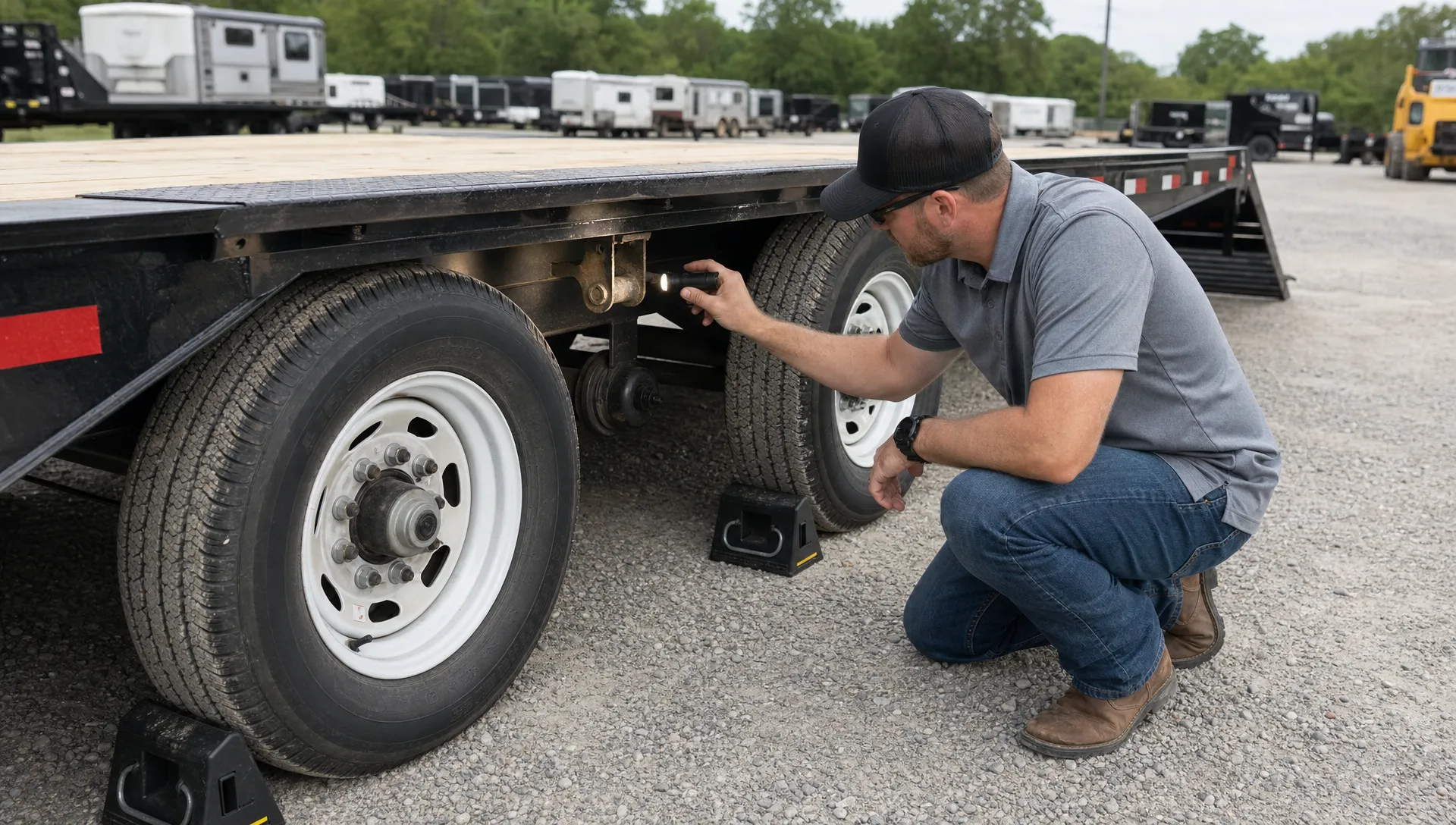
Bring a flashlight, gloves, tape measure, tire-pressure gauge and a way to photograph findings. A compatible tow vehicle and brake controller may be necessary for functional checks, but arrange any towing test with the seller first.
Keep the inspection safe:
- Chock the wheels before stationary checks.
- Use only manufacturer-approved lifting points and properly rated support equipment.
- Never crawl beneath a trailer supported only by a jack.
- Never enter beneath a raised dump body or tilt deck without the manufacturer-required mechanical supports correctly engaged.
For heavier equipment, unexplained repairs or unfamiliar hydraulic systems, arrange an independent trailer technician's inspection before committing money.
Check ownership before inspecting used trailers
Match the VIN on the trailer to the ownership documents. Look for altered characters, disturbed rivets, inconsistent labels or evidence that a VIN plate has been moved. A missing or unreadable label needs resolution, not a verbal explanation alone.
Confirm that the seller owns the trailer or is authorized to sell it. Ask about outstanding liens and obtain the appropriate lien-release documentation when applicable. Registration and title requirements vary by state, trailer weight and other classifications, so verify requirements with your state's motor vehicle agency before paying.
Some trailers may legitimately lack a conventional title under applicable state rules. That does not eliminate the need for a documented ownership chain or confirmation that you can register the unit where you live.
For used trailers, a bill of sale does not automatically resolve an ownership dispute, outstanding lien or registration problem. Record the VIN, seller information, agreed price and any written conditions of sale. Pause the transaction if the identity or ownership cannot be established.
Confirm capacity and towing compatibility
Read the manufacturer's certification label for the gross vehicle weight rating, or GVWR, and gross axle weight ratings, or GAWR. Check tire, wheel, coupler and hitch ratings as well. Replacement components do not automatically increase the trailer's approved capacity.
Payload is not the same as GVWR. As a starting calculation, subtract the trailer's actual empty weight from its GVWR. For example, a hypothetical 10,000 lb GVWR trailer weighing 2,800 lb empty has 7,200 lb remaining before accounting for cargo and anything not included in that empty weight. Added toolboxes, spare tires or other equipment consume capacity.
Published empty weights may not reflect modifications on used trailers. If the available margin is tight, obtain a scale weight and verify axle loading and tongue or pin weight for the intended load.
Your truck's towing capacity, payload, receiver or gooseneck hitch limits and applicable combination ratings must also work together. Prime Trail Trailers' trailer buyer's guide explains how to match these requirements before choosing a size or configuration.
Inspect the frame, tongue and attachment points
Walk around the trailer before looking underneath. Check whether the deck sits reasonably square and whether the tongue, gooseneck structure or rear crossmember appears twisted. Uneven ground can distort appearances, so confirm suspicious findings on a level surface.
Use a flashlight to inspect the main frame rails, crossmembers, suspension mounts, coupler attachment and transitions where the tongue meets the frame. Look closely around weld toes and bolt holes, where movement or fatigue may leave visible evidence.
Light surface rust differs from deep scaling, perforation or substantial metal loss. Fresh coating over rough, swollen steel deserves closer inspection. So do cracked welds, elongated holes, buckled members and reinforcement plates with no repair records.
On used trailers, an undocumented structural repair should trigger professional evaluation rather than an automatic price deduction. A properly designed repair may be acceptable, but an improvised weld can hide a continuing alignment or fatigue problem.
Inspect safety chains, attachment points, the coupler latch and jack. A latch that closes is not proof that the coupler fits the intended ball or that its mechanism is sound. Verify size, rating and condition before connecting.
Examine the deck, ramps and weather protection
Walk the accessible deck and inspect it from below where safely visible. Look for soft wood, split planks, loose fasteners, rusted steel decking and deteriorated crossmembers. New deck boards can conceal an older frame, so inspect both rather than judging the surface alone.
Check ramp hinges, retaining pins, spring assists and ramp attachment points. Bent ramps or damaged pockets may indicate overloading or poor loading alignment. Confirm that ramp capacity and the loading arrangement suit your equipment, including concentrated wheel or track loads.
Water intrusion can make used trailers expensive to restore even when the exterior looks presentable. On enclosed models, inspect roof seams, wall-to-floor joints, door openings and interior corners for staining, corrosion, swelling or musty odors. Test doors and latches without forcing them.
If an enclosed model is your main candidate, the enclosed-trailer buyer's checklist provides a more detailed look at moisture damage and usable loading space.
Check tires, axles, bearings and brakes
Tires and running gear
Check every tire, including the spare, for cuts, cracking, bulges, exposed cords and uneven wear. Confirm the correct size and adequate load capacity. Cold inflation should follow the trailer manufacturer's guidance for the installed tire configuration, not a guess based on appearance.
Read the DOT date code where accessible. For tires made since 2000, the final four digits identify the production week and year. Tire age matters even when tread remains; follow the tire and trailer manufacturers' replacement guidance. The NHTSA tire-safety guide explains tire identification and inspection basics.
Uneven wear can result from inflation problems, worn suspension, alignment issues or bent components. Inspect leaf springs, hangers, shackles, equalizers and visible axle attachments. Do not dismiss a trailer that leans or tracks unevenly as simply needing tires.
Bearings, brakes and breakaway equipment
Ask for service records showing what was done, not just a statement that the bearings were recently greased. On used trailers with unknown service histories, budget for a professional bearing and brake inspection before regular hauling.
With the trailer properly lifted and supported by a qualified person, wheel rotation and play checks can help identify rough bearings, dragging brakes or loose components. External checks alone cannot establish the condition of internal bearings or brake assemblies.
For electric brakes, inspect accessible wiring for damaged insulation, loose connections and poorly protected splices. Have a technician verify brake operation at each equipped wheel. Working lights do not prove the brakes function.
Inspect the breakaway switch, cable, battery and charging arrangement where fitted. Test the system according to its manufacturer's procedure. A battery box or illuminated indicator alone does not prove that the system can apply the brakes effectively.
Operate dump and tilt systems safely
Hydraulic systems on used trailers need more than a quick demonstration that the deck rises. Inspect accessible hoses, fittings, cylinders, wiring and mounting points for leaks, abrasion, corrosion or movement. Ask whether fluid has been repeatedly added and whether any cylinder or pump repairs are documented.
Have the seller demonstrate an unloaded operating cycle according to the manufacturer's instructions. Keep people clear of pinch points and the moving structure. Watch for jerky movement, unusual noise, visible leaks or difficulty lowering. If troubleshooting requires access underneath, stop until the correct mechanical supports are installed.
An empty operating cycle does not prove the system will safely handle a rated load. Persistent drifting, binding or suspected structural movement requires a technician's assessment. Do not improvise a loaded test with unknown material weight.
Compare the actual configuration, not just trailer length
The Double-A 22' Deck Over Hydraulic Tilt Deck listing specifies a 17,500 lb GVW and two 8K axles. For a comparable equipment-hauling configuration, inspect the hydraulic tilt system, deck structure and loading transition, then verify the particular trailer's label and component ratings. Do not infer usable payload from axle ratings alone.
The Double-A 5' X 10' Single Axle Dump Trailer listing specifies a 5,000 lb GVW and electric brakes. On a compact dump trailer of this type, check the dump body, tailgate latches, hydraulic operation and braking system. Soil, gravel and demolition debris must be evaluated by weight, not just whether they fit inside the box.
These configurations illustrate why the inspection must follow the trailer's intended job rather than a generic checklist alone.
Complete a controlled towing check
Only road-test used trailers after the stationary inspection identifies no unresolved safety defects. Confirm the trailer can legally be towed, obtain the seller's permission and use a compatible truck, hitch and electrical connection. Verify the coupler is secured, chains are correctly attached and the jack is fully retracted.
Check running lights, brake lights, turn signals and any required clearance lights before moving. Secure ramps, doors and loose equipment.
In a safe, low-speed area, evaluate tracking, unusual noises and brake response. A trailer that pulls sideways under braking, sways unexpectedly or produces grinding noises needs diagnosis, not a longer test drive. An unloaded test also cannot prove stability or braking performance at full working weight.
Afterward, look again for leaks, shifted components and signs of abnormal hub heating. Avoid touching potentially hot parts. If something changes during the test, document it and stop towing until the cause is understood.
Turn inspection findings into an offer
A useful inspection ends with an itemized decision, not simply a lower number. Separate routine service from safety-critical defects and unresolved ownership concerns.
| Finding | Sensible next step | Effect on the purchase decision | |---|---|---| | Worn tires or aged decking with a sound supporting structure | Obtain replacement estimates | Potentially negotiable when scope is clear | | Unknown bearing and brake service history | Price an inspection and necessary service | Include the work in the acquisition budget | | Hydraulic leakage or inconsistent operation | Obtain a technician's diagnosis | Avoid pricing the repair by guesswork | | Cracked frame, damaged suspension mounts or suspected axle misalignment | Arrange specialist evaluation | Pause until repairability and safety are established | | Unresolved VIN, ownership or lien issue | Require valid documentation and verification | Do not proceed until resolved |
The strongest offers on used trailers are supported by comparable listings and documented repair costs. Compare similar trailer types, dimensions, ratings, loading systems and condition. A basic utility trailer is not a useful price benchmark for a hydraulic equipment trailer just because both have the same deck length.
Calculate your ceiling from the total cost of putting the unit into service:
Maximum purchase price = acceptable ready-to-work value minus immediate repairs, transport, transaction costs and an allowance for unresolved maintenance risk.
Use written estimates when possible. Distinguish mandatory repairs from optional upgrades so the seller can see how you reached your number. For example, defective brakes belong in the immediate repair budget; a toolbox you would like to add is a separate preference.
Compare used trailers against suitable new options as well. If purchase price plus necessary repairs approaches the cost of a better-documented alternative, the apparent bargain may offer little value. Do not use a larger contingency allowance to justify buying a trailer with an unassessed structural defect.
Frequently asked questions
Should I buy a used trailer without a title? Only after verifying your state's requirements and confirming that the seller's documents establish ownership and allow registration. Some trailers may be exempt from titling, but an unexplained missing title is not the same as a lawful exemption.
Is surface rust a reason to reject a trailer? Not necessarily. Light surface corrosion can be manageable, while deep scaling, perforation, cracked welds and deterioration around suspension mounts require closer evaluation. Judge remaining structural condition rather than paint appearance.
Can I inspect a trailer without towing it? You can assess many items while stationary, but that leaves tracking and real brake response unverified. If a safe, legal road test is unavailable, make the offer contingent on professional inspection or choose another trailer.
Are used trailers worth buying if service records are missing? They can be, provided ownership is clear, the condition is professionally assessed where needed and the price leaves room for inspection and baseline service. Missing records increase uncertainty; they do not prove either good or bad condition.
Choose a trailer you can put to work confidently
Before making an offer, confirm ownership, verify capacity, inspect the structure and obtain answers about every safety-related defect. The right deal on used trailers is one that still makes sense after repairs, transportation and downtime are included.
Browse available trailers at Prime Trail Trailers to compare new and used options. Contact the sales team for help matching your load, tow vehicle and budget to a suitable configuration, and request current pricing and availability before deciding.
Have Questions? We're Here to Help
Still unsure which trailer fits your needs, or need specs, pricing or delivery advice? The Prime Trail Trailers team is ready to answer your questions and help you find the right rig.
Prime Trail Trailers
Prime Trail Trailers is a family-owned trailer dealer in Markle, Indiana, stocking utility, dump, enclosed, equipment, car hauler and gooseneck trailers with nationwide delivery. This guide is based on what our customers ask us most and the trailers we sell every day.
More about Prime Trail Trailers