
Small Cargo Trailer Buying Guide for Work and Weekend Use
The right trailer must fit more than your gear. Learn how to compare usable space, loaded weight and door access. Use practical checks to choose a setup that handles weekday work and weekend hauling.
Quick Summary
The right trailer must fit more than your gear. Learn how to compare usable space, loaded weight and door access. Use practical checks to choose a setup that handles weekday work and weekend hauling.
A small cargo trailer should handle your weekday tools without becoming an oversized burden on weekend trips. The right choice depends on what fits through the doors, how much the loaded trailer weighs and whether your vehicle can tow it safely. Advertised floor dimensions alone will not answer those questions.
For contractors, small-business owners and personal-use buyers, the best purchase is usually the smallest enclosed trailer that accommodates the complete load, securement equipment and practical loading space. This guide explains how to compare sizes, capacities, door styles and purchase costs, including two Continental Cargo Tailwind configurations to consider when narrower options fall short.
Start with two load plans: work and weekend
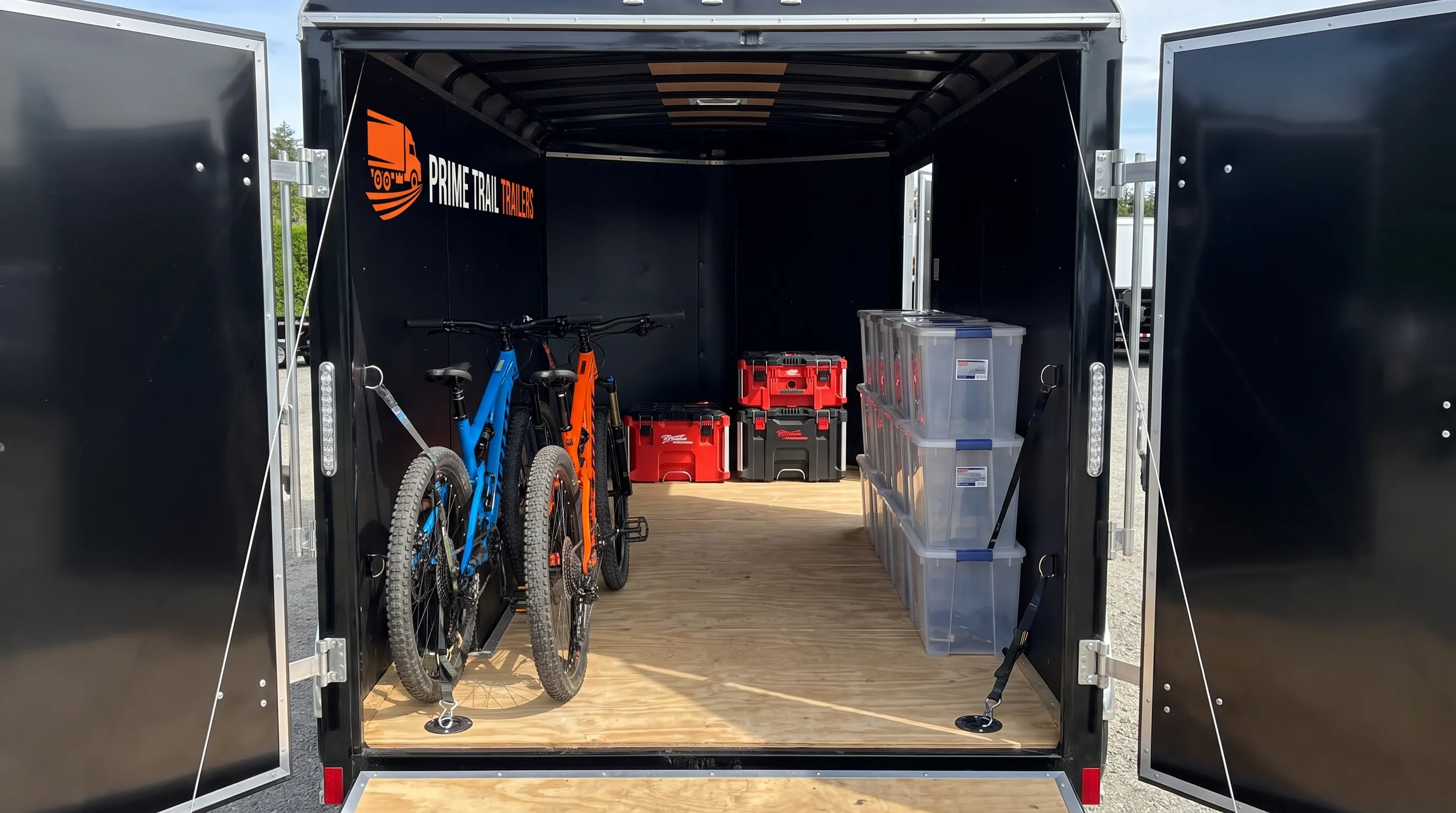
Before comparing listings, write down what you will carry on a normal workday and on your largest realistic weekend trip. A contractor might transport rolling toolboxes, a compressor and installation materials during the week, then bicycles and camping gear on Saturday.
Measure the longest, widest and tallest items in their transport position. Include handles, mower attachments, storage cases and anything that cannot be folded or removed. Then estimate their weights using manufacturer specifications or a scale rather than appearance.
Your layout also needs room to work. If retrieving one toolbox requires unloading everything behind it, the trailer may technically fit the load but still waste time at every stop. Sketch where heavy items, frequently used tools and weekend cargo will sit.
For a dual-purpose setup, removable bins often make more sense than permanent cabinets. They let you change the load without carrying unnecessary cabinetry all week.
Choose a small cargo trailer size around usable space
There is no single size that defines this category. A homeowner carrying storage totes may consider a 5-foot-wide model sufficient, while a trade business may need a wider enclosure for equipment and access.
Use these nominal sizes as a starting point, not as confirmation of interior measurements or current inventory:
| Nominal size | Possible work and weekend fit | Main point to verify | |---|---|---| | 5 × 8 feet | Hand tools, moving boxes and compact recreational gear | Clear door opening and space around the load | | 6 × 10 feet | Rolling toolboxes, service supplies and larger household items | Interior height and loaded weight | | 6 × 12 feet | Mixed equipment loads or longer recreational gear | Access after everything is secured | | 7 × 12 feet | Wider equipment or a more organized trade layout | Exterior width, storage space and towing compatibility | | 7 × 14 feet | Longer equipment or additional work storage | Whether the added size is necessary for regular use |
Ask for usable interior length, width and height, plus the rear opening dimensions. Nominal dimensions do not establish clearance around door hardware, wheel boxes or installed shelving.
Measure the parking location too. Overall trailer length includes the tongue, while exterior height can exceed the doorway clearance of a residential garage. Leave room to open the rear doors or lower the ramp where you intend to load.
Check towing limits before choosing equipment
A small cargo trailer can still exceed a vehicle’s limits once tools, accessories and supplies are aboard. Do not choose by appearance, axle count or an advertised maximum towing figure alone.
Check the tow vehicle’s ratings for its exact configuration, along with the receiver, hitch ball and ball mount ratings. Passengers, truck-bed cargo and trailer tongue weight also consume the tow vehicle’s available payload. The combination must remain within all applicable vehicle, axle, hitch and trailer limits.
Calculate payload with the finished setup in mind
Available trailer payload starts with GVWR minus actual empty weight. Gross vehicle weight rating, or GVWR, is the maximum permitted weight of the trailer and everything it carries.
For a hypothetical example, a trailer rated at 2,990 pounds with an actual empty weight of 1,200 pounds has 1,790 pounds available before additional equipment and cargo. Installing 250 pounds of shelving, a spare tire and accessories would leave 1,540 pounds for the remaining load.
Those figures illustrate the calculation; they are not specifications for either product discussed below. Confirm the certification label and the weight of the actual unit, especially when comparing used or modified trailers. Dense hardware, batteries and supplies can consume capacity before the enclosure looks full.
Account for tongue weight and braking
When matching a small cargo trailer to your vehicle, check tongue weight as carefully as total trailer weight. For many conventional bumper-pull trailers, guidance commonly calls for approximately 10% to 15% of loaded trailer weight on the hitch, but follow the trailer and vehicle manufacturers’ requirements.
Verify the loaded combination on appropriate scales rather than relying only on estimates. A rear-heavy load can contribute to sway, and moving equipment to fix balance may change how useful your floor plan is.
Confirm brake equipment, electrical connections and whether a compatible brake controller is required. Trailer-brake requirements vary by state and operating circumstances, so check the rules that apply to your route. Compact dimensions do not establish whether brakes are required.
Choose rear doors around your loading routine
A ramp door suits loads that roll, provided its rating and dimensions match the equipment. Check the weight it must support during loading, including an operator when applicable, as well as ramp angle, traction and rear clearance. Low-clearance equipment may need a shallower approach than the trailer provides.
Barn doors suit hand-loaded tools, boxes and materials when a full-width loading ramp is unnecessary. They also avoid occupying the ground space needed by a lowered ramp, although the doors still need room to swing and stay secured while open.
The right small cargo trailer should simplify your most frequent loading task. Buying a ramp for occasional use can be worthwhile, but only if its benefits outweigh the space and handling requirements at your normal job sites and parking spots.
Two Tailwind configurations worth comparing
The Universal Trailers 7' X 12' Continental Cargo - Tailwind Model w/ Barn Doors is relevant when a narrower enclosure will not accommodate your layout and rear access primarily involves carrying tools, equipment or materials inside. Its listed barn-door configuration gives buyers a specific alternative to compare against ramp-door models.
The Universal Trailers 7' X 14' Continental Cargo - Tailwind Model w/ Ramp Door is worth reviewing when you need additional nominal floor length and ramp access for loading equipment. It represents a step up in space rather than an automatic recommendation for every compact-trailer shopper.
Before choosing either, request the actual unit’s payload, interior dimensions, rear opening measurements and relevant door or ramp ratings. Confirm current pricing and availability rather than assuming the model name supplies every specification.
Make one trailer work for both uses
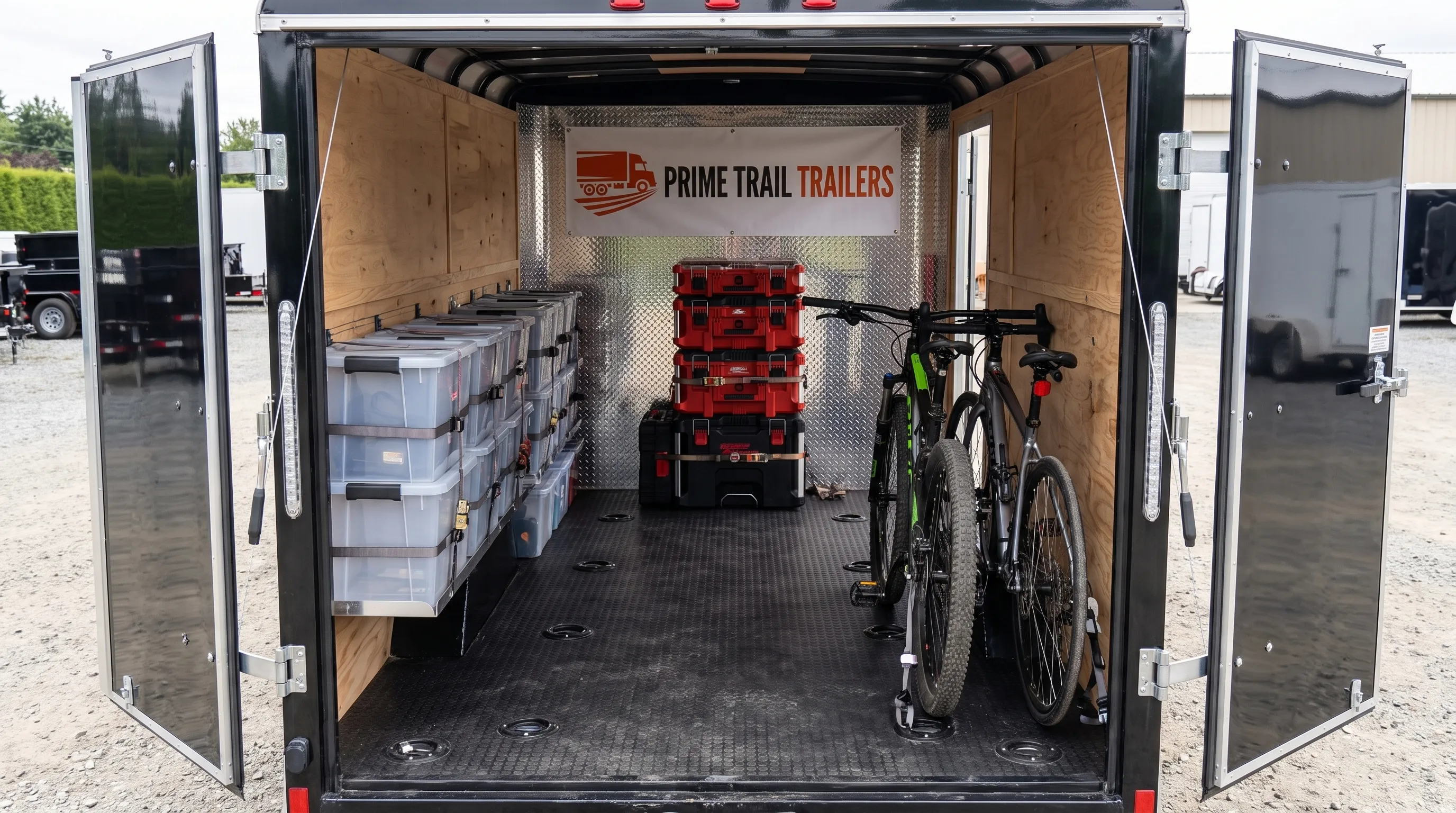
The most useful dual-purpose layout separates permanent necessities from cargo that changes. Keep frequently needed securement equipment accessible, then use removable containers for trade supplies and recreational gear.
Outfit a small cargo trailer around both load plans before committing to permanent shelving. Cabinets consume payload and floor space even when empty, and a layout designed solely around weekday tools may block longer weekend gear.
Use rated attachment points and suitable restraints for the load. Do not assume wall panels, shelves or unverified floor rings can secure heavy equipment. Cargo needs restraint against movement, not simply enough surrounding boxes to hold it in place.
An enclosed body provides separation from road spray and weather exposure, but it does not guarantee freedom from leaks, condensation or theft. Inspect weather seals, secure the trailer when parked and let wet equipment dry before extended storage. Never transport passengers inside the cargo compartment or operate fuel-burning equipment inside it.
Compare new and used units by condition, not appearance
A clean exterior does not establish that the roof, floor or running gear is sound. On any unit, check the doors, seals, floor, lighting, coupler and visible wiring. Verify that identification and ownership documents match the trailer.
A used small cargo trailer deserves particular attention around roof seams, lower wall edges and door thresholds. Stains, soft flooring, musty odors or swollen panels can indicate moisture problems that fresh paint will not resolve. Look underneath for corrosion, damaged members and questionable repairs.
Check tire condition, load ratings and manufacturing dates, then assess bearings and brakes as equipped. NHTSA’s tire-safety guidance explains why correct inflation and attention to tire age matter. Use the trailer manufacturer’s specified cold inflation guidance rather than treating the tire sidewall maximum as the default setting.
For a more detailed evaluation, Prime Trail Trailers’ guide to inspecting used cargo trailers before buying covers the structure, running gear and paperwork. Have uncertain structural, bearing or brake conditions evaluated before purchase.
Compare the complete purchase cost
A lower advertised price may not produce the lower-cost setup. One trailer may need tires, repairs or loading equipment immediately, while another may better match your intended use without modifications.
Request comparable quotes for the small cargo trailer configurations you are seriously considering. Each quote should identify the unit, included equipment, applicable charges and anything needed before you can tow it home or put it to work.
Keep the comparison focused on four categories:
- Trailer and transaction costs: Confirm the unit price, taxes, title or registration requirements and any applicable dealer charges.
- Tow-vehicle setup: Account for compatible hitch components, wiring and a brake controller when required.
- Working equipment: Include restraints, rated attachment points, storage and any loading accessories your plan requires.
- Delivery or pickup: Compare the delivery quote with travel, fuel and time required to collect the trailer yourself.
Prime Trail Trailers offers new and used trailers, sales assistance and nationwide delivery options. Ask for unit-specific pricing and delivery details rather than assuming every location or trailer has identical arrangements.
Frequently asked questions
What size is best for work and weekend use? Start with both complete loads, then check interior dimensions, door clearance and payload. A 5 × 8 or 6 × 10 layout may suit compact gear, while wider or longer equipment may justify a larger model. Dimensions alone cannot establish suitability.
Can an SUV tow a small cargo trailer? Some SUVs can, but the answer depends on the exact vehicle configuration and the trailer’s loaded weight. Check towing capacity, available payload, tongue-weight limits, hitch ratings and braking requirements. Do not assume every SUV is approved to tow.
Are barn doors or a ramp better? A ramp is generally more convenient for wheeled equipment when its rating and approach angle are suitable. Barn doors work well for hand-loaded cargo. Compare how each arrangement functions in your driveway, storage area and usual job-site conditions.
Is a 7 × 14 trailer too large for occasional use? It may be if your normal load fits comfortably in a shorter model. Extra space is useful when genuinely needed, but it also increases parking requirements and may add weight. Compare the actual units rather than assuming bigger provides better value.
Should I buy new or used? Compare condition, documented specifications and total ready-to-use cost. A used unit may make sense when its structure and systems are sound. A new unit may better suit a buyer who wants an unmodified starting point, but both still need inspection and towing verification.
Find the right fit at Prime Trail Trailers
Choose a small cargo trailer that fits your real load, your tow vehicle and the places you use it. Confirm usable dimensions and loaded capacity first, then compare door access, condition and the complete purchase cost.
You can browse trailers at Prime Trail Trailers and request help comparing available units. Share your heaviest load, largest cargo dimensions, vehicle details and delivery location so the sales team can help you narrow the options and request current pricing.
Have Questions? We're Here to Help
Still unsure which trailer fits your needs, or need specs, pricing or delivery advice? The Prime Trail Trailers team is ready to answer your questions and help you find the right rig.
Prime Trail Trailers
Prime Trail Trailers is a family-owned trailer dealer in Markle, Indiana, stocking utility, dump, enclosed, equipment, car hauler and gooseneck trailers with nationwide delivery. This guide is based on what our customers ask us most and the trailers we sell every day.
More about Prime Trail Trailers