
Used Enclosed Trailers for Sale: A Smart Buyer’s Checklist
A low asking price can hide expensive repairs or paperwork problems. Learn how to verify condition, calculate usable payload and compare total costs. Use this checklist to separate a workable hauling investment from a costly project.
Quick Summary
A low asking price can hide expensive repairs or paperwork problems. Learn how to verify condition, calculate usable payload and compare total costs. Use this checklist to separate a workable hauling investment from a costly project.
Shopping for used enclosed trailers for sale means judging more than the asking price. A clean exterior can hide water-damaged flooring, overdue brake work or paperwork that will delay registration. The best purchase is a trailer that fits your load, can be transferred legally and still makes financial sense after repairs, transportation and setup.
Use this checklist to screen listings, inspect serious candidates and compare the total cost before committing. For contractors and business owners, avoiding downtime matters just as much as saving on the purchase price.
Start with the load you actually haul
Before contacting sellers, write down your heaviest normal load and the space it requires. Include equipment, tools, shelving, spare parts and supplies, not just the largest machine.
Measure the cargo’s width, height and length, then allow room to load, secure and unload it. Advertised trailer dimensions do not establish the usable interior space or rear door opening. A mower might fit inside but fail to clear the doorway; a vehicle might fit through the opening but leave no room to exit or attach straps.
Your initial buying requirements should cover:
- Usable space: Interior dimensions, clear door opening and room around the cargo.
- Weight capacity: Enough verified payload for equipment and permanently installed accessories.
- Loading access: Suitable ramp capacity, loading angle and side-door access.
- Towing compatibility: A loaded trailer that stays within the truck, hitch, receiver and other applicable ratings.
When comparing used enclosed trailers for sale, reject unsuitable configurations before spending time on condition or price negotiations.
Verify ownership before arranging payment
Ask for the VIN, manufacturer’s identification label and ownership documents early. Compare the VIN on the documents with the trailer itself, including any frame marking where applicable. Investigate mismatches, missing labels or identification that appears altered before proceeding.
The seller should have authority to transfer ownership. If a lien exists, establish how it will be released and verify the process directly with the lender. A bill of sale alone may not satisfy your state’s requirements.
Registration and title rules vary by state and trailer classification. Check with your state motor vehicle agency before buying an untitled trailer or one coming from another state. Do not assume that a trailer registered without a title elsewhere can be registered the same way where you live.
NHTSA’s VIN decoder can help check manufacturer information when a VIN is supported, but it does not establish ownership, clear liens or provide a complete damage history.
Among used enclosed trailers for sale, unresolved ownership issues deserve priority over cosmetic defects. Settle the paperwork question before paying for repairs, delivery or a nonrefundable commitment.
Screen distant listings before you travel
Request current photographs of the actual unit, not just exterior listing photos. Useful views include the roof edges, underside, floor perimeter, rear threshold, coupler, identification label and tire sidewalls. Ask for close-ups of repairs, stains and damaged areas.
Discuss previous use. A trailer that carried landscaping equipment may have experienced wet floors and concentrated wheel loads. A mobile workshop may have added considerable weight through cabinets, batteries and interior finishes. Neither history automatically rules it out, but both affect what to inspect.
Ask when the bearings, brakes and tires were last serviced, then request records. “Recently serviced” is less useful than an invoice describing the work.
For a remote purchase, consider an independent inspection by a qualified trailer service shop. Verify the seller’s identity and business details independently before sending money. A shipping arrangement does not replace verification of the trailer or its condition.
Inspect used enclosed trailers for sale beyond the exterior panels
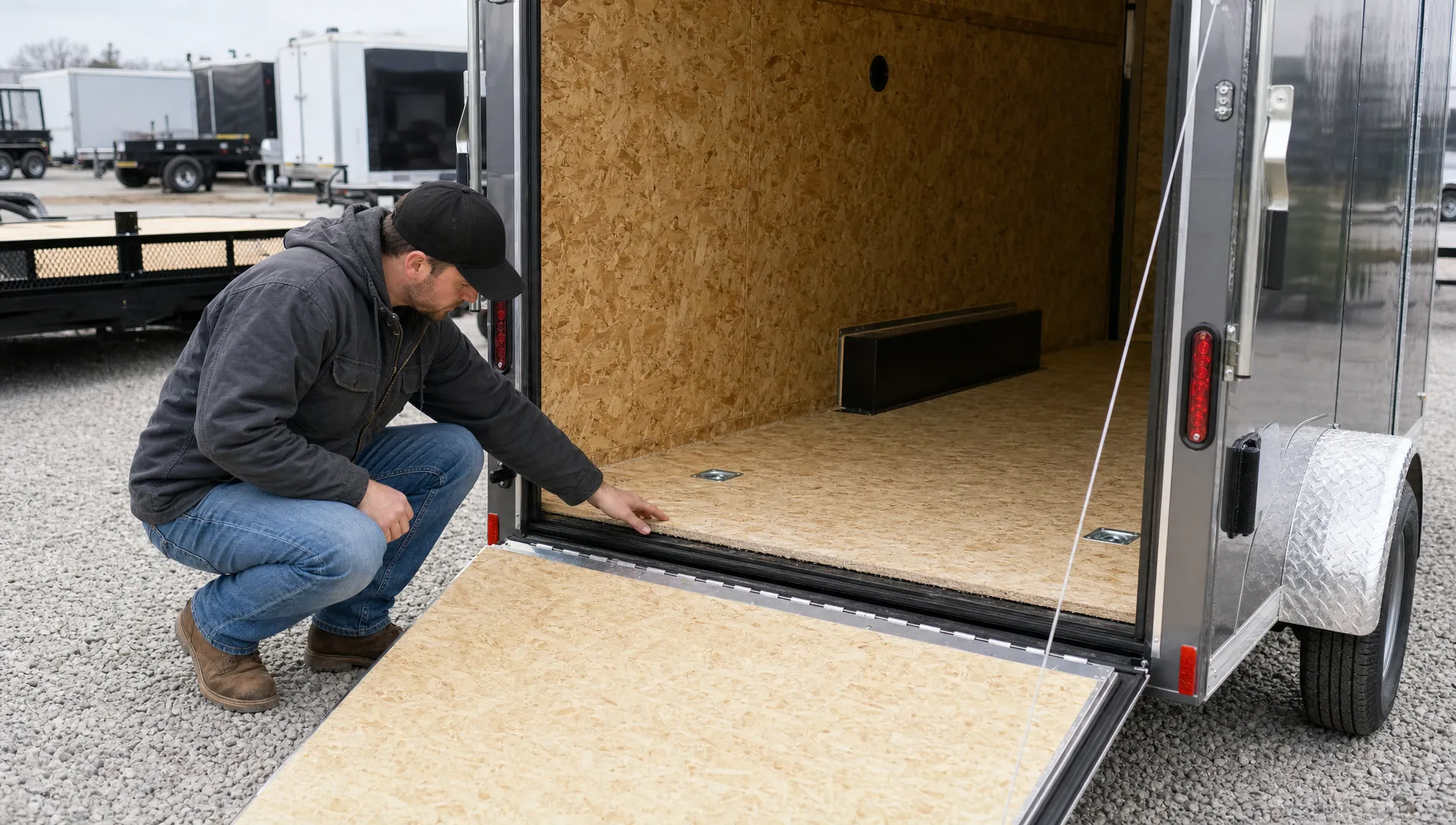
Exterior dents can be inexpensive to live with. Concealed rot, weakened structural members and failed running gear can change the economics completely. Inspect in daylight with the trailer empty enough to expose the floor and walls.
Trace water intrusion to its source
Check roof seams, corner trim, door seals, vents and previous fastener holes. Inside, look for staining, swollen panels, soft flooring, musty odors and fresh coverings that prevent inspection of older surfaces.
Pay particular attention to floor edges, the rear threshold and areas beneath side doors. Inspect accessible areas from below as well as above, without getting underneath an unsupported trailer.
Fresh sealant is not proof that a leak has been repaired. Ask what leaked, how long it leaked and whether damaged material was replaced. If flooring or wall liners conceal the affected area, get permission for further inspection or price the uncertainty into your decision.
A used trailer should not be described as structurally sound solely because its floor feels firm in the center. Hidden perimeter damage can remain after the obvious wet spot dries.
Separate cosmetic wear from structural concerns
Use the following findings to decide what needs a repair quote and what requires a qualified assessment.
| Finding | What it may mean | Buying response | |---|---|---| | Small siding dents with intact seams | Cosmetic wear | Compare appearance and price | | Soft floor near doors or wall edges | Possible moisture damage | Establish the full repair scope | | Cracked welds, bent frame members or severe corrosion | Potential loss of structural integrity | Pause pending professional assessment | | Uneven tire wear | Possible alignment, suspension, pressure or loading problems | Diagnose the cause before replacing tires | | Added wiring, shelving or wall openings | Modified electrical systems, weight or weather sealing | Check workmanship and document changes |
The strongest candidates among used enclosed trailers for sale have explainable wear and documented repairs, rather than damage the seller cannot account for.
Check tires, brakes, bearings and doors
Inspect tire condition, load ratings and date codes, not just tread depth. Look for cracking, bulges and uneven wear. Include the spare, if supplied, in your assessment.
Have a qualified technician evaluate wheel bearings, hubs, brakes, suspension and the breakaway system. Verify lights, wiring and connector operation. Maintenance records help, but they do not replace a present-condition inspection.
Operate the side door and rear door fully. Check hinges, latches, weather seals and ramp hardware. Do not adjust loaded ramp springs or cables yourself. Door binding may be a hardware issue, but it can also warrant checking whether the opening is square.
For additional component-level checks, use Prime Trail Trailers’ guide to what to inspect on a cargo trailer before buying.
Confirm payload and ramp capacity separately
GVWR is the maximum rated loaded weight of the trailer, not the amount of cargo it can carry. A practical starting calculation is:
Available payload = GVWR minus the trailer’s actual empty weight.
Account for installed shelving, spare tires, batteries and other equipment. When modifications or weight figures are uncertain, a scale measurement provides a better starting point than an old advertisement.
An axle upgrade does not automatically increase the manufacturer’s GVWR. Likewise, a trailer’s overall weight rating does not establish its ramp capacity or the strength of individual tie-down points.
Capacity mistakes can erase the savings on used enclosed trailers for sale, particularly when a buyer discovers that a loaded work setup exceeds the available payload.
Use listed configurations as comparison points
Prime Trail Trailers lists a Double-A 8'6" x 16' Ruger Series with ramp door and HD 14K GVWR with a stated empty weight of 4,000 pounds. Subtracting that figure from its 14,000-pound GVWR gives a 10,000-pound payload baseline, before accounting for any additional equipment or differences in the actual unit’s weight. Ramp, floor, securement and tow-vehicle limits still require separate verification.
The Double-A 7.5' x 16' Ruger Series with ramp door, 10K GVWR and extra-tall configuration offers another useful specification reference. For tall equipment, verify the actual door clearance rather than relying on the extra-tall description. Its payload cannot be calculated from GVWR alone without an empty-weight figure.
These product pages are configuration references, not confirmation that either listed unit is used or currently available. Confirm condition, specifications and availability with the sales team.
Compare total ready-to-work cost, not sticker price
Build the same cost worksheet for every serious candidate. Start with the asking price, then add applicable taxes and registration, transportation, immediate repairs and changes required for your work.
Separate essential repairs from preferences. Safe tires, functioning brakes and a sound floor are not equivalent to adding cabinets or changing exterior graphics. Get written estimates for substantial repairs before negotiating.
As a hypothetical example, a $6,000 trailer needing $1,500 in immediate work costs $7,500 before taxes, transportation and setup. That does not automatically make it a bad purchase, but it changes the comparison with a more expensive trailer that needs less work.
For commercial use, consider scheduling as well. A trailer awaiting floor replacement cannot carry equipment to the next job, and temporary rental or transport costs may reduce the apparent savings.
Comparing used enclosed trailers for sale against an equivalent new configuration also helps establish whether the discount justifies the condition risk. Match dimensions, GVWR, door design and included equipment rather than comparing unlike trailers. Prime Trail Trailers’ new-versus-used trailer buying guide provides broader context for that decision.
Avoid treating any asking price as proof of market value. A seller’s price is one input; verified condition and comparable specifications are more useful.
Turn inspection findings into a purchase decision
Negotiate with specific findings rather than a general request for a discount. A brake-service estimate or documented floor repair creates a clearer discussion than saying the trailer looks worn.
Use three outcomes to keep the decision practical:
- Proceed: Ownership is clear, the configuration fits and inspection supports the price.
- Renegotiate or inspect further: Repairable defects have a defined scope, or a specialist needs to resolve a specific concern.
- Walk away: Ownership remains unresolved, identification is suspicious or the seller will not allow reasonable verification of serious damage.
Put the agreed price, trailer identification, included equipment and any promised work in writing. Clarify pickup or delivery arrangements and verify completed repairs before accepting the trailer.
The right choice among used enclosed trailers for sale is not necessarily the least expensive listing. It is the one whose legal status, working capacity and condition you can verify at an acceptable total cost.
Frequently asked questions
Is a used enclosed trailer a good investment? It can be when it protects valuable cargo, supports regular work and costs less overall than suitable alternatives. Evaluate expected use, maintenance, storage and repair exposure. For occasional hauling, compare ownership costs with rental before buying.
How much should I pay for a used enclosed trailer? There is no reliable universal price without knowing its dimensions, GVWR, construction, age and condition. Compare similar configurations, subtract documented repair costs from your budget and check current alternatives before making an offer.
Should I buy a used trailer without a title? First confirm your state’s requirements for that specific trailer. Some transactions may legally use other documentation, but missing required ownership records can prevent registration. Have the seller resolve documentation problems before payment rather than relying on a promise that they are easy to fix.
Can I tow it home immediately after buying? Only after verifying roadworthiness, required registration or permits, towing compatibility, hitch connections, tires, lights and brakes where fitted or required. If those checks cannot be completed, arrange appropriate transport instead.
Compare your options with Prime Trail Trailers
Before buying, bring together your cargo measurements, expected loaded weight, tow-vehicle information and inspection findings. Those details make it easier to compare used enclosed trailers for sale without sacrificing capacity or accepting avoidable repair risk.
Browse available trailers at Prime Trail Trailers and ask the sales team about current enclosed trailer options. Request the specifications, condition information and pricing needed to make a confident comparison.
Have Questions? We're Here to Help
Still unsure which trailer fits your needs, or need specs, pricing or delivery advice? The Prime Trail Trailers team is ready to answer your questions and help you find the right rig.
Prime Trail Trailers
Prime Trail Trailers is a family-owned trailer dealer in Markle, Indiana, stocking utility, dump, enclosed, equipment, car hauler and gooseneck trailers with nationwide delivery. This guide is based on what our customers ask us most and the trailers we sell every day.
More about Prime Trail Trailers