
What to Look for in a Vehicle Trailer Before You Tow
Before you tow, make sure the trailer, truck and load work together. Learn which ratings, loading clearances and safety checks matter, plus what to confirm with a dealer before choosing a new or used trailer.
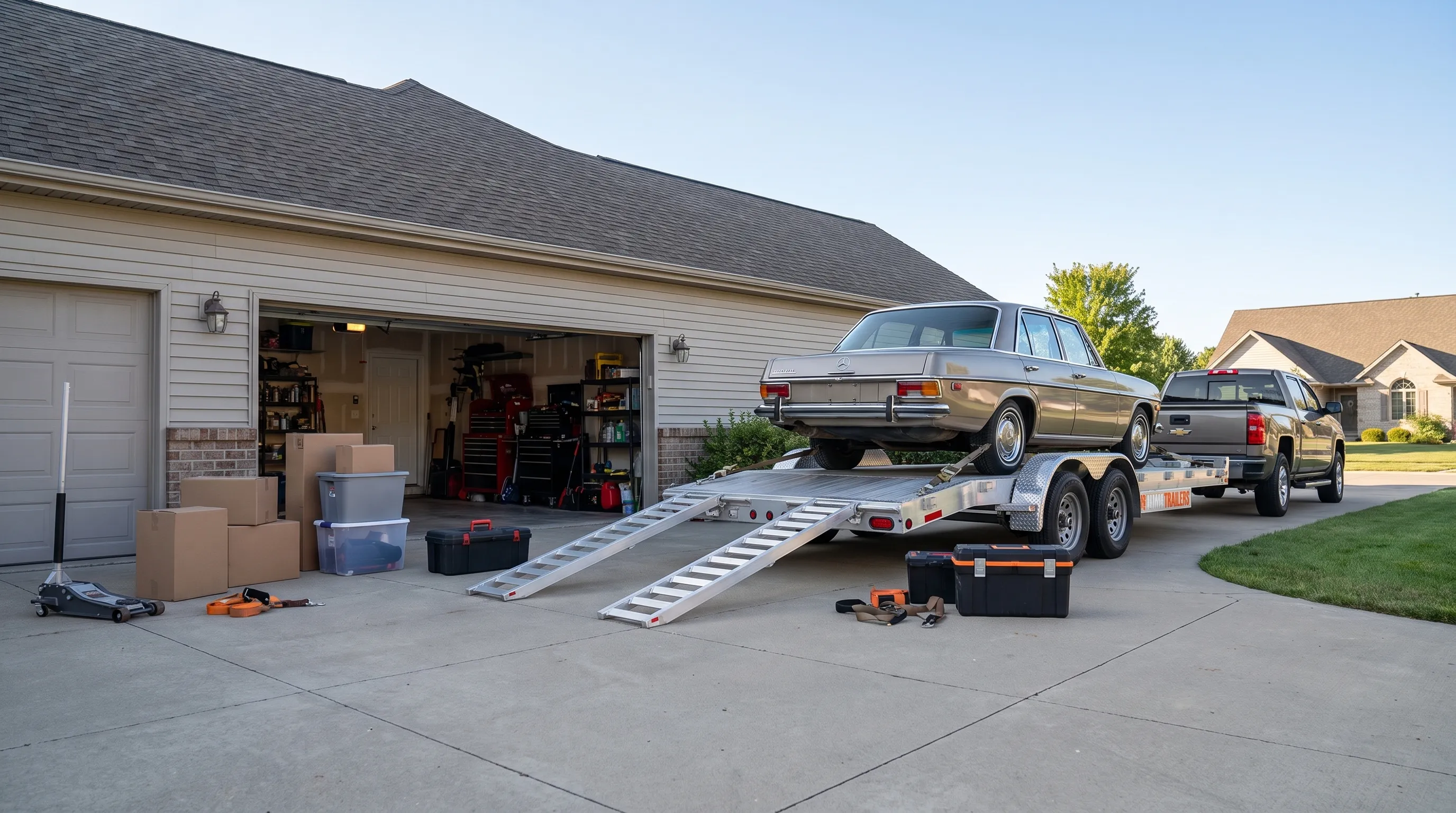
A vehicle trailer needs to do more than hold the car, truck or equipment you plan to haul. Its loaded weight, hitch connection, loading geometry and braking system must work with your tow vehicle. A trailer can have enough deck space and still exceed your truck’s limits or leave a low-clearance vehicle unable to climb the ramps.
Before buying or heading onto the road, check the entire towing setup. The following inspection sequence helps you identify mismatches, compare trailers accurately and know what to ask a dealer before committing.
Start with the ratings, not the deck size
GVWR is not payload capacity. Gross vehicle weight rating is the maximum permitted loaded weight of the trailer, including the trailer itself. Payload is what remains for the transported vehicle, tools, spare tires and other cargo after accounting for the trailer’s actual empty weight.
Check the certification label and manufacturer documentation rather than relying on an advertisement’s headline capacity. Your tow vehicle has separate limits that also matter.
| Rating or measurement | What it tells you | What to verify | |---|---|---| | Trailer GVWR | Maximum permitted loaded trailer weight | Trailer weight plus all cargo stays within this rating | | Trailer GAWR | Maximum load allowed on an axle | Each axle stays within its individual rating | | Trailer empty weight | Weight before adding cargo | Figure reflects the trailer’s installed options | | Tow rating | Vehicle’s permitted trailer weight for its configuration | Rating matches the engine, drivetrain and towing equipment | | Tow vehicle GVWR | Maximum loaded weight of the truck or SUV | Passengers, cargo, hitch equipment and tongue weight are included | | GCWR | Maximum combined weight of the tow vehicle and trailer | Actual combined weight stays within the manufacturer’s limit | | Hitch and coupler ratings | Limits of the connection components | Every component is suitable for the load |
The usable capacity of a vehicle trailer depends on all applicable limits, not simply the largest number in the listing. Axles, tires, hitch components and the tow vehicle must each remain within their ratings.
Work through a realistic payload example
Suppose a trailer has a 10,000-pound GVWR and an actual empty weight of 2,500 pounds. Its calculated payload capacity is 7,500 pounds.
A 5,800-pound vehicle plus 400 pounds of tools and accessories creates a 6,200-pound cargo load. The loaded trailer would weigh approximately 8,700 pounds. That fits within the trailer’s GVWR, but it does not establish that your truck can tow it.
You still need to check the truck’s tow rating, available payload, rear axle rating and hitch limits. Passengers, bed cargo and hitch hardware reduce the payload available to carry tongue weight.
When weighing the combination, add the scale readings for the truck’s axles and trailer’s axles to obtain the combined weight. Do not add tongue weight again, because it is already carried on the truck’s axles. Determining the trailer’s total loaded weight separately requires accounting for both its axle load and the weight supported at the hitch.
Will the vehicle trailer fit your load?
Deck length and width are only part of the fit check. Measure the transported vehicle’s overall length, tire track width, wheelbase and ground clearance. Then compare those measurements with the trailer’s usable dimensions, not just its advertised size.
On a between-fender car hauler, fenders may restrict door opening or clearance around wide tires. An enclosed trailer needs sufficient interior width and height, rear door clearance and room to reach tie-down points. A deck-over design removes between-fender restrictions, but deck height and loading angle deserve particular attention.
Inspect ramps, transitions and anchor access
Check the ramp rating for your intended load and how that rating is defined. A rating for a pair of ramps is not necessarily the rating for each individual ramp. Verify the mounting method, usable width and support requirements as well.
Low cars can scrape at the bottom of a ramp or where the ramp meets the deck. Long-wheelbase vehicles may encounter clearance problems even when their front bumper clears the approach. Tilt decks change the loading process, but they do not eliminate the need to check clearance and operating instructions.
For heavier or wider loads, the 24' Double-A Heavy-Duty Deck Over Trailer (15,400LBS GVW - 2:7K Axles) is a relevant model to compare. Before calculating payload or planning vehicle loading, confirm its certified ratings, as-equipped empty weight, usable deck dimensions and loading equipment specifications with Prime Trail Trailers. The listing’s GVW label should not be treated as cargo capacity.
Match the hitch connection to the complete load
Inspect the receiver, ball mount, hitch ball and coupler as individual components. The ball diameter must match the coupler, and each component must have adequate trailer-weight and tongue-weight ratings for the intended setup.
A properly rated receiver does not compensate for an underrated ball mount. Likewise, using a larger truck does not correct a damaged coupler or an incorrectly installed hitch.
Once loaded, a conventional trailer should sit approximately level when hitched, subject to its manufacturer’s instructions. Excessive nose-up or nose-down positioning can affect axle loading, clearance and handling. Select the correct ball-mount rise or drop rather than improvising the connection.
For a vehicle trailer with a conventional ball hitch, manufacturer guidance often calls for tongue weight around 10% to 15% of loaded trailer weight. Follow the requirements for the specific trailer and tow vehicle; do not apply that range automatically to gooseneck setups.
If weight distribution is required or permitted, verify compatibility with the tow vehicle, receiver and trailer. It does not increase their published ratings. Gooseneck trailers also require a compatible truck-bed hitch, adequate bed clearance and careful consideration of pin weight.
Verify brakes, wiring and breakaway equipment
Brake requirements vary by state, trailer weight and operating circumstances. Check the rules that apply to your route and use, particularly for commercial hauling. Legal minimums also do not replace the tow vehicle manufacturer’s requirements.
Confirm which axles have brakes and whether the system uses electric, hydraulic surge or electric-over-hydraulic actuation. The tow vehicle must have the controls and electrical compatibility the system requires. A connector that fits physically does not prove that every circuit functions correctly.
Before towing a vehicle trailer, test the running lights, brake lights, turn signals and braking system. Check connector pins for corrosion, loose wiring and damage near moving components.
If fitted, inspect the breakaway switch, cable and battery according to the equipment manufacturer’s procedure. Attach the cable to the specified point on the tow vehicle independently of the safety chains. Confirm the battery can operate the brakes rather than assuming it is charged because the trailer lights work.
For a used unit with uncertain brake condition, arrange an inspection before highway towing. Set the brake controller according to its instructions and verify braking in a controlled, low-speed area before entering traffic.
Inspect tires, wheels, bearings and structure
Look beyond tread depth. Trailer tires can deteriorate from age, prolonged storage, underinflation or overload. Check for sidewall cracks, bulges, exposed cords and uneven wear, then verify tire size, load rating and speed rating.
Use the trailer and tire manufacturers’ guidance for cold inflation pressure. Do not copy the pressure from another trailer or assume a passenger-car tire is a suitable replacement. The NHTSA tire safety guidance explains pressure checks, tire identification and age-related considerations.
Inspect wheels and lug hardware for damage or missing components. Confirm lug-nut torque using the specified procedure. Wheel bearings should turn smoothly without excessive play, and seals should not show obvious leakage. Ask for service records when buying used.
A vehicle trailer also needs sound load-bearing structure. Look for bent crossmembers, cracked welds, serious corrosion, loose decking and damage around suspension mounts or anchor points. Fresh paint can hide a problem, so inspect the underside where access is safe.
For additional used-trailer inspection detail, Prime Trail Trailers’ used utility trailer buyer’s checklist covers condition and documentation checks that also help when evaluating an open hauling trailer.
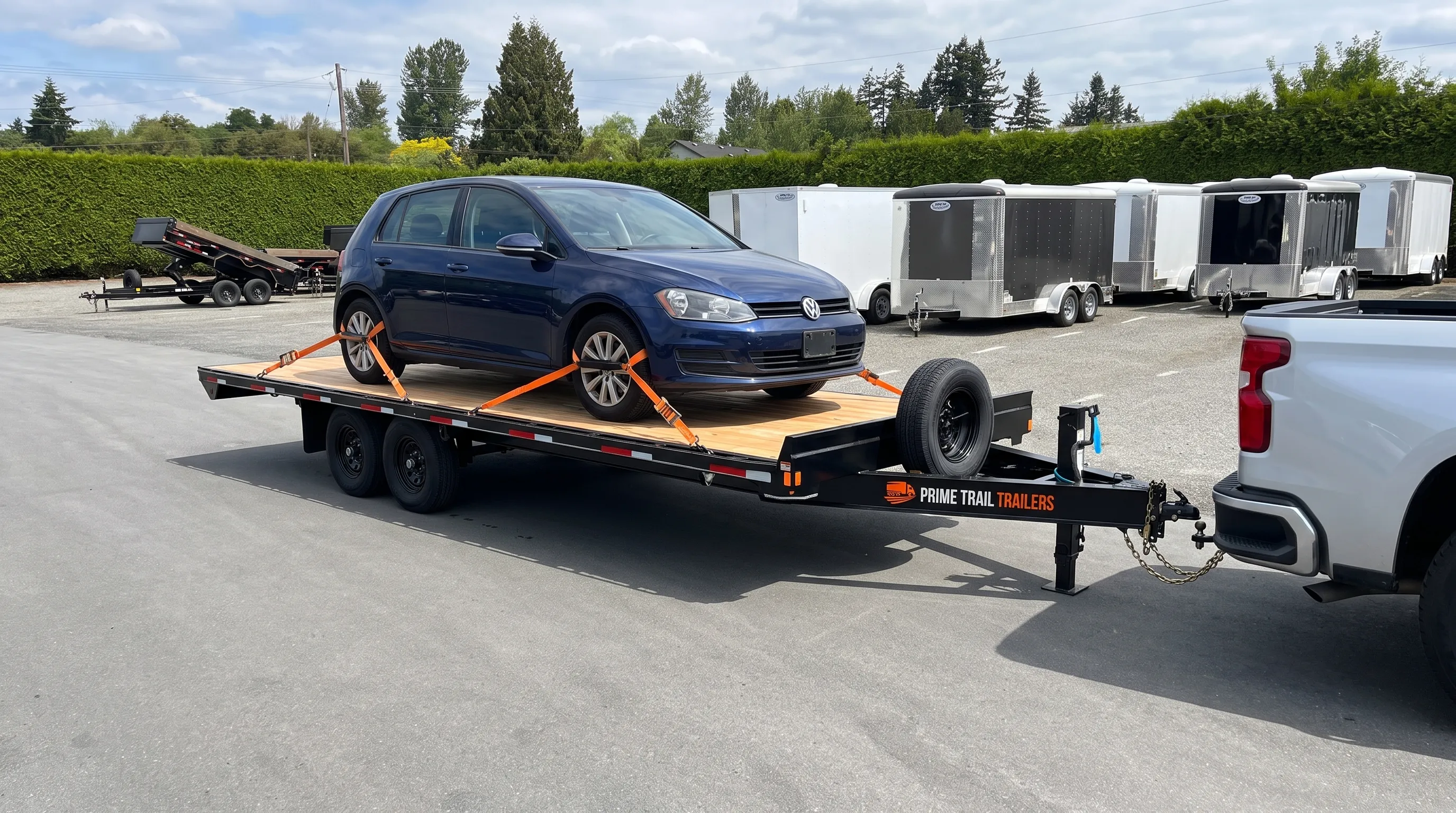
Plan vehicle placement and securement before loading
The right trailer should provide usable tie-down locations for the vehicles you actually transport. Anchors that are difficult to reach or poorly positioned can make secure loading unnecessarily complicated.
Use rated straps or chains, compatible tensioning hardware and approved attachment methods for the transported vehicle. Follow the instructions for wheel nets, axle straps or designated transport points. Do not assume a suspension component is suitable for securing the load.
A parking brake and transmission setting are not substitutes for tie-downs. A loading winch is not a substitute either unless the equipment is specifically designed and approved for that securement purpose.
Load placement on a vehicle trailer affects tongue weight and axle loading. Position the vehicle to achieve the required balance, then verify weights rather than relying on appearance. Adding toolboxes, spare tires or other cargo later can change that balance.
For commercial operations subject to federal requirements, the FMCSA cargo securement rules include provisions for transported automobiles and equipment. Requirements depend on the cargo and operation, so a generic strap-count rule is not sufficient for every load.
Complete a walk-around before entering traffic
Do this check after loading and securing the cargo. Loading can change hitch height, tire deflection and access to hardware that looked fine when the trailer was empty.
- Coupler and hitch: Confirm proper engagement, a secured latch and installed retaining pins.
- Safety chains: Check attachment, suitable slack and routing that does not drag or bind during turns.
- Breakaway cable: Verify the specified attachment and unobstructed operation.
- Jack and ramps: Fully retract or stow them and secure their retaining hardware.
- Cargo securement: Check each strap or chain, tensioner and anchor connection.
- Tires and lights: Confirm cold tire pressure before travel and test all required lighting.
- Clearance: Check the tailgate, fenders, hitch equipment and load for turning interference.
Keep enough stopping distance and allow for the trailer’s wider turning path. Follow applicable speed limits and the equipment manufacturers’ limitations.
After the vehicle trailer has traveled a short distance, stop somewhere safe to recheck securement and the connection. Investigate unusual heat, noise, pulling or instability before continuing; do not assume those symptoms are normal because the trailer is new to you.
Ask for the details that make a quote useful
A meaningful comparison requires more than price and nominal length. Ask the dealer to identify the exact unit and provide its certified GVWR, actual or documented as-equipped empty weight, axle ratings, brake configuration, tire specifications and usable dimensions.
Also confirm the loading equipment and anchor-point ratings. For a used trailer, request available maintenance history and clarify title or registration documentation before purchase.
Compare the total setup you need, including any hitch equipment, compatible brake controller, suitable tie-downs and necessary service work. A lower purchase price can lose its advantage if the trailer requires substantial work before it is ready to haul.
Prime Trail Trailers’ trailer buyer’s guide provides a broader framework for comparing hauling needs, construction and budget. Use it alongside these pre-tow checks rather than choosing solely by advertised capacity.
Frequently asked questions
Can an SUV tow a vehicle trailer? Some SUVs can, but suitability depends on the exact vehicle configuration, loaded trailer weight, available payload and hitch limits. Check the owner’s manual and vehicle labels. Tongue weight, passengers and luggage can exhaust payload before the advertised tow rating is reached.
Does a 10,000-pound GVWR mean I can haul a 10,000-pound vehicle? No. GVWR includes the trailer itself and all cargo. Subtract the trailer’s actual empty weight to calculate payload, then confirm axle, tire and tow vehicle limits.
Are longer ramps always better for low cars? Longer ramps can reduce the approach angle, but ramp length alone does not establish safe loading. Check ramp capacity, mounting, deck height and the transition onto the deck. The vehicle’s wheelbase and ground clearance also matter.
What should I verify before towing a trailer home from the dealer? Confirm your hitch, electrical connection and brake controls are compatible, then inspect tires, lights, coupler engagement, chains and breakaway equipment. Verify that your tow vehicle is rated for the trailer, even if you are bringing it home empty.
Compare trailers with your towing setup in mind
Choose a vehicle trailer around the load you need to move and the tow vehicle you will actually use. Bring the vehicle’s weight and dimensions, your truck’s ratings and your loading requirements to the conversation so the comparison is based on usable capacity, not assumptions.
Browse available trailers at Prime Trail Trailers and request help comparing suitable car haulers, equipment trailers or deck-over options. Ask the sales team to confirm specifications, pricing, availability and delivery options for the unit you are considering before arranging pickup or transport.
Have Questions? We're Here to Help
Still unsure which trailer fits your needs, or need specs, pricing or delivery advice? The Prime Trail Trailers team is ready to answer your questions and help you find the right rig.