
How to Measure a Trailer Axle for Replacement: Hub Face, Spring Center, and GAWR Guide
Learn how to accurately measure your trailer axle for replacement, including hub face width, spring center, and GAWR, to ensure safe towing and proper fitment.
Quick Summary
Learn how to accurately measure your trailer axle for replacement, including hub face width, spring center, and GAWR, to ensure safe towing and proper fitment.
Replacing a bent or damaged trailer axle requires precise measurements to ensure your new setup tracks straight and handles heavy loads safely. Whether you hit a massive pothole hauling equipment or simply wore out an old axle, guessing your dimensions will lead to tire clearance issues, suspension binding, and dangerous towing conditions. This guide breaks down exactly how to measure your trailer axle's hub face, spring center, and capacity so you can order the perfect replacement.
Signs You Need to Replace Your Trailer Axle
Before you pull out the tape measure, it is crucial to determine if your axle actually needs replacement or just an alignment. While minor toe or camber issues can sometimes be corrected by a professional shop, structural damage requires a full replacement.


Look for a bent axle tube, which is one of the clearest signs you need a new unit. Tubes bend when a trailer takes a hard hit, such as dropping a wheel into a deep pothole at highway speeds or overloading the trailer until the suspension bottoms out. Keep in mind that axles are built with a slight upward bow (positive camber) when empty; this is intentional. However, if the tube is bent backward, downward, or kinked, it is compromised. Other signs include cracked welds at the spring seats, severe uneven tire wear that alignment cannot fix, or a trailer that pulls hard to one side only when loaded. If you are hauling heavy machinery on equipment trailers in demanding environments like Dallas, TX, running on a compromised axle is a major safety hazard.
Key Specifications: What to Look For on the Axle Tag
Before measuring manually, always check the center portion of the axle tube (usually the rear-facing side) for a manufacturer label, identification tag, or stamped serial number.
If the label is readable, it will provide the exact specifications you need. A standard Dexter or Rockwell label typically includes:
- Serial Number: Can be used by the manufacturer to pull the exact build sheet.
- GAWR (Gross Axle Weight Rating): The maximum weight the axle can support.
- Hub Face Dimension: The width between the mounting surfaces.
- Spring Center Dimension: The distance between the leaf spring mounts.
- Torsion Start Angle: (For torsion axles only) The resting angle of the trailing arm.
If the tag is missing or illegible—common on older utility trailers exposed to road salt and debris—you will need to measure these dimensions yourself. For more on identifying axle ratings, see our Trailer Axle Diameter and Weight Capacity Guide.
How to Measure Hub Face Width
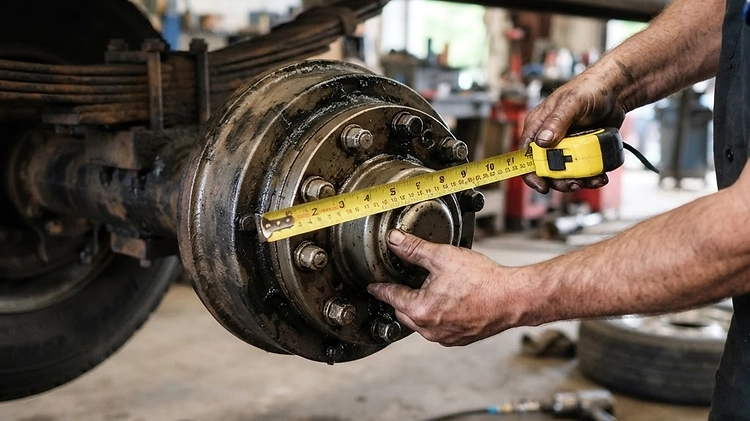
The hub face width is the most critical measurement for ensuring your tires clear the trailer frame and fenders. It is the distance from the base of the wheel studs on one side of the axle to the base of the wheel studs on the opposite side.


To measure the hub face accurately, remove the wheels and tires. Hook your tape measure on the flat mounting surface of the hub (where the wheel sits flat against the hub) on the driver's side, and pull it straight across to the exact same surface on the passenger's side. Do not measure to the tip of the spindle or the outside of the brake drum. If your axle is already broken or missing hubs, you can measure the overall spindle length (from spindle tip to spindle tip) and consult a manufacturer chart to find the corresponding hub face width, though direct hub-to-hub measurement is always preferred.
How to Measure Spring Center
On a standard leaf-spring axle, the spring center dictates where the axle mounts to the trailer's suspension. If this measurement is off, the axle will not bolt up to your leaf springs, or it will cause severe suspension binding.
Measure from the center of the welded spring seat on one side of the axle to the center of the spring seat on the opposite side. If the axle is still mounted on the trailer, you can measure from the center of one leaf spring to the center of the opposite leaf spring. Always double-check this measurement. Matching the spring center without matching the hub face can create tire-clearance problems, so both measurements must be precise. If you are upgrading your suspension, review our Trailer Axle Alignment Procedure Guide to ensure everything tracks perfectly once installed.
Torsion Axle Measurements: Start Angles and Brackets
Torsion axles do not use leaf springs, so they require a different set of measurements. Instead of a spring center, you must measure the "outside-of-bracket" dimension, which is the distance between the outer edges of the mounting brackets welded to the axle tube.

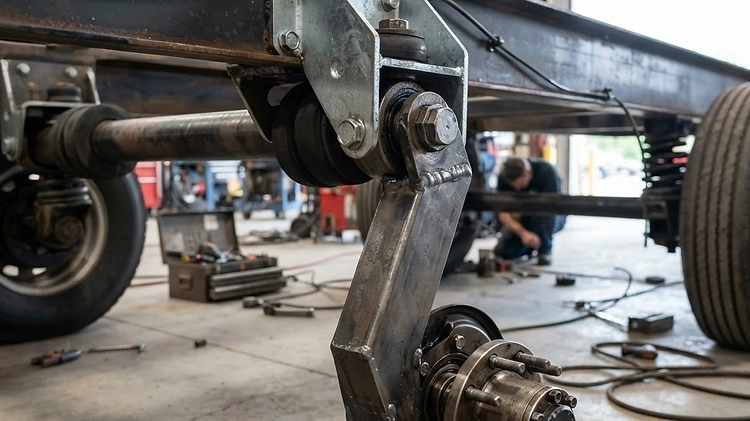
Additionally, you must identify the start angle of the torsion arm. This is the angle the trailing arm sits at when the trailer is unloaded. Common start angles include 45 degrees down, 22.5 degrees down, 0 degrees (straight back), and 10 degrees up. Ordering the wrong start angle will drastically alter your trailer's ride height, potentially causing the tires to rub the fenders or the trailer to sit unlevel. For commercial haulers looking for trailers for sale in Texas, maintaining the correct ride height is essential for safe loading and unloading.
Bottom Line
Accurately measuring your trailer axle's hub face, spring center, and capacity ensures your replacement axle will bolt up correctly and tow safely. Never guess your dimensions, and always verify your GAWR to match your hauling needs. If you are upgrading your entire setup, explore our guides hub for more maintenance tips, or browse our shop inventory for heavy-duty options like the 2026 Iron Bull 10K Gravity Tilt Equipment Trailer or the 2026 Wil-Ro Utility Truck Bed.
FAQ
Have Questions? We're Here to Help
Still unsure which trailer fits your needs, or need specs, pricing or delivery advice? The Prime Trail Trailers team is ready to answer your questions and help you find the right rig.
Prime Trail Trailers
Prime Trail Trailers is a family-owned trailer dealer in Markle, Indiana, stocking utility, dump, enclosed, equipment, car hauler and gooseneck trailers with nationwide delivery. This guide is based on what our customers ask us most and the trailers we sell every day.
More about Prime Trail Trailers