
Commercial Trailer Suspension Alignment and Thrust Angle Calibration Guide
Learn how to properly calibrate commercial trailer suspension systems, measure thrust angles, and prevent dog tracking for optimal tire life and safe hauling.

Quick Summary
Learn how to properly calibrate commercial trailer suspension systems, measure thrust angles, and prevent dog tracking for optimal tire life and safe hauling.
Properly aligned trailer axles optimize fuel economy, improve driveability, and prevent excessive tire wear that eats into your hauling profits. Whether you are pulling a heavy-duty flatbed across the country or navigating local routes with a dump trailer, suspension alignment is a critical maintenance task that is often overlooked until tires are already ruined. This guide covers the exact procedures for checking thrust angles, positioning your trailer for accurate measurements, and maintaining both air ride and leaf spring suspensions.
Why Trailer Suspension Alignment Matters for Commercial Hauling
A perfect alignment scenario has all trailer wheels parallel to one another and perpendicular to the centerline of the trailer. When axles are skewed even slightly, the trailer "dog tracks," meaning the wheels do not follow the tow vehicle's path. Dog tracking is the single biggest cause of sway at highway speeds and drastically reduces fuel efficiency.

According to industry standards, the typical trailer alignment specification for thrust angle is ± 0.1 degrees when measured from the kingpin to the axle track of a standard commercial axle. Maintaining this tight tolerance requires regular inspections, especially if you frequently haul maximum payloads or operate on rough job sites. For fleets operating trailers for sale in Texas or navigating the busy highways around Houston trailer delivery routes, keeping axles perfectly aligned is essential for safety and compliance.
Key Specifications: Thrust Angle and Axle Positioning
Before diving into the physical adjustments, it is crucial to understand the key measurements that dictate trailer alignment. Unlike tow vehicles, trailer wheels do not steer, which makes alignment simpler in theory but highly dependent on precise frame measurements.
The Kingpin to Front Axle Measurement
The primary measurement for any commercial trailer is the distance from the kingpin (or coupler) to the front axle. This establishes the thrust angle. On a tandem or tri-axle setup, it is best to align the center axle with the kingpin first to prevent the margin of error from compounding across multiple axles. Once the primary axle is perfectly perpendicular to the centerline, subsequent axles are aligned parallel to the primary axle.
Suspension Ride Height Calibration
For trailers equipped with air ride suspensions, alignment must be performed at the nominal ride height. The trailer must be perfectly level from side to side and front to rear. If you are inspecting a heavy-duty unit like the 2027 MAXX-D YDX 8.5x32 22.5K Gooseneck Hydraulic Dovetail, verifying the proper ride height before taking any measurements is a mandatory first step.
Pre-Alignment Inspection and Trailer Positioning
Trailer positioning is critical during alignment. The trailer suspension must be in a "relaxed" state without any pre-load applied to the pivot bushings or spring hangers.

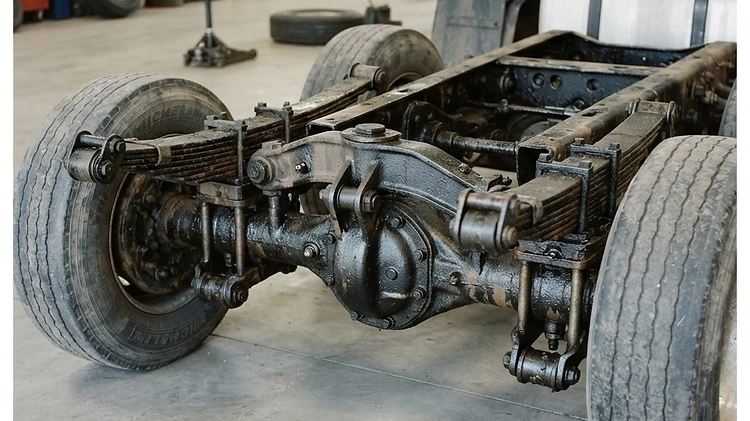
To achieve a relaxed state, park the trailer on a level, debris-free surface in an unladen state. Free the suspension of any binds by pushing the trailer backwards and then pulling it forward in a straight line. While pulling forward, apply the trailer brakes and release them. This ensures that all suspension components settle into their natural resting positions. Never attempt to measure alignment on a loaded trailer or on uneven ground, as frame flex will distort your measurements.
Diagnosing Misalignment: Tire Wear Patterns
Inspecting tire wear patterns every 1,500 to 3,000 miles is the most effective way to catch alignment issues early. Uneven wear is the first warning sign that your suspension requires attention.
| Symptom | Likely Cause | Severity | | :--- | :--- | :--- | | Feathered tread across the tire face | Excess toe-in or toe-out | Medium | | One shoulder worn smooth, other intact | Camber too aggressive or bent axle | High | | Cupping or scalloping | Worn suspension components or out-of-balance | Medium | | Rapid wear on inside edge of all tires | Overloaded trailer causing axle flex | High |
If you notice these patterns on your flatbed trailers or dump trailers, immediately check the suspension hardware. Look for loose U-bolts, worn spring bushings, or damaged frame bracket alignment slots.
Step-by-Step Axle Alignment Check
You can perform a basic alignment check at your shop using a tape measure and a straightedge. For a straightedge, a perfectly straight piece of steel pipe or angle iron (about 8 feet long) works best.

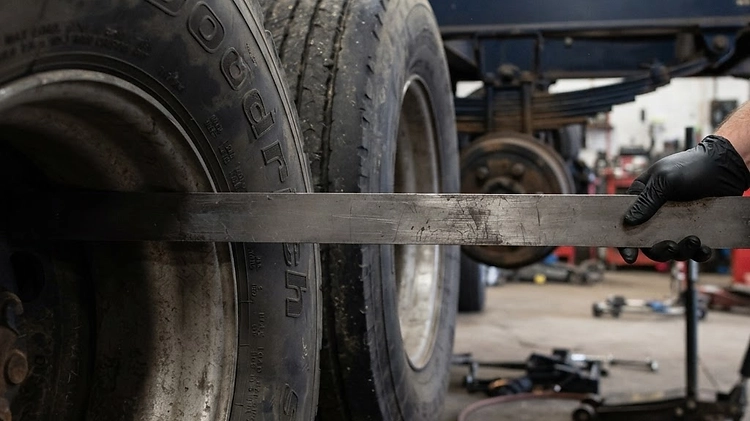
- Check the Bulges: Hold the straightedge against the sidewall bulges of the tires on one side of the trailer. On a multi-axle trailer, all tire bulges should make contact with the straightedge simultaneously (within a 1/8-inch tolerance).
- Measure the Axle Spacing: Measure the distance between the center of the front axle hub and the rear axle hub on both the driver and passenger sides. These measurements must be identical.
- Inspect the Hardware: Check the torque on the U-bolts that fasten the spring pack to the axle. The clamp group between the spring and axle must be torqued to the manufacturer's exact specifications to prevent the axle from shifting under heavy braking.
For comprehensive maintenance, always refer to our Trailer Axle Alignment and Tire Wear: 2026 Maintenance Guide and our Trailer Suspension Maintenance Guide.
Bottom Line
Maintaining perfect suspension alignment is non-negotiable for commercial haulers who want to maximize tire life, improve fuel economy, and ensure safe towing at highway speeds. By regularly checking your thrust angle, monitoring tire wear, and keeping suspension components properly torqued, you can avoid costly roadside breakdowns and premature tire replacements.
For more expert advice on keeping your fleet in top condition, explore our complete guides hub. If you are looking to upgrade your hauling capabilities, browse our shop inventory for premium models like the 2026 Iron Bull Trailers 7x20 TRB 10K Gravity Tilt Equipment Trailer. Be sure to also review our Trailer TPMS Installation Buying Guide, Trailer Breakaway System Maintenance & DOT Compliance Guide, and Trailer Tire Load Range and PSI Guide to complete your maintenance routine.
FAQ
Have Questions? We're Here to Help
Still unsure which trailer fits your needs, or need specs, pricing or delivery advice? The Prime Trail Trailers team is ready to answer your questions and help you find the right rig.
Prime Trail Trailers
Prime Trail Trailers is a family-owned trailer dealer in Markle, Indiana, stocking utility, dump, enclosed, equipment, car hauler and gooseneck trailers with nationwide delivery. This guide is based on what our customers ask us most and the trailers we sell every day.
More about Prime Trail Trailers