
How to Measure Trailer Tongue Weight and Calculate Safe Payload Limits
Learn how to accurately measure trailer tongue weight using the bathroom scale method, calculate true payload capacity, and ensure safe towing compliance.
Quick Summary
Learn how to accurately measure trailer tongue weight using the bathroom scale method, calculate true payload capacity, and ensure safe towing compliance.
Towing a trailer safely requires more than just a powerful truck; it demands a precise understanding of weight distribution. Whether you are hauling construction materials or moving heavy equipment, guessing your trailer's weight is a recipe for disaster. Knowing exactly how to measure your tongue weight and calculate your true payload capacity ensures you stay within legal limits and prevents dangerous trailer sway.
In this guide, we will break down the exact steps to measure your trailer's tongue weight at home, explain how to calculate your maximum payload, and explore the critical differences between GVWR and GCWR. By mastering these metrics, you can protect your tow vehicle, your cargo, and yourself on the road.
Understanding the Core Towing Metrics: GVWR, GCWR, and Payload
Before you can safely load a trailer, you must understand the acronyms stamped on your vehicle and trailer VIN plates. The Gross Vehicle Weight Rating (GVWR) is the absolute maximum weight your trailer can safely weigh when fully loaded. This includes the empty weight of the trailer itself plus all cargo.

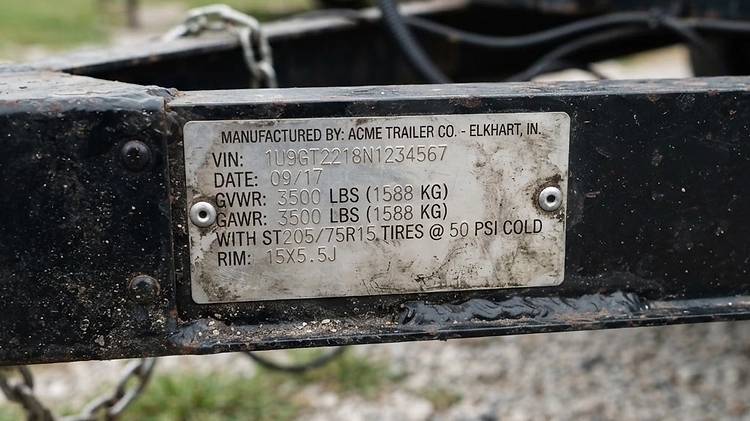
The Gross Combined Weight Rating (GCWR) is the maximum allowable weight of your fully loaded tow vehicle and your fully loaded trailer combined. Payload capacity, on the other hand, is the actual amount of weight you can put in or on the trailer. To find your trailer's payload capacity, simply subtract the trailer's empty weight (tare weight) from its GVWR. For a deeper dive into these definitions, check out our comprehensive guide on Towing Capacity vs. Payload Capacity.
Why Tongue Weight Matters for Safe Towing
Tongue weight is the downward force that the tongue of the trailer exerts on the hitch of the tow vehicle. For conventional bumper-pull trailers, the ideal tongue weight should be between 10% and 15% of the total loaded trailer weight.
If the tongue weight is too light (under 10%), the trailer is prone to severe swaying, which can easily lead to a loss of control. If the tongue weight is too heavy (over 15%), it will push the rear of the tow vehicle down, lifting the front wheels and compromising your steering and braking capabilities. Proper weight distribution is critical, which is why we highly recommend reviewing The Physics of Trailer Sway to understand the mechanics behind cargo loading.
How to Measure Trailer Tongue Weight at Home
You don't always need a commercial scale to determine your tongue weight. For smaller utility trailers with a tongue weight under 300 pounds, a standard bathroom scale will work perfectly. Simply place the scale on level ground, put a block of wood on the scale to protect it, and lower the trailer jack until the coupler is at its normal towing height.


For heavier trailers where the tongue weight exceeds 300 pounds, you can use the "bathroom scale and pipe" method. Lay a sturdy 2x4 flat on the ground. Place the bathroom scale two feet away from the trailer tongue, and a brick or block one foot away in the opposite direction. Lay a pipe across the scale and another across the brick, then rest a heavy board across both pipes. Lower the trailer jack onto the board exactly one foot from the brick (and two feet from the scale). Read the scale and multiply the number by three to get your actual tongue weight.
Commercial Scales and Weigh Safe Hitches
For heavy-duty hauling, such as pulling loaded dump trailers or large equipment, the bathroom scale method isn't practical. The most accurate way to measure your setup is by visiting a CAT scale at a local truck stop. Weigh your truck and trailer together, then weigh the truck alone, to calculate the exact weights on each axle.
Alternatively, investing in a specialized hitch with a built-in scale is a game-changer for frequent towers. Products like the Gen-Y Hitch Adjustable Drop Hitches or Weigh Safe ball mounts provide a real-time readout of your tongue weight every time you hook up. This takes the guesswork out of loading and ensures you are always within the safe 10-15% range.
Calculating Your Trailer's True Payload Capacity
When calculating payload, remember that any modifications or accessories added to the trailer reduce the available payload pound-for-pound. For example, if you purchase a 16ft Deckover Dump Trailer and add heavy-duty ramps, a spare tire, and a toolbox, you must subtract the weight of those items from the manufacturer's stated payload capacity.


Furthermore, the payload of your tow vehicle is just as important. The tongue weight of the trailer counts directly against your truck's payload capacity. If your truck has a payload capacity of 1,500 lbs, and your trailer exerts 800 lbs of tongue weight, you only have 700 lbs left for passengers, fuel, and cargo in the truck bed. Always consult our guides hub for more detailed breakdowns on vehicle-specific towing requirements.
Bottom Line
Accurately measuring your trailer's tongue weight and calculating your true payload capacity are non-negotiable steps for safe towing. Whether you are hauling equipment across trailers for sale in Texas or navigating the busy highways of Dallas, TX, proper weight distribution ensures a smooth, stable ride.
If you are unsure about your current setup or need a trailer with a higher GVWR to handle your workload, explore our full inventory in the Prime Trail Trailers shop. For more insights on choosing the right towing setup, read our comparison on Bumper Pull vs. Gooseneck Trailers.
Shop Related Trailers
FAQ
Have Questions? We're Here to Help
Still unsure which trailer fits your needs, or need specs, pricing or delivery advice? The Prime Trail Trailers team is ready to answer your questions and help you find the right rig.
Prime Trail Trailers
Prime Trail Trailers is a family-owned trailer dealer in Markle, Indiana, stocking utility, dump, enclosed, equipment, car hauler and gooseneck trailers with nationwide delivery. This guide is based on what our customers ask us most and the trailers we sell every day.
More about Prime Trail Trailers