
Commercial Trailer Load Placement: Maximizing Payload Without Exceeding Axle Limits
Learn how to strategically position cargo on commercial trailers to maximize your payload capacity while staying strictly within legal axle weight limits.

Quick Summary
Learn how to strategically position cargo on commercial trailers to maximize your payload capacity while staying strictly within legal axle weight limits.
Maximizing your commercial trailer's payload isn't just about staying under the gross vehicle weight rating (GVWR); it requires precise load placement to ensure compliance with strict axle weight limits. A poorly positioned load can easily overload a single or tandem axle, leading to hefty DOT fines, accelerated equipment wear, and dangerous handling dynamics, even if the total weight is technically legal. Understanding how to manipulate your cargo's center of gravity and distribute weight across your tractor and trailer axles is the key to hauling heavier loads safely and legally.
In this guide, we break down the physics of trailer load distribution, the legal axle weight thresholds you must navigate, and actionable strategies for positioning freight on flatbeds, deckovers, and enclosed trailers. Whether you are running hotshot routes or managing a heavy-haul fleet, mastering load placement will optimize your hauling efficiency.
The Physics of Trailer Load Distribution
When you place freight on a trailer, the weight does not simply press straight down onto the trailer axles. Instead, the trailer acts as a lever, with the axles serving as the fulcrum. The position of the cargo dictates how much weight is transferred forward to the tow vehicle (via the kingpin, gooseneck, or bumper pull hitch) and how much remains on the trailer's suspension.


For commercial semi-trailers, the front of the trailer rests on the tractor's fifth wheel, meaning a significant portion of the cargo weight is transferred to the tractor's steer and drive axles. If you load heavy freight too far forward, you risk overloading the tractor's drive axles. Conversely, loading too far to the rear removes critical weight from the drive axles—reducing traction and steering control—while simultaneously overloading the trailer's tandem or spread axles. Achieving the perfect balance requires understanding the specific weight limits of each axle group.
For more foundational towing math, review our guide on how to calculate towing capacity and the GCWR minus payload formula.
Understanding Legal Axle Weight Limits
Before you can optimize load placement, you must know the legal boundaries. Federal regulations establish maximum weight limits for commercial vehicles operating on the Interstate Highway System. While individual states may have specific variances for non-interstate roads, the federal standards serve as the baseline for commercial hauling.

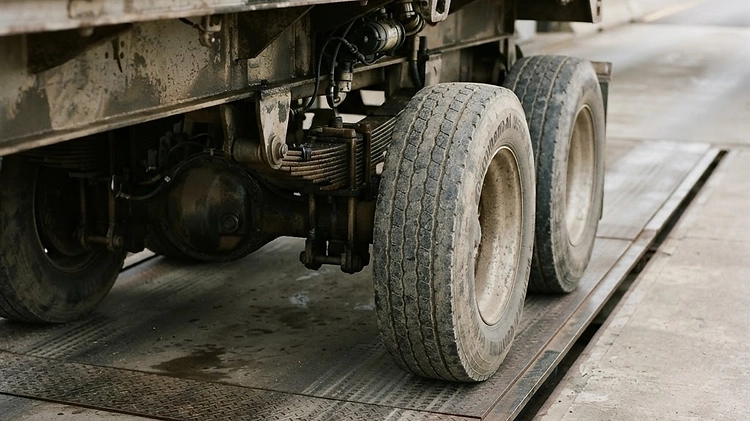
According to federal guidelines, the maximum gross vehicle weight is 80,000 pounds. However, this weight must be distributed across the axles according to strict limits:
- Steer Axle: Typically limited to 12,000 pounds (or the rating of the front tires).
- Single Axle: 20,000 pounds maximum.
- Tandem Axle: 34,000 pounds maximum (two axles spaced between 40 and 96 inches apart).
If you are operating flatbed trailers with a spread-axle configuration (where the axles are spaced 10 feet apart), each axle is treated as a single axle, allowing for up to 20,000 pounds per axle, or 40,000 pounds total for the spread group. This configuration offers greater flexibility in load placement, which is why it is highly favored in the commercial flatbed industry.
For a deeper dive into state-specific rules, consult our 2026 interstate trailer weight limits and axle regulations guide.
How Cargo Placement Affects the Center of Gravity (CoG)
The Center of Gravity (CoG) is the exact point where the weight of your cargo is evenly balanced. In trailer loading, managing both the longitudinal (front-to-back) and vertical (top-to-bottom) CoG is critical for stability and legal compliance.


Longitudinal Center of Gravity
To maximize payload without exceeding axle limits, the longitudinal CoG of your freight must be positioned precisely between the tractor's drive axles and the trailer's axles. For a standard 53-foot flatbed with closed tandems, the ideal CoG is typically slightly forward of the trailer's center point. This ensures that the 45,000 to 48,000 pounds of freight is shared appropriately between the 34,000-pound capacity of the drive axles and the 34,000-pound capacity of the trailer tandems.
Vertical Center of Gravity
A high vertical CoG increases the risk of a rollover, especially during evasive maneuvers or high crosswinds. When loading mixed freight, always place the heaviest items flat on the deck and stack lighter items on top. If you are hauling tall, dense machinery on deckover trailers, ensure the load is centered laterally (side-to-side) to prevent uneven tire wear and suspension stress.
Strategies to Maximize Payload on Flatbeds
Maximizing payload requires strategic planning before the first piece of freight touches the deck. Here are proven strategies for optimizing load placement:
- Weigh Empty First: You cannot maximize payload if you don't know your exact curb weight. Weigh your truck and trailer empty (with full fuel and driver) to determine your true available payload capacity. Learn more in our trailer payload math and GVWR guide.
- Utilize the Fifth Wheel: Sliding the fifth wheel forward transfers weight to the steer axle, while sliding it backward shifts weight to the drive axles. Adjusting the fifth wheel is often the easiest way to correct a minor drive-axle overload.
- Slide the Trailer Tandems: If your trailer is equipped with sliding tandems, moving them forward shifts weight to the trailer axles, while sliding them backward transfers weight to the tractor's drive axles.
- Split Heavy Loads: If you are hauling multiple heavy coils or concrete barriers, do not group them tightly together. Space them out along the deck to distribute the weight evenly across the entire frame and suspension system.
If you are looking for robust equipment capable of handling precise load distribution, consider the 2026 Wil-Ro Patriot Flatbed 8'6" X 96" or the 2026 PJ Trailers L6 8.5X24 10k Deckover.
The Role of the Bridge Formula in Load Placement
The Federal Bridge Gross Weight Formula is designed to protect highway bridges from catastrophic failure by dictating the maximum weight that can be carried by any group of axles based on the distance between them. The formula is: W = 500 [LN/(N-1) + 12N + 36].
In practical terms, this means that a shorter trailer cannot legally carry as much weight as a longer trailer with the same number of axles, because the weight is concentrated over a smaller area of the bridge. When positioning extremely heavy, dense loads, you must ensure that the weight is spread over a sufficient length of the trailer to comply with the bridge formula. For a comprehensive breakdown, read our guide on how the Federal Bridge Formula dictates commercial trailer payload.
Key Specifications: Axle Spacing and Weight Thresholds
| Axle Configuration | Typical Spacing | Maximum Legal Weight (Federal) | | :--- | :--- | :--- | | Single Axle | N/A | 20,000 lbs | | Closed Tandem | 40" - 96" | 34,000 lbs | | Spread Axle | 120" (10 feet) | 40,000 lbs (20,000 lbs per axle) | | Tridem (Tri-Axle) | Varies by state | Typically 42,000 - 44,000 lbs |
Bottom Line
Mastering commercial trailer load placement is an essential skill for maximizing payload and profitability while avoiding costly overweight citations. By understanding the physics of weight transfer, adhering to federal axle limits, and strategically managing your cargo's center of gravity, you can haul heavier loads with confidence. Whether you are navigating the busy freight corridors of Houston, TX or looking for reliable trailers for sale in Texas, proper load distribution is the foundation of safe commercial hauling.
Ready to upgrade your hauling capabilities? Explore our complete inventory of commercial-grade trailers in our shop or visit our guides hub for more expert towing advice.
FAQ
Have Questions? We're Here to Help
Still unsure which trailer fits your needs, or need specs, pricing or delivery advice? The Prime Trail Trailers team is ready to answer your questions and help you find the right rig.
Prime Trail Trailers
Prime Trail Trailers is a family-owned trailer dealer in Markle, Indiana, stocking utility, dump, enclosed, equipment, car hauler and gooseneck trailers with nationwide delivery. This guide is based on what our customers ask us most and the trailers we sell every day.
More about Prime Trail Trailers