
Trailer Payload Math Explained: How to Calculate True Carrying Capacity from GVWR and Curb Weight
Stop guessing your trailer's payload capacity. Learn how to calculate true carrying capacity using GVWR, curb weight, and tow vehicle ratings for safe hauling.

Quick Summary
Stop guessing your trailer's payload capacity. Learn how to calculate true carrying capacity using GVWR, curb weight, and tow vehicle ratings for safe hauling.
Overloading a trailer is one of the most common and dangerous mistakes in the hauling industry. Many buyers assume that a trailer with a 14,000-pound rating can carry 14,000 pounds of cargo, but this misunderstanding leads to blown tires, bent axles, and severe accidents. To haul safely and legally, you must understand the exact mathematical relationship between your trailer's Gross Vehicle Weight Rating (GVWR), its empty curb weight, and your tow vehicle's limits.
The Core Formula: GVWR vs. Payload Capacity
The most critical number on your trailer's VIN plate is the Gross Vehicle Weight Rating (GVWR). This federally regulated figure represents the absolute maximum the fully loaded trailer is ever allowed to weigh—including the trailer itself, the cargo, and any strapped-on accessories.

However, GVWR is not your payload capacity. To find out how much weight you can actually put on the deck, you must subtract the trailer's empty weight (also known as curb weight or dry weight) from the GVWR. For example, if you purchase a heavy-duty dump trailer with a 14,000 lb GVWR, and the trailer itself weighs 4,200 lbs empty, your true payload capacity is 9,800 lbs. If you are looking at dump trailers or equipment trailers, always verify the curb weight before assuming it can handle your skid steer or excavator. For more details on how accessories impact this, see our guide on how trailer accessories reduce payload capacity.
Why Curb Weight is the Missing Link in Towing Math
Curb weight is the weight of the trailer as it sits empty, but it can fluctuate based on the options you choose. Upgrading to thicker steel decking, adding heavy-duty ramps, or installing a spare tire mount will increase the curb weight and directly decrease your available payload.
When shopping for trailers for sale in Indiana or sourcing equipment for jobs in Chicago, IL, always check the specific weight of the unit you are buying, not just the brochure's base model weight. For instance, the 2026 Iron Bull Trailers 7x20 TRB 10K Gravity Tilt Equipment Trailer will have a specific curb weight that dictates exactly how much machinery it can legally carry. Understanding this balance is crucial, as explained in our trailer GVWR vs payload capacity guide.
How Tow Vehicle Ratings Limit Your Trailer
Your trailer's payload capacity is only half the equation; your tow vehicle must also be rated to handle the load. The truck's Gross Combined Weight Rating (GCWR) is the maximum allowable weight of the loaded truck and the loaded trailer combined.

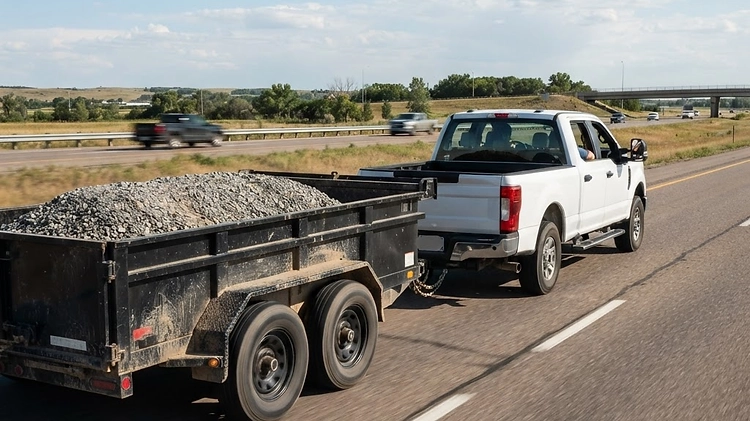
Furthermore, the trailer's tongue weight—the downward force exerted on the hitch—counts directly against your tow vehicle's payload capacity. If your truck has a payload capacity of 2,000 lbs, and your trailer exerts 1,200 lbs of tongue weight, you only have 800 lbs left for passengers, fuel, and bed cargo. This is a common bottleneck, which we cover extensively in our payload vs towing capacity bottleneck guide and our trailer axle weight distribution guide. If you are upgrading your truck to handle more payload, consider a specialized bed like the 2026 BEDBOSS Dually ArmorBed Flatbed Truck Bed.
The Role of Tongue Weight and Weight Distribution Hitches
Proper load balancing is essential for safe towing. Generally, 10% to 15% of a bumper-pull trailer's total loaded weight should rest on the hitch. Too little tongue weight causes dangerous trailer sway, while too much overloads the tow vehicle's rear axle.
To manage heavy tongue weights, many drivers use a weight-distribution hitch. These systems use spring bars to transfer part of the hitch load forward to the tow vehicle's front axle and backward to the trailer axles, restoring steering control and stability. However, a weight-distribution hitch does not increase your vehicle's maximum payload or towing capacity. For a deeper dive into axle limits, read our trailer GVWR vs GAWR axle ratings guide and learn how to determine your true trailer tow limit.
Key Specifications to Check Before Loading
Before you load your trailer, you must verify several key ratings to ensure you remain within safe and legal limits.


Here is a quick checklist of the specifications you need to know:
- GVWR (Gross Vehicle Weight Rating): The maximum legal weight of the fully loaded trailer.
- GAWR (Gross Axle Weight Rating): The maximum distributed weight a single axle can support.
- Curb Weight: The empty weight of the trailer, including all permanent accessories.
- Payload Capacity: GVWR minus Curb Weight.
- Tire Load Index: The maximum weight the tires can safely carry at a specific PSI (see our trailer tire ply ratings guide and ST vs LT trailer tires guide).
Bottom Line
Calculating your trailer's true payload capacity is not a guessing game—it is a simple mathematical formula that ensures your safety on the road. Always subtract your trailer's curb weight from its GVWR to find your actual carrying capacity, and never exceed your tow vehicle's GCWR or payload limits. For more expert advice on towing safely, visit our comprehensive towing guides hub, or browse our full inventory of heavy-duty haulers in our online shop.
FAQ
Have Questions? We're Here to Help
Still unsure which trailer fits your needs, or need specs, pricing or delivery advice? The Prime Trail Trailers team is ready to answer your questions and help you find the right rig.
Prime Trail Trailers
Prime Trail Trailers is a family-owned trailer dealer in Markle, Indiana, stocking utility, dump, enclosed, equipment, car hauler and gooseneck trailers with nationwide delivery. This guide is based on what our customers ask us most and the trailers we sell every day.
More about Prime Trail Trailers