
Trunnion Axle Weight Limits and Heavy Equipment Trailer Capacity Guide
Learn how trunnion axles increase heavy equipment trailer payload capacity, understand DOT weight limits, and master weight distribution for oversized loads.

Quick Summary
Learn how trunnion axles increase heavy equipment trailer payload capacity, understand DOT weight limits, and master weight distribution for oversized loads.
Heavy hauling requires specialized equipment, and when standard tandem or spread axles max out their legal limits, trunnion axles step in to handle the extreme loads. Understanding trunnion axle weight limits and how they impact your trailer's overall payload capacity is critical for compliance, safety, and efficiency on the job site. Whether you are moving massive excavators or industrial machinery, knowing the exact capabilities of your axle configuration prevents costly fines and dangerous equipment failures.
What is a Trunnion Axle on a Trailer?
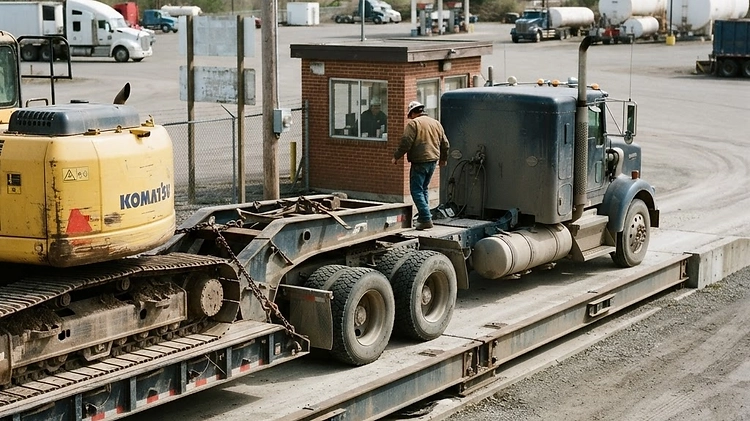
A trunnion axle configuration is specifically designed for heavy haul and oversized loads. Unlike standard straight axles, a trunnion setup typically features two axles oscillating on a central pivot point, often utilizing eight tires per axle line. This design allows the trailer to distribute massive weight more evenly across the pavement, especially on uneven terrain or crowned roads.

The primary advantage of a trunnion axle is its ability to carry significantly more weight than a standard single or tandem axle group. Because the weight is spread over more tires and a wider footprint, state and federal DOT regulations often grant higher weight allowances for these configurations, making them indispensable for the heavy construction and oilfield industries.
Trunnion Axle Weight Limits and DOT Regulations
When calculating your maximum legal payload, you must adhere to both federal bridge formulas and specific state regulations. While a standard single axle is typically limited to 20,000 pounds and a tandem axle group to 34,000 pounds, trunnion axles operate under different rules due to their expanded footprint.
For example, according to the Texas Department of Motor Vehicles, trunnion axles may be permitted to carry up to 30,000 pounds per axle if the configuration has two axles, eight tires per axle, and the axles are at least 10 feet wide. This means a dual-trunnion setup could potentially support 60,000 pounds, drastically increasing your hauling capabilities when operating trailers for sale in Texas or navigating heavy industrial zones in Houston, TX. Always cross-reference these limits with our Interstate Trailer Weight Limits: 2026 State and Federal Axle Regulations guide to ensure multi-state compliance.
Calculating Payload Capacity for Heavy Haul Trailers
Determining your true payload capacity requires more than just looking at the Gross Vehicle Weight Rating (GVWR). You must factor in the Gross Axle Weight Rating (GAWR) and the empty tare weight of the trailer itself.

The formula is straightforward: GVWR minus the empty weight equals your maximum payload capacity. However, you must also ensure that the weight is distributed so that no single axle exceeds its GAWR. For a deep dive into these calculations, review our Trailer Payload Math Explained: How to Calculate True Carrying Capacity from GVWR and Curb Weight. Remember that adding heavy-duty chains, binders, and dunnage will eat into this payload allowance.
Weight Distribution: The 60/40 Rule and Beyond
Proper weight distribution is the cornerstone of safe towing, especially when dealing with the extreme weights supported by trunnion axles. The industry standard 60/40 rule dictates that 60% of the cargo weight should be positioned ahead of the trailer axles, with 40% behind them. This ensures adequate tongue weight (typically 10-15% of the total loaded trailer weight) transfers to the tow vehicle, preventing dangerous trailer sway.
When loading heavy machinery onto equipment trailers, you must carefully position the center of gravity. If you are comparing axle setups for your fleet, our guide on Spread Axle vs. Closed Tandem Trailers: Weight Distribution and Legal Axle Limits provides excellent context on how axle spacing affects load balancing. Always adhere to the 80/20 Towing Rule: Why You Should Never Max Out Your Truck's Towing Capacity to maintain a safety margin.
Key Specifications to Look For in Heavy Equipment Trailers
When investing in a heavy haul trailer, the axle configuration is just one piece of the puzzle. You must evaluate the entire structural integrity of the unit to ensure it can handle the dynamic forces of heavy machinery.


Consider the following specifications when browsing flatbed trailers:
- Frame Construction: Look for pierced I-beam frames that lower the deck height and increase structural rigidity.
- Suspension Type: Heavy-duty leaf springs or specialized air ride systems are required to manage the oscillation of trunnion axles.
- Decking Material: Oak or specialized composite decking is necessary to withstand the point-loading of steel-tracked equipment.
- Tie-Down Points: Ensure the trailer has adequately rated D-rings that exceed your heaviest load requirements.
| Axle Type | Typical Max Weight Limit | Best Use Case | | :--- | :--- | :--- | | Single Axle | 20,000 lbs | Light utility and small cargo | | Tandem Axle | 34,000 lbs | Standard commercial freight | | Spread Axle | 40,000 lbs (20k per axle) | Long-haul flatbed stability | | Trunnion Axle | Up to 60,000 lbs (state dependent) | Oversized heavy equipment hauling |
Bottom Line
Mastering trunnion axle weight limits and payload calculations is essential for any serious heavy haul operation. By understanding your GAWR, GVWR, and state-specific DOT regulations, you can maximize your efficiency while avoiding costly overweight citations. For more comprehensive towing strategies, visit our main guides hub. If you are ready to upgrade your fleet to handle extreme loads, explore our shop inventory to find heavy-duty solutions like the 2027 Horizon HET 8.5x20 Gravity Tilt Equipment Trailer or the 2026 PJ Trailers L6 8.5X24 10k Deckover.
FAQ
Have Questions? We're Here to Help
Still unsure which trailer fits your needs, or need specs, pricing or delivery advice? The Prime Trail Trailers team is ready to answer your questions and help you find the right rig.
Prime Trail Trailers
Prime Trail Trailers is a family-owned trailer dealer in Markle, Indiana, stocking utility, dump, enclosed, equipment, car hauler and gooseneck trailers with nationwide delivery. This guide is based on what our customers ask us most and the trailers we sell every day.
More about Prime Trail Trailers