
DOT Trailer Safety Chain Requirements: 2026 Towing & Compliance Guide
Master the 2026 DOT trailer safety chain requirements. Learn proper crossing patterns, Working Load Limits (WLL), and breakaway system integration to tow safely.

Towing a trailer safely requires more than just dropping the coupler onto the ball and hitting the road. In 2026, strict enforcement of DOT trailer safety chain requirements means that a simple mistake in chain crossing or weight ratings can lead to severe fines, out-of-service orders, and catastrophic accidents. Whether you are hauling heavy machinery to a job site or transporting livestock across state lines, understanding the exact federal regulations for safety chains is non-negotiable.
This comprehensive guide breaks down everything you need to know about trailer safety chains, from selecting the correct Working Load Limit (WLL) to proper attachment techniques. By following these guidelines, you will ensure compliance with Federal Motor Carrier Safety Administration (FMCSA) rules and keep your cargo secure.
Why DOT Trailer Safety Chain Requirements Matter in 2026
Safety chains serve as the critical fail-safe between your tow vehicle and your trailer. If the primary coupling mechanism fails—due to a broken hitch, an improperly seated ball, or structural fatigue—the safety chains are the only thing preventing the trailer from careening into oncoming traffic. Recent data indicates that DOT safety chain violations account for a significant portion of trailer-related citations, with many resulting in immediate out-of-service orders.
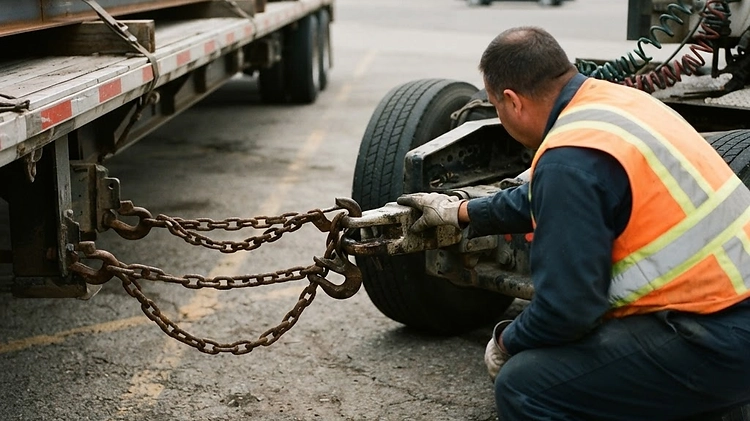
For commercial haulers operating trailers for sale in Texas or navigating busy corridors in Houston trailer delivery, compliance is heavily monitored. The average safety chain violation can cost thousands in fines and lost revenue. Ensuring your chains meet the standards set forth in 49 CFR 393.70 is essential for maintaining your CSA score and protecting your business.
Federal DOT Safety Chain Regulations Explained (49 CFR 393.70)
The Federal Motor Carrier Safety Regulations establish specific mandates for trailer safety chains that apply to all commercial motor vehicles. These rules dictate the strength, configuration, and condition of the chains used on any towed unit.
Core Requirements
- Strength Rating: The combined breaking strength of the safety chains must equal or exceed the Gross Vehicle Weight Rating (GVWR) of the towed trailer.
- Number of Chains: A minimum of two safety chains is required for all standard towed vehicles (excluding certain fifth-wheel setups that do not require chains).
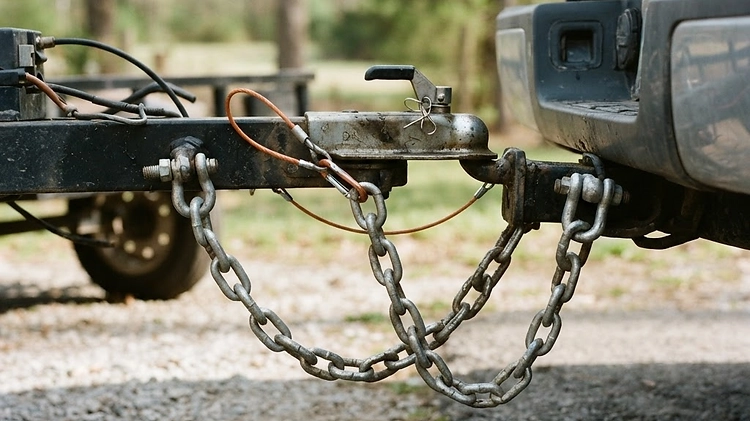
- Crossing Pattern: Chains must be crossed under the trailer tongue to form a cradle. This cradle is designed to catch the tongue and prevent it from dropping to the pavement if the coupler disconnects.
- Attachment Points: Chains must be securely attached to the structural frame of the towing vehicle or designated hitch receiver tow points. Never attach safety chains to a bumper or non-structural component.
- Slack: Chains must have enough slack to permit tight turns, but not so much that they drag on the road surface.
For more foundational towing knowledge, review our guide on Towing Capacity vs. Payload Capacity: The Complete Hauling & Sizing Guide.
How to Choose the Right Safety Chain Strength and WLL
Selecting the correct safety chain is entirely dependent on the weight of your trailer. Safety chains are rated by their Working Load Limit (WLL) and minimum breaking strength. The DOT requires that the total capacity of the chains exceeds the trailer's GVWR.
Understanding Chain Grades
Chains are categorized by grades, which indicate their tensile strength:
- Grade 30 (Proof Coil): Suitable for light-duty utility trailers. Not recommended for commercial hauling.
- Grade 43 (High Test): Commonly used for medium-duty towing, such as enclosed cargo trailers and standard car haulers.
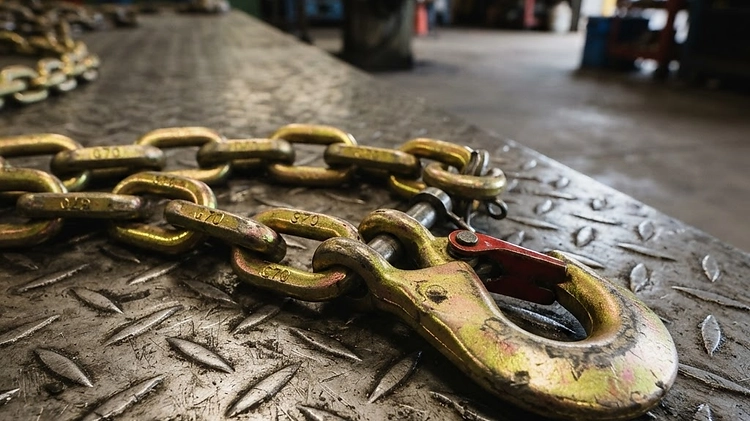
- Grade 70 (Transport): The industry standard for heavy-duty commercial towing, including equipment trailers and dump trailers. Grade 70 chains are easily identifiable by their gold chromate finish.
- Grade 80 and 100 (Alloy): Used for extreme heavy hauling and overhead lifting.
When outfitting a heavy-duty rig like the 2027 PJ T6 7x20 Gooseneck Gravity Tilt Equipment Trailer, you must ensure your chains are rated for the 15.6K GVWR. Always verify the stamped grade on the chain links and the hooks.

To understand how trailer weight impacts your entire setup, read our breakdown of Trailer Axle Weight Ratings (GAWR) Explained: How to Calculate Dual-Axle Load Limits.
The Correct Way to Cross and Attach Safety Chains
The most common mistake drivers make is failing to cross their safety chains. Crossing the chains under the coupler creates a cradle. If the trailer detaches, the tongue will drop onto the crossed chains rather than digging into the asphalt, which could cause the trailer to pole-vault and flip.
Attachment Best Practices
- Cross the Chains: The chain from the left side of the trailer must attach to the right side of the tow vehicle's hitch, and vice versa.
- Check the Slack: Connect the chains and perform a full lock-to-lock turn in a safe area. The chains should not bind or pull tight, nor should they drag on the ground when driving straight. If they are too long, twist them to shorten the length before attaching, or use proper chain tensioners.
- Secure the Hooks: Always use hooks with safety latches (clevis hooks) to prevent them from bouncing off the hitch loops over rough terrain. Open S-hooks are prone to disconnecting and are often cited during DOT inspections.
Proper chain attachment is just as critical as proper weight distribution. Learn more about balancing your load in The 60/40 Rule: How to Safely Load a Utility Trailer for Perfect Weight Distribution and How to Safely Load a Flatbed Trailer: Weight Distribution & Axle Limits.
Integrating Safety Chains with Breakaway Systems
For trailers equipped with electric brakes and a GVWR over 3,000 lbs, DOT regulations require a functional breakaway system. This system is designed to automatically apply the trailer brakes if it completely separates from the tow vehicle.
The Crucial Length Difference
The breakaway cable must be attached to the tow vehicle independently of the safety chains. More importantly, the breakaway cable must be shorter than the safety chains. If the coupler fails, the trailer will fall onto the safety chains. The breakaway cable should pull the pin and activate the trailer brakes while the trailer is still cradled by the chains, allowing you to bring both vehicles to a controlled stop.
If the breakaway cable is longer than the chains, the brakes will never activate during a coupler failure, putting immense strain on the tow vehicle's brakes to stop the dead weight of the trailer.

For more on trailer braking systems, consult our Trailer Brake Controller Setup & Tuning Guide: Proportional vs. Time-Delayed Systems.
Pre-Trip Inspection Checklist for Trailer Chains
A thorough pre-trip inspection is your best defense against equipment failure and DOT fines. Before every haul, inspect your safety chains using this checklist:
- Visual Inspection: Look for stretched links, deep gouges, severe rust, or cracks in the welds.
- Hook Integrity: Ensure the safety latches on the hooks spring back firmly and are not bent.
- Mounting Points: Check the attachment points on both the trailer tongue and the tow vehicle hitch for signs of metal fatigue or loose bolts.
- Clearance: Verify that the chains are crossed and have the appropriate amount of slack.
Maintaining your towing equipment is vital. For a broader look at trailer upkeep, explore our guides hub for comprehensive maintenance schedules.
Bottom Line
Mastering DOT trailer safety chain requirements is a fundamental responsibility for anyone towing a trailer. By selecting chains with the proper WLL, crossing them correctly to form a cradle, and ensuring your breakaway system is integrated properly, you protect your cargo, your business, and the public.
Whether you are outfitting a 2026 Wil-Ro Utility Truck Bed for commercial hauling or upgrading your fleet of utility trailers and equipment trailers, Prime Trail Trailers has the expertise and inventory to keep you compliant and on the road. Browse our full shop inventory today to find the right equipment for your next heavy haul, and be sure to read our guides on How to Measure Trailer Tongue Weight and Calculate Safe Payload Limits, The Physics of Trailer Sway: Why Proper Tongue Weight and Cargo Loading Matter, Bumper Pull vs. Gooseneck Trailers: Towing Capacity & Stability Guide, and How to Safely Load and Tow a Livestock Trailer: Weight Distribution & Capacity Guide.
FAQ
Have Questions? We're Here to Help
Still unsure which trailer fits your needs, or need specs, pricing or delivery advice? The Prime Trail Trailers team is ready to answer your questions and help you find the right rig.