
Trailer Hitch Classes and Receiver Ratings: The Hidden Towing Capacity Bottleneck
Your truck's advertised towing capacity means nothing if your hitch receiver is the weak link. Learn how hitch classes and receiver ratings limit your true towing capacity.
Quick Summary
Your truck's advertised towing capacity means nothing if your hitch receiver is the weak link. Learn how hitch classes and receiver ratings limit your true towing capacity.
A truck’s advertised maximum tow rating is not the final answer for every load. In the real world, the safe, rated limit for a towing combination is whichever applicable rating you reach first—and very often, the hidden bottleneck is the trailer hitch receiver itself. Understanding hitch classes and receiver weight limits is critical to ensuring your towing setup is safe, legal, and capable of handling your cargo.
The Weakest Link: Why Hitch Ratings Override Truck Tow Ratings
Towing capacity is only as high as the lowest-rated component in your setup. You might have a heavy-duty truck rated to pull 20,000 pounds, but if your hitch receiver is only rated for 10,000 pounds, your maximum safe towing capacity is strictly capped at 10,000 pounds.

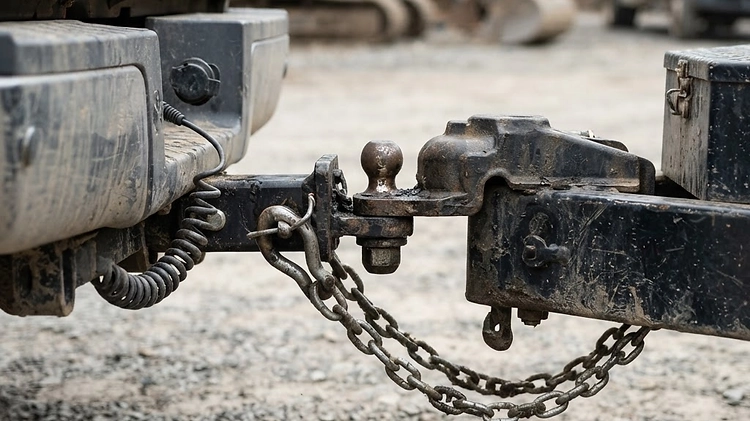
Every component in the towing chain—the receiver, the ball mount, the hitch ball, and the coupler—has its own specific weight limit. When you calculate your true towing capacity, you must account for these hardware limits alongside your vehicle's Gross Combined Weight Rating (GCWR) and payload capacity. Ignoring the receiver's limits can lead to catastrophic hardware failure, severe sway, and liability in the event of an accident.
Understanding Trailer Hitch Classes (I through V)
Trailer hitches are categorized into five primary classes based on their maximum Gross Trailer Weight (GTW) and maximum Tongue Weight (TW).
- Class I: Up to 2,000 lbs GTW / 200 lbs TW. Typically found on compact cars and small crossovers. Uses a 1-1/4" receiver tube.
- Class II: Up to 3,500 lbs GTW / 350 lbs TW. Common on midsize SUVs and minivans. Uses a 1-1/4" receiver tube.
- Class III: Up to 8,000 lbs GTW / 800 lbs TW. The standard for half-ton trucks and large SUVs. Uses a 2" receiver tube.
- Class IV: Up to 10,000 lbs GTW / 1,000 lbs TW (sometimes higher with weight distribution). Found on heavy-duty trucks. Uses a 2" receiver tube.
- Class V: Up to 20,000+ lbs GTW / 2,000+ lbs TW. Designed for commercial hauling and heavy equipment. Uses a 2-1/2" or 3" receiver tube.
If you are looking at equipment trailers or heavy-duty haulers, you will almost certainly need a Class IV or Class V hitch to safely manage the load.
Weight Distribution Hitches: Unlocking Maximum Receiver Capacity
Many Class III, IV, and V receivers have two separate sets of ratings printed on their certification label: Weight Carrying (WC) and Weight Distributing (WD).


Weight Carrying is the standard rating when you simply drop a ball mount into the receiver and hook up the trailer. Weight Distributing is the higher rating that applies only if you are using a specialized weight distribution hitch system. These systems use spring bars to leverage the tongue weight across all axles of the tow vehicle and trailer, preventing the rear of the truck from sagging.
For example, a receiver might be rated for 5,000 lbs WC but 10,000 lbs WD. If you are towing a heavy load without a weight distribution system, you are strictly bound by the lower WC rating. This is a crucial factor when applying the 80/20 towing rule to your setup.
Key Specifications: What to Look For on Your Hitch Receiver
Before you hook up a trailer, you need to inspect the physical hardware on your tow vehicle. Here is what to look for:
- The Certification Sticker: Look under the rear bumper at the hitch cross-tube. There should be a factory sticker listing the maximum GTW and TW for both WC and WD setups.
- Receiver Tube Size: Measure the inside opening. A 2" receiver is standard for most light-to-medium duty towing, while 2-1/2" and 3" receivers are required for extreme heavy-duty applications.
- Ball Mount and Ball Ratings: Pull the ball mount out and check the stamped ratings on both the shank and the top of the hitch ball. If your receiver is rated for 10,000 lbs but your hitch ball is only stamped for 6,000 lbs, your capacity is 6,000 lbs.
Whether you are hauling construction materials on utility trailers or transporting vehicles, verifying these numbers is a mandatory pre-trip step.
How Hitch Limits Interact with Payload and GVWR
Your hitch receiver's tongue weight limit directly impacts your tow vehicle's payload capacity. Tongue weight is the downward force exerted on the hitch ball, and it is carried entirely by the tow vehicle's suspension.

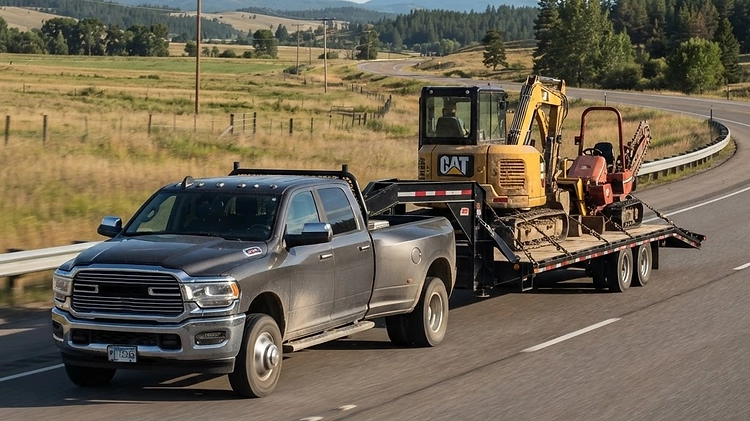
If your hitch is rated for a maximum of 800 lbs of tongue weight, you must ensure your trailer is loaded so that the tongue weight does not exceed this number. However, you must also adjust your trailer tongue weight to remain within the safe 10-15% range of the total trailer weight to prevent sway.
Furthermore, that 800 lbs of tongue weight consumes 800 lbs of your truck's payload capacity. You must subtract this from your truck's Gross Vehicle Weight Rating (GVWR) to determine your true trailer tow limit. Understanding this trailer payload math is essential for safe hauling, especially when navigating strict DOT regulations for trailers for sale in Texas or managing heavy loads in Houston, TX.
The Bottom Line
Never assume your truck can tow its advertised maximum capacity without first verifying the ratings of your hitch receiver, ball mount, and hitch ball. The hitch class dictates the absolute physical limits of your connection point. By understanding the difference between weight carrying and weight distributing limits, and how tongue weight impacts your vehicle's payload, you can tow safely and legally.
Ready to upgrade your hauling capabilities? Explore our comprehensive towing guides to learn more about SAE J2807 towing standards and side-to-side weight distribution. When you are ready for a trailer that matches your truck's true capabilities, browse our shop inventory for top-tier models like the 2026 Iron Bull 10K Gravity Tilt Equipment Trailer or the 2026 PJ Trailers 10k Deckover.
FAQ
Have Questions? We're Here to Help
Still unsure which trailer fits your needs, or need specs, pricing or delivery advice? The Prime Trail Trailers team is ready to answer your questions and help you find the right rig.
Prime Trail Trailers
Prime Trail Trailers is a family-owned trailer dealer in Markle, Indiana, stocking utility, dump, enclosed, equipment, car hauler and gooseneck trailers with nationwide delivery. This guide is based on what our customers ask us most and the trailers we sell every day.
More about Prime Trail Trailers